
Parallelograms on Same Base and Between Same Parallels Have Equal Areas
Loading the math board and drawing, please wait…
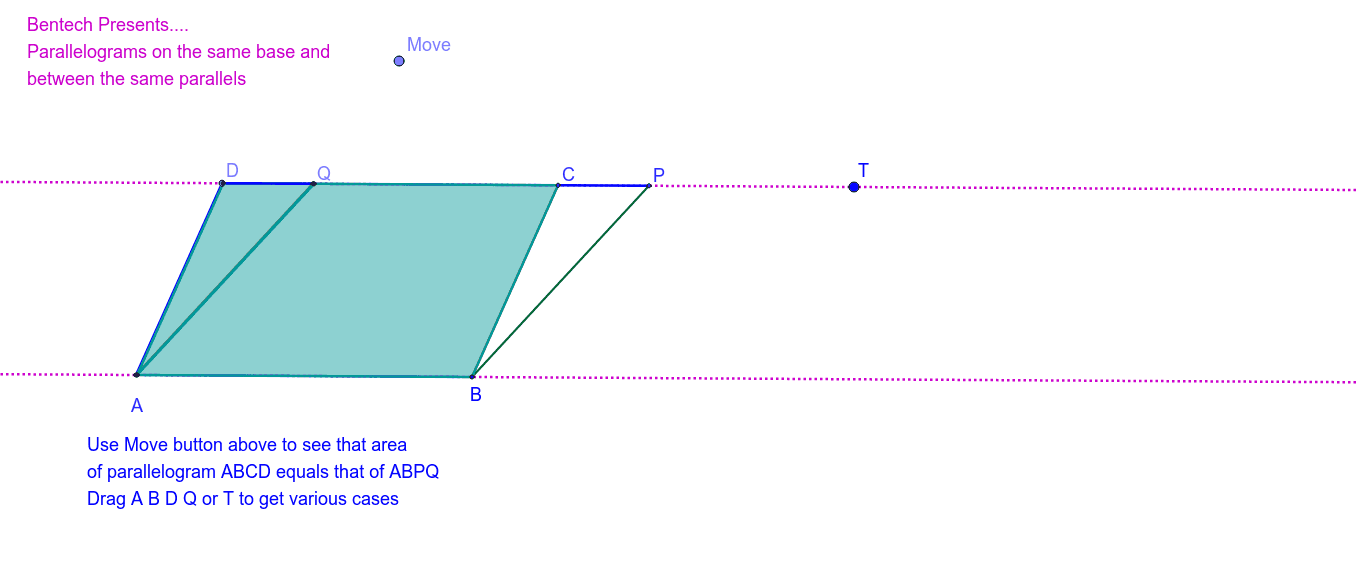
This GeoGebra example dynamically demonstrates the classic Euclidean theorem that parallelograms sharing the same base and lying between the same parallel lines have equal areas. The core mathematical concept is the area formula for parallelograms (base × height) and the invariance of area under equal base and equal height conditions, involving parallel lines, translation, and rotation. The construction uses commands such as Line, Point, Segment, Polygon, Vector, Translate, and Intersect to build the base and parallel lines, create multiple parallelograms via translation, and use a slider (object u) to move points and compare areas interactively. This is suitable for middle school geometry lessons, helping students grasp area derivation and the idea of equal-area transformation, and can be used for classroom demonstrations or student exploration.
GeoGebra Commands & Parameters
Line(A, B) → aLine(T, a) → bPoint(b) → QSegment(Q, A) → cLine(B, c) → dPoint(b) → DSegment(D, A) → eLine(B, e) → fPolygon(Q, A, D) → poly1, e_1, d_1, a_1Line(F, b) → gPoint(g) → MoveVector(F, Move) → uPolygon(Q, A, D) → poly2, e_2, d_2, a_2Translate(Q, u) → D'Translate(A, u) → A'Translate(D, u) → E'Polygon(D', A', E') → poly2', e', d', a'Intersect(b, d) → PIntersect(b, f) → CSegment(Q, D) → jSegment(C, P) → kSegment(C, B) → hSegment(P, B) → iSegment(Q, C) → lSegment(A, B) → mPolygon(Q, A, B, C) → poly3, q, a_3, b_1, c_1