
Fourier Series Expansion Interactive Demo
Loading the math board and drawing, please wait…
In collections
UQ-Applied Mathematical Analysis
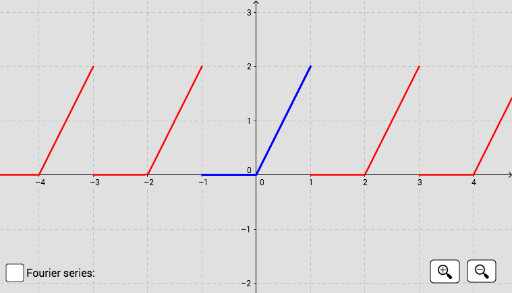
① This GeoGebra example demonstrates how a Fourier series approximates a periodic function, with interactive controls to adjust parameters and observe the effect of increasing the number of terms. ② Core mathematical concepts include Fourier series, trigonometric series, periodic functions, harmonic superposition, coefficient computation (a₀, aₙ, bₙ), and partial sum approximation. ③ Construction highlights: Sequence generates coefficient lists, If and LaTeX handle conditional expressions and formula display, Midpoint and centre aid geometric construction, Textfield and InputBox provide user input, buttons trigger calculations, sliders control the term count n, and function superposition plots the approximating curve. ④ Suitable for university-level mathematical analysis, signal processing, or engineering mathematics courses, as well as advanced high school enrichment to visualize the geometric meaning of Fourier decomposition.
GeoGebra Commands & Parameters
Midpoint(A, B) → CTextfield(f) → InputBox1Textfield(initial) → InputBox2Textfield(final) → InputBox3Sequence((1 / (period / 2) * Integral[(f(x) * cos(((i * x) * π / (period / 2)))), initial, final]), i, 1, 20) → anSequence((1 / (period / 2) * Integral[(f(x) * sin(((i * x) * π / (period / 2)))), initial, final]), i, 1, 20) → bnSequence((Element[an, i] * cos(((π * i / (period / 2)) * x))) + (Element[bn, i] * sin(((π * i / (period / 2)) * x))), i, 1, n) → list1Sequence((1 / (period / 2) * Integral[(f(x) * cos(((i * x) * π / (period / 2)))), initial, final]), i, 2, n) → an'Sequence((1 / (period / 2) * Integral[(f(x) * sin(((i * x) * π / (period / 2)))), initial, final]), i, 2, n) → bn'If(n ≟ 0, a_0 / 2, a_0 / 2 + Sum[list1, n]) → pTextfield(A0) → InputBox4Textfield(A1) → InputBox5Textfield(B1) → InputBox6Textfield(n) → InputBox7LaTeX(p, true, true) → text3If(A0 ≟ c ∧ (A1 ≠ a) ∧ (B1 ≠ b) ∨ (A0 ≠ c) ∧ A1 ≟ a ∧ (B1 ≠ b) ∨ (A0 ≠ c) ∧ (A1 ≠ a) ∧ B1 ≟ b, 1, If[A0 ≟ c ∧ A1 ≟ a ∧ (B1 ≠ b) ∨ A0 ≟ c ∧ (A1 ≠ a) ∧ B1 ≟ b ∨ (A0 ≠ c) ∧ A1 ≟ a ∧ B1 ≟ b, 2, If[A0 ≟ c ∧ A1 ≟ a ∧ B1 ≟ b, 3, 0]]) → num