
Forming Shapes by Tiling with Triangles (P3)
Loading the math board and drawing, please wait…
In collections
P3 3S2 Making Triangles
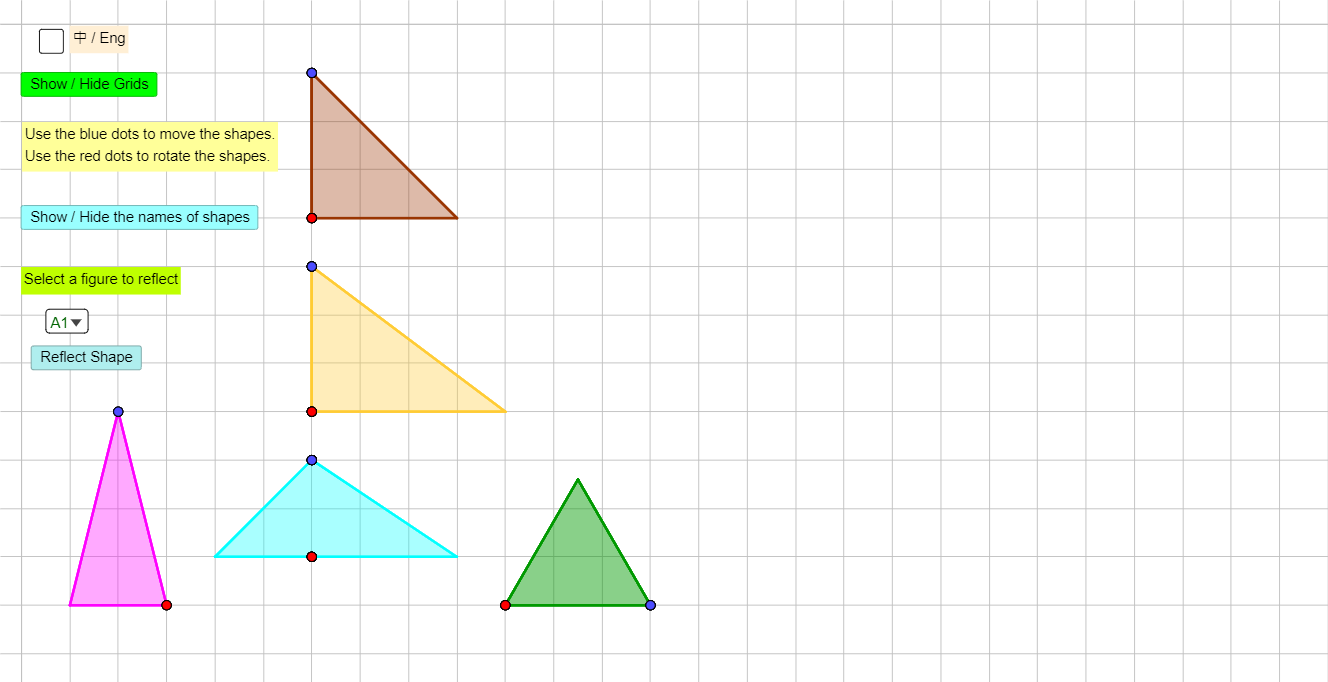
This example demonstrates how to build more complex planar shapes by tiling with triangles and applying mirror symmetry step by step. The key mathematical ideas include geometric construction, triangle and polygon composition, and reflection (mirror) transformations; it also connects to the broader use of vectors/parametric thinking in organizing geometric structure. Construction highlights from the given GeoGebra commands: Point is used to define key vertices, Polygon builds triangle/polygon regions from those vertices, and Mirror generates reflected copies across selected lines. IndexOf and If support conditional selection/updating of point sets during construction. The involved objects include grid controls (ShGrid, buttonShowGridC/buttonShowGridE), instruction texts (Text2InstructionC/Text3InstructionE), reflected point sets (ReflectA1–ReflectA4 and ReflectB1–ReflectB4), and the resulting polygonal assemblies (A, A1, A2, plus grouped vertices such as A1P1/A1P2/A1P3). Suitable for middle/high school geometry, interactive exploration, and GeoGebra lessons on transformations and constructive tiling.
GeoGebra Commands & Parameters
Point(Circle[A1P1, 3]) → A1P2Polygon(A1P1, A1P2, A1P3) → A1, c, a, bPoint(Circle[A2P1, 3]) → A2P2Polygon(A2P1, A2P2, A2P3) → A2, c_1, a_1, b_1Mirror(A1P1, c) → A1P1'Mirror(A1P2, c) → A1P2'Mirror(A1P3, c) → A1P3'Polygon(A1P1', A1P2', A1P3') → A1', a1p3', a1p1', a1p2'IndexOf(SelectedElement[ListFig], ListFig) → ReflectFigIf(ShowChi, "選擇要反轉的圖形", "Select a figure to reflect") → TextInstSelectMirror(A2P1, c_1) → A2P1'Mirror(A2P2, c_1) → A2P2'Mirror(A2P3, c_1) → A2P3'Polygon(A2P1', A2P2', A2P3') → A2', a2p3', a2p1', a2p2'Point(Circle[A3P1, 3]) → A3P2Polygon(A3P1, A3P2, A3P3) → A3, c_2, a_2, b_2Mirror(A3P1, c_2) → A3P1'Mirror(A3P2, c_2) → A3P2'Mirror(A3P3, c_2) → A3P3'Polygon(A3P1', A3P2', A3P3') → A3', a3p3', a3p1', a3p2'Point(Circle[A4P1, 3]) → A4P2Polygon(A4P1, A4P2, A4P3) → A4, c_3, a_3, b_3Mirror(A4P1, c_3) → A4P1'Mirror(A4P2, c_3) → A4P2'Mirror(A4P3, c_3) → A4P3'Polygon(A4P1', A4P2', A4P3') → A4', c', a4p1', a4p2'Point(Circle[B1P1, 3]) → B1P2Polygon(B1P1, B1P2, B1P3) → B1, d, a_4, b_4Mirror(B1P1, d) → B1P1'Mirror(B1P2, d) → B1P2'Mirror(B1P3, d) → B1P3'Polygon(B1P1', B1P2', B1P3') → B1', b1p3', b1p1', b1p2'Point(Circle[B2P1, 3]) → B2P2Polygon(B2P1, B2P2, B2P3) → B2, c_4, a_5, b_5Mirror(B2P1, c_4) → B2P1'Mirror(B2P2, c_4) → B2P2'Mirror(B2P3, c_4) → B2P3'Polygon(B2P1', B2P2', B2P3') → B2', b2p3', a', b2p2'Point(Circle[B3P1, 3]) → B3P2Polygon(B3P1, B3P2, B3P3) → B3, c_5, a_6, b_6Mirror(B3P1, c_5) → B3P1'Mirror(B3P2, c_5) → B3P2'Mirror(B3P3, c_5) → B3P3'Polygon(B3P1', B3P2', B3P3') → B3', f, b3p1', b3p2'Point(Circle[B4P1, 3]) → B4P2Polygon(B4P1, B4P2, B4P3) → B4, d_1, a_7, b_7Mirror(B4P1, d_1) → B4P1'Mirror(B4P2, d_1) → B4P2'Mirror(B4P3, d_1) → B4P3'Polygon(B4P1', B4P2', B4P3') → B4', b4p3', b4p1', b4p2'Point(Circle[C1P1, 2]) → C1P2Polygon(C1P1, C1P2, C1P3) → C1, c_6, a_8, b_8Polygon(C1P1, C1P2, C1P4) → C1a, c1p4, c1p1, c1p2Mirror(C1P1, c_6) → C1P1'Mirror(C1P2, c_6) → C1P2'Mirror(C1P3, c_6) → C1P3'Polygon(C1P1', C1P2', C1P3') → C1', c1p3', c1p1', c1p2'Mirror(C1P1, c_6) → C1P1'_1Mirror(C1P2, c_6) → C1P2'_1Mirror(C1P4, c_6) → C1P4'Polygon(C1P1'_1, C1P2'_1, C1P4') → C1a', c1p4', c1p1'_1, c1p2'_1Point(Circle[C2P1, 2]) → C2P2Polygon(C2P1, C2P2, C2P3) → C2, c_7, a_9, b_9Polygon(C2P1, C2P2, C2P4) → C2a, c2p4, c2p1, c2p2Mirror(C2P1, c2p4) → C2P1'Mirror(C2P2, c2p4) → C2P2'Mirror(C2P4, c2p4) → C2P4'Polygon(C2P1', C2P2', C2P4') → C2a', c2p4', c2p1', c2p2'Mirror(C2P1, c2p4) → C2P1'_1Mirror(C2P2, c2p4) → C2P2'_1Mirror(C2P3, c2p4) → C2P3'Polygon(C2P1'_1, C2P2'_1, C2P3') → C2', c2p3', c2p1'_1, c2p2'_1Point(Circle[C3P1, 2]) → C3P2Polygon(C3P1, C3P2, C3P3) → C3, c_8, a_{10}, b_{10}Polygon(C3P1, C3P2, C3P4) → C3a, c3p4, c3p1, c3p2Mirror(C3P1, c_8) → C3P1'Mirror(C3P2, c_8) → C3P2'Mirror(C3P4, c_8) → C3P4'Polygon(C3P1', C3P2', C3P4') → C3a', c3p4', c3p1', c3p2'Mirror(C3P1, c_8) → C3P1'_1Mirror(C3P2, c_8) → C3P2'_1Mirror(C3P3, c_8) → C3P3'Polygon(C3P1'_1, C3P2'_1, C3P3') → C3', c3p3', c3p1'_1, c3p2'_1Point(Circle[C4P1, 2]) → C4P2Polygon(C4P1, C4P2, C4P3) → C4, c_9, a_{11}, b_{11}Polygon(C4P1, C4P2, C4P4) → C4a, c4p4, c4p1, c4p2Mirror(C4P1, c_9) → C4P1'Mirror(C4P2, c_9) → C4P2'Mirror(C4P4, c_9) → C4P4'Polygon(C4P1', C4P2', C4P4') → C4a', c4p4', c4p1', c4p2'Mirror(C4P1, c_9) → C4P1'_1Mirror(C4P2, c_9) → C4P2'_1Mirror(C4P3, c_9) → C4P3'Polygon(C4P1'_1, C4P2'_1, C4P3') → C4', c4p3', c4p1'_1, c4p2'_1Point(Circle[D1P1, 4.123105625617661]) → D1P2Polygon(D1P1, D1P2, D1P3) → D1, c_{10}, a_{12}, b_{12}Point(Circle[D2P1, 4.123105625617661]) → D2P2Polygon(D2P1, D2P2, D2P3) → D2, c_{11}, a_{13}, b_{13}Point(Circle[D3P1, 4.123105625617661]) → D3P2Polygon(D3P1, D3P2, D3P3) → D3, c_{12}, a_{14}, b_{14}Point(Circle[D4P1, 4.123105625617661]) → D4P2Polygon(D4P1, D4P2, D4P3) → D4, c_{13}, a_{15}, b_{15}Point(Circle[E1P1, 3]) → E1P2Polygon(E1P1, E1P2, E1P3) → E1, c_{14}, a_{16}, b_{16}Point(Circle[E2P1, 3]) → E2P2Polygon(E2P1, E2P2, E2P3) → E2, c_{15}, a_{17}, b_{17}Point(Circle[E3P1, 3]) → E3P2Polygon(E3P1, E3P2, E3P3) → E3, c_{16}, a_{18}, b_{18}Point(Circle[E4P1, 3]) → E4P2Polygon(E4P1, E4P2, E4P3) → E4, c_{17}, a_{19}, b_{19}Point(Circle[E5P1, 3]) → E5P2Polygon(E5P1, E5P2, E5P3) → E5, c_{18}, a_{20}, b_{20}Point(Circle[E6P1, 3]) → E6P2Polygon(E6P1, E6P2, E6P3) → E6, c_{19}, a_{21}, b_{21}
AI Drawing Prompt Reference
Draw a complex polygon composed of multiple triangles arranged by mirror symmetry. Start by placing several basic triangles on a grid. Then generate reflected copies of each triangle using mirror transformations. Finally, combine these reflected copies with the original triangles to form larger polygon structures. The construction should proceed step by step to ensure clear symmetry relationships, suitable for geometry teaching and exploration.
The prompt above was compiled from the original drawing commands and is for reference only.