
Finding the Inverse Function and Domain Example by Walch Education
Loading the math board and drawing, please wait…
In collections
UCSS Secondary Math III Unit 4A Lesson 1
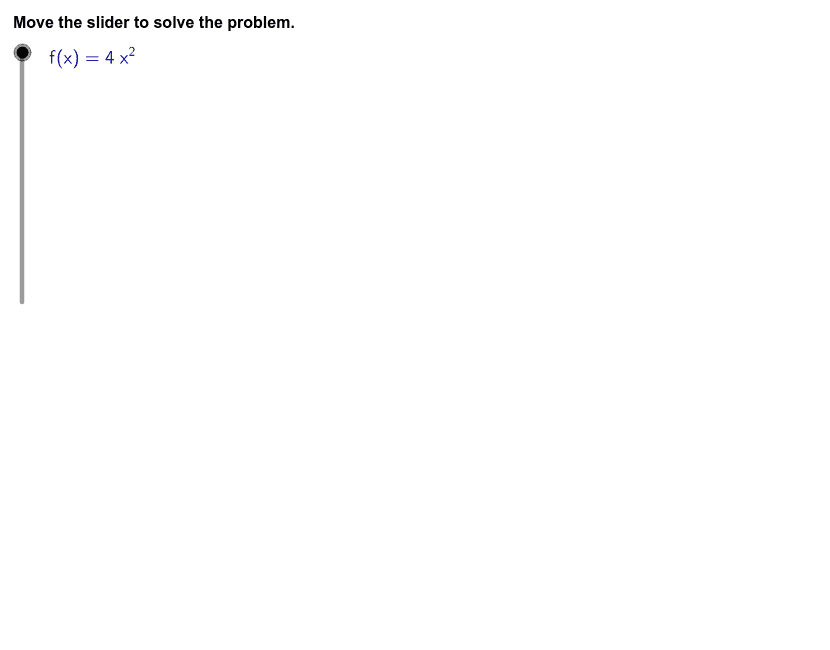
This example demonstrates how to find the inverse function g(x) of f(x) = 4x^2 and determine its domain. Key math concepts include inverse functions, domain, completing the square, and piecewise functions. The construction utilizes GeoGebra commands like LaTeX, If, TableText, stepMax, stepper, steps, counter, and text objects. Suitable for high school mathematics students learning about inverse functions and their solutions.
GeoGebra Commands & Parameters
LaTeX(steps) → counterLaTeX((("\textcolor{#000099}{f(x)=" * f) * "}")) → ProblemLaTeX("\text{Switch the domain and function variables, and then rename }\textcolor{#000099}{f(x)}\text{ as }\textcolor{#006633}{g(x).}") → text1LaTeX((("\text{Since the inverse function results from switching the input and output variables}\cr\text{of the original function, identify which variable represents the input and which}\cr\text{represents the output. For the function }\textcolor{#000099}{f(x) = " * f) * "}\text{, }\textcolor{#000099}{x}\text{ is the input (independent)}\cr\text{variable, and }\textcolor{#000099}{f(x)}\text{ is the output (dependent) variable. Therefore, swap }\textcolor{#000099}{f(x)}\text{ and }\textcolor{#000099}{x}.")) → text2LaTeX("\text{Next, rename }\textcolor{#000099}{f(x)}\text{ as }\textcolor{#006633}{g(x)}\text{, since this new relation represents the inverse of the}\cr\text{original function.}") → text4LaTeX((((("\text{The resulting inverse relation, }\textcolor{#006633}{x = " * a) * "[g(x)]^2}\text{, is the possible inverse function of}\cr\text{the original function. It must be evaluated to determine whether it has }\cr\text{one-to-one correspondence with the original function, }\textcolor{#000099}{f(x) = ") * a) * "x^2}.")) → text6LaTeX("\text{Solve the possible inverse for }\textcolor{#006633}{g(x)}.") → text7LaTeX("\text{Determine the domain of }\textcolor{#006633}{g(x)}.") → text9LaTeX("\text{Determine the range of }\textcolor{#006633}{g(x)}.") → text13LaTeX("\text{We need to compare the range of }\textcolor{#006633}{g(x)}\text{ to the domain of }\textcolor{#000099}{f(x)}.") → text14LaTeX("\text{Determine the domain of }\textcolor{#000099}{f(x)}.") → text16LaTeX("\text{Determine whether the function }\textcolor{#000099}{f(x)}\text{ exhibits one-to-one correspondence.}") → text18LaTeX("\text{Determine the parts of its domain over which }\textcolor{#000099}{f(x)}\text{ exhibits one-to-one}\cr\text{correspondence.}") → text21LaTeX("\text{Determine the range of }\textcolor{#000099}{f(x)}.") → text23LaTeX("\text{Match domains to ranges to find the inverse(s) of }\textcolor{#000099}{f(x)}.") → text25LaTeX("\text{Check that the range of }\textcolor{#000099}{f(x)}\text{ matches the domain of }\textcolor{#006633}{g(x)}.") → text28If(a ≥ 0, "", "-") → signtextIf(a ≥ 0, "non-negative", "negative") → numberwordsIf(a ≥ 0, LaTeX["[0, + \infty)"], LaTeX["(-\infty,0]"]) → domaingLaTeX((("\text{Because }\textcolor{#000099}{f(x)}\text{ is a quadratic function and }\textcolor{#000099}{x^2}\text{ can never be negative, the}\cr\text{range of }\textcolor{#000099}{f(x)}\text{ is }\textcolor{#000099}{" * domaing) * "}.")) → text24If(a ≥ 0, sqrt(x) / asqrt, sqrt((-x)) / asqrt) → g_1If(a ≥ 0, ((-sqrt(x))) / asqrt, ((-sqrt((-x)))) / asqrt) → g_2LaTeX((((("\text{The range of }\textcolor{#000099}{f(x)}\text{ is }\textcolor{#000099}{" * domaing) * "}\text{. The domain of }\textcolor{#006633}{g(x)}\text{ is }\textcolor{#006633}{") * domaing) * "}.")) → text29LaTeX("\text{Use the buttons below to return to the original problem or}\cr\text{randomly generate a similar practice problem.}") → text31TableText({{LaTeX[(("\textcolor{#000099}{f(x)=" * a) * "x^2}")], LaTeX["\text{Original function}"]}, {LaTeX[(("\textcolor{#000099}{x=" * a) * "[f(x)]^2}")], LaTeX["\text{Switch }\textcolor{#000099}{f(x)}\text{ and }\textcolor{#000099}{x}."]}}) → text3TableText({{LaTeX[(("\textcolor{#000099}{x=" * a) * "[f(x)]^2}")], LaTeX["\text{Equation with variables switched}"]}, {LaTeX[(("\textcolor{#006633}{x=" * a) * "[g(x)]^2}")], LaTeX["\text{Rename }\textcolor{#000099}{f(x)}\text{ as }\textcolor{#006633}{g(x)}."]}}) → text5LaTeX("\text{The function }\textcolor{#000099}{f(x)}\text{ can only have an inverse over the part(s) of its domain}\cr\text{for which it exhibits one-to-one correspondence.}") → text19LaTeX((((((((("\text{We can determine that the function }\textcolor{#000099}{f(x) = " * a) * "x^2}\text{ does not show}\cr\text{one-to-one correspondence for all domain values because }\textcolor{#000099}{f(a) = ") * a) * "a^2}\text{ and }\cr\textcolor{#000099}{f(–a) = ") * a) * "(–a)^2 = ") * a) * "a^2}\text{. Since }\textcolor{#000099}{f(x)}\text{ has the same value for two different}\cr\text{values of }\textcolor{#000099}{x}\text{, }\textcolor{#000099}{f(x)}\text{ is not one-to-one.}\cr\text{An equivalant graphical test is the horizontal line test. If any horizontal}\cr\text{line touches the graph of }\textcolor{#000099}{f(x)}\text{ more than once, then }\textcolor{#000099}{f(x)}\text{ is not one-to-one.}")) → text20LaTeX("\text{We need to know where }\textcolor{#006633}{g(x)}\text{ is defined in order to know its domain,}\cr\text{which we want to compare to the range of }\textcolor{#000099}{f(x)}.") → text10LaTeX((((("\text{The function }\textcolor{#006633}{g(x)}\text{ is a radical function; specifically, it is a square root} \cr\text{function. Recall that the value of the expression inside the square root} \cr\text{must be positive in order for the function to be defined. The expression} \cr\text{under the square root is }\textcolor{#006633}{" * signtext) * "x}\text{; therefore, the values of }\textcolor{#006633}{x}\text{ are limited to}\cr\text{") * numberwords) * " numbers.}")) → text11LaTeX("\text{There are no limitations on the output values; therefore, the range}\cr\text{of }\textcolor{#006633}{g(x)}\text{ is }\textcolor{#006633}{(−\infty, +\infty)}.") → text15LaTeX("\text{There are no limitations on the input values; therefore, the domain}\cr\text{of }\textcolor{#000099}{f(x)}\text{ is }\textcolor{#000099}{(−\infty, +\infty)}.") → text17LaTeX("\text{ The restricted domains of }\textcolor{#000099}{f(x)}\text{, on which }\textcolor{#000099}{f(x)}\text{ is one-to-one, are }\textcolor{#000099}{(−\infty, 0]}\cr\text{ and }\textcolor{#000099}{[0, +\infty)}\text{. Only the point }\textcolor{#000099}{(0, 0)}\text{ is not restricted, because all of}\cr\text{ the other points do not have one-to-one correspondence. The horizontal}\cr\text{ line crosses the graph at two points for all other points on the graph.}") → text22LaTeX("\text{In order for a function to have an inverse, it must be one-to-one. Therefore, }\cr\text{match the restricted domains of }\textcolor{#000099}{f(x)}\text{ to the range of }\textcolor{#006633}{g(x)}.") → text26TableText({{LaTeX["\text{Restricted domain of }\textcolor{#000099}{f(x)}\text{:}"], LaTeX["\text{Inverse function with matching range:}"]}, {LaTeX["\textcolor{#000099}{[0,+\infty)}"], LaTeX[(("\textcolor{#006633}{g(x)=" * g_1) * "}")]}, {LaTeX["\textcolor{#000099}{(-\infty,0]}"], LaTeX[(("\textcolor{#006633}{g(x)=" * g_2) * "}")]}}) → text27LaTeX((((((((("\text{The inverse of }\textcolor{#000099}{f(x)=" * a) * "x^2}\text{ on the restricted domain }\textcolor{#000099}{0≤x<+\infty}\text{ is }\textcolor{#006633}{g(x)=") * g_1) * "}.\cr \text{The inverse of }\textcolor{#000099}{f(x)=") * a) * "x^2}\text{ on the restricted domain }\textcolor{#000099}{-\infty<x≤0}\text{ is }\textcolor{#006633}{g(x)=") * g_2) * "}.")) → text30LaTeX((("\text{Thus, the domain of }\textcolor{#006633}{g(x)}\text{ is }\textcolor{#006633}{" * domaing) * "}\text{ because }\textcolor{#006633}{x}\text{ is raised to the }\textcolor{#006633}{\frac{1}{2}}\text{ power}\cr\text{ (recall that }\textcolor{#006633}{\sqrt{x} = x^\frac{1}{2}}\text{).}")) → text12TableText({{LaTeX[(("\textcolor{#006633}{x=" * a) * "[g(x)]^2}")], LaTeX["\text{Possible inverse}"]}, {LaTeX[(("\textcolor{#006633}{\frac{x}{" * a) * "}=[g(x)]^2}")], LaTeX[(("\text{Divide both sides by }\textcolor{#006633}{" * a) * "}.")]}, {LaTeX[(("\textcolor{#006633}{[g(x)]^2}=\frac{x}{" * a) * "}")], LaTeX["\text{Use Symmetric Property of Equality.}"]}, {LaTeX[(((("\textcolor{#006633}{g(x)}=\pm\sqrt{\frac{" * signtext) * "x}{") * abs(a)) * "}}")], LaTeX["\text{Find both roots of the equation. (Recall }(-1)^2=(1)^2\text{.)}"]}, {LaTeX[(((("\textcolor{#006633}{g(x)}=\pm\frac{\sqrt{" * signtext) * "x}}{\sqrt{") * abs(a)) * "}}")], LaTeX["\text{Distribute the square root operation.}"]}, {LaTeX[(((("\textcolor{#006633}{g(x)}=\pm\frac{\sqrt{" * signtext) * "x}}{") * asqrt) * "}")], LaTeX["\text{Simplify.}"]}, {LaTeX[(((("\textcolor{#006633}{g(x)}=\pm\frac{1}{" * asqrt) * "}\sqrt{") * signtext) * "x}")], LaTeX["\text{Separate out the coefficient.}"]}}) → text8
AI Drawing Prompt Reference
Draw the graph of the function f(x) = 4x^2 and show the process of finding its inverse function g(x). First, switch x and f(x) in f(x) to get x = 4y^2, then solve for y to find g(x). Highlight the graph of f(x) and show g(x) in two different colors over the intervals [0, +∞) and (-∞, 0], corresponding to the monotonic intervals of f(x). Finally, use text to explain the domain and range of g(x), and the correspondence between the monotonic intervals of f(x) and the domain of g(x).
The prompt above was compiled from the original drawing commands and is for reference only.