
Find Sine Given a Point in Coordinate System
Loading the math board and drawing, please wait…
In collections
CCGPS AA Unit 5 Lesson 1
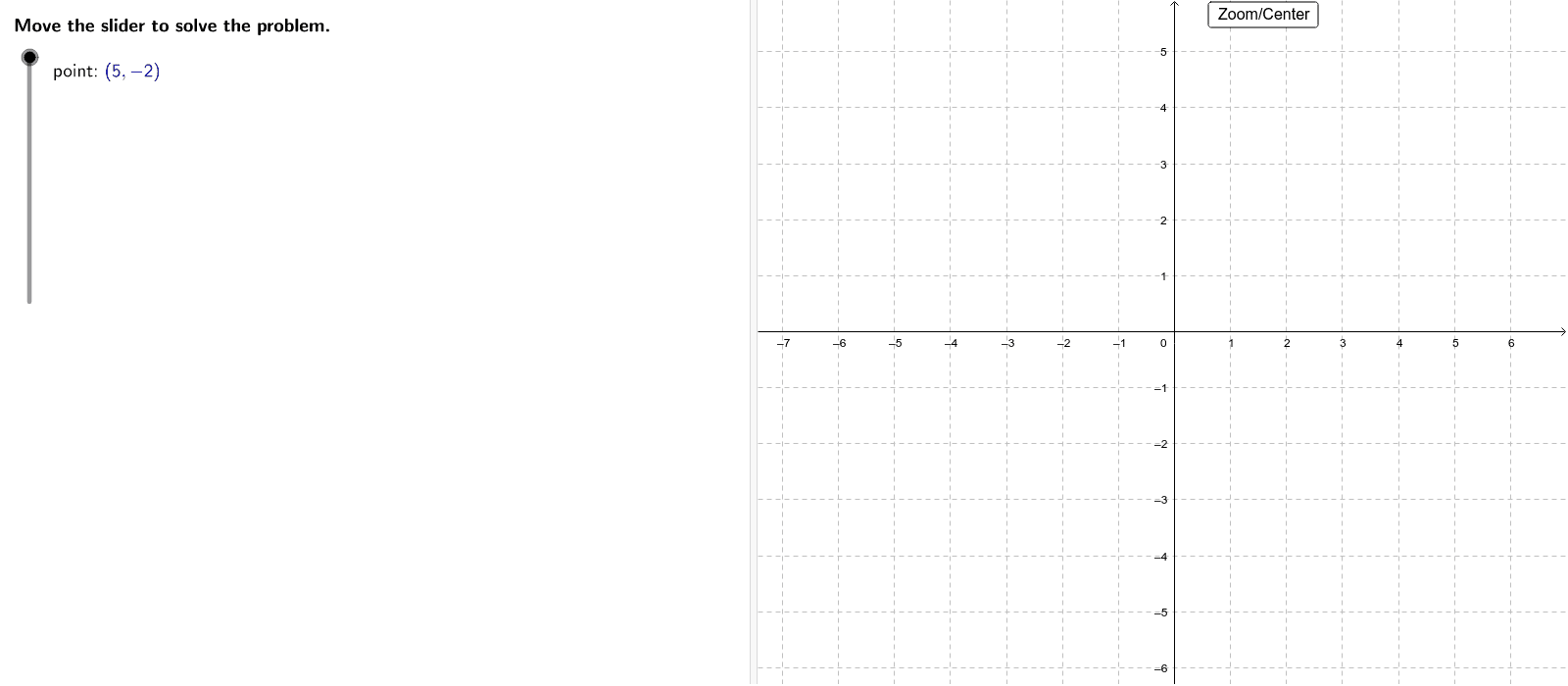
This example demonstrates how to find the sine value given a point in a coordinate system by constructing a right triangle. Key math concepts include the sine function in trigonometry. Construction highlights include using GeoGebra commands for circle, segment, angle, and other objects.
GeoGebra Commands & Parameters
LaTeX(steps) → counterCircle(B, A) → cLaTeX("\text{Make a sketch.}") → text1Segment(B, A) → hypotenuseSegment(B, C) → AdjacentSegment(C, A) → oppositeAngle(A, B, C) → θ_1If((0 ≤ x(A)) ∧ (0 ≤ y(A)), LaTeX["\text{I}"], If[(0 > x(A)) ∧ (0 ≤ y(A)), LaTeX["\text{II}"], If[(0 > x(A)) ∧ (0 > y(A)), LaTeX["\text{III}"], LaTeX["\text{IV}"]]]) → quadrantLaTeX("\text{Pythagorean Theorem}") → text12LaTeX("\text{Square and add.}") → text16LaTeX("\text{Sine ratio}") → text22Angle((radius, 0), B, A) → θIf((0 ≤ x(A)) ∧ (0 ≤ y(A)), LaTeX["\text{A: all positive so sine is positive}"], If[(0 > x(A)) ∧ (0 ≤ y(A)), LaTeX["\text{S: sine and cosecant are positive}"], If[(0 > x(A)) ∧ (0 > y(A)), LaTeX["\text{T: tangent and cotangent are positive; sine is negative}"], LaTeX["\text{C: cosine and secant are positive sine is negative}"]]]) → signsASTCIf((0 ≤ x(A)) ∧ (0 ≤ y(A)), LaTeX["\text{y-coordinate is positive so sine is positive}"], If[(0 > x(A)) ∧ (0 ≤ y(A)), LaTeX["\text{y-coordinate is positive so sine is positive}"], If[(0 > x(A)) ∧ (0 > y(A)), LaTeX["\text{y-coordinate is negative so sine is negative}"], LaTeX["\text{y-coordinate is negative so sine is negative}"]]]) → signsCoordsIf(y(A) ≥ 0, "", "-") → signPickLaTeX("\text{Move the slider to solve the problem.}") → text0LaTeX("\text{Sketch the triangle, the angle, and the reference angle.}") → text3LaTeX("\text{The reference angle is the angle the terminal side makes with the x-axis.}") → text4LaTeX("\text{Sine is the ratio of the length of the opposite side to the length of the hypotenuse; }\cr\text{therefore, these two lengths must be determined.}") → text8LaTeX("\text{Use the buttons below to return to the original problem or}\cr\text{randomly generate a similar practice problem.}") → text32LaTeX((("\text{point: }\textcolor{#000099}{" * A) * "}")) → ProblemLaTeX((("\text{Plot }\textcolor{#000099}{" * A) * "} \text{ on a coordinate plane and draw the terminal side extending from }\cr\text{the origin through that point.}")) → text2LaTeX((("\text{The length of the opposite side is the magnitude of the y-coordinate, }\textcolor{#CC0000}{" * abs(y(A))) * ".}")) → text9LaTeX((("\text{The length of the adjacent side is the magnitude of the x-coordinate, }\textcolor{#006633}{" * abs(x(A))) * ".}")) → text11LaTeX("c^2=a^2+b^2") → text13LaTeX((("c=\sqrt{" * csq) * "}")) → text19LaTeX((((("\text{Substitute }" * abs(y(A))) * " \text{ for the opposite side }\cr\text{and }\sqrt{") * csq) * "} \text{ for the hypotenuse.}")) → text24LaTeX((("\text{The sign of sine is given by the sign of the y-coordinate. }\cr\text{The }" * signsCoords) * ".")) → text29LaTeX((("\text{The sketch shows that reference angle is in Quadrant }" * quadrant) * ".")) → text5LaTeX("\text{Use the sine of the reference angle to determine the sine of the angle }\textcolor{#CC9900}{θ}.") → text26LaTeX("\text{Determine the sign of }\sin(\textcolor{#CC9900}{θ}) \text{ by recalling the ASTC pattern or by considering }\cr\text{the signs of the x- and y-coordinates.}") → text27LaTeX((((((("\sin(\textcolor{#CC9900}{\theta})=" * signPick) * "\frac{") * abs(y(A))) * "}{\sqrt{") * csq) * "}}")) → text30LaTeX((((((((("\text{For a positive angle }\textcolor{#CC9900}{θ} \text{ in standard position with a terminal side that passes}\cr\text{through the point }" * A) * "\text{, }sin(\textcolor{#CC9900}{θ})=") * signPick) * "\frac{") * abs(y(A))) * "}{\sqrt{") * csq) * "}.}")) → text31LaTeX("\text{The magnitude of the x-coordinate is the length of the adjacent side and the }\cr\text{magnitude of the y-coordinate is the length of the opposite side.}\cr\text{The hypotenuse can be found using the Pythagorean Theorem.}") → text6LaTeX("\text{In order to find the length of the hypotenuse, find the length of the adjacent side.}") → text10LaTeX((((("c^2 = (" * abs(y(A))) * ")^2 + (") * abs(x(A))) * ")^2")) → text15LaTeX((((((("c^2 = " * bsq) * " + ") * asq) * "=") * csq) * "")) → text17LaTeX((((("\text{Substitute }\textcolor{#CC0000}{" * abs(y(A))) * "} \text{ for a and }\textcolor{#006633}{") * abs(x(A))) * "}\text{ for b.}")) → text14LaTeX("\text{Take the square root of both sides.}") → text18LaTeX("\text{Find the sine of the reference angle}.") → text20LaTeX("\text{Now that the lengths of the opposite side and the hypotenuse are known, }\cr\text{substitute these values into the sine ratio}.") → text21LaTeX("sine=\frac{\text{length of opposite side}}{\text{length of hypotenuse}}") → text23LaTeX((((("sine=\frac{" * abs(y(A))) * "}{\sqrt{") * csq) * "}}")) → text25LaTeX((((("\text{The terminal side is in Quadrant }" * quadrant) * " \text{. According to ASTC,}\cr") * signsASTC) * ".")) → text28LaTeX("\text{Determine the sign of }\sin(\theta) \text{ by recalling the ASTC pattern or by considering }\cr\text{the signs of the x- and y-coordinates.}") → text7
AI Drawing Prompt Reference
Draw a point A in the coordinate system and draw the terminal side from the origin through point A to form a right triangle with point A as the right angle vertex and the origin as the other right angle vertex. Construct an angle θ with point A as the vertex and find its reference angle. Use the Pythagorean theorem to calculate the hypotenuse length, then determine the sine value based on the lengths of the opposite side and the hypotenuse. Pay attention to the signs of point A's coordinates to determine the sign of the sine value.
The prompt above was compiled from the original drawing commands and is for reference only.