
Find Divisors of a Number – Divisors and Partner Divisors
Loading the math board and drawing, please wait…
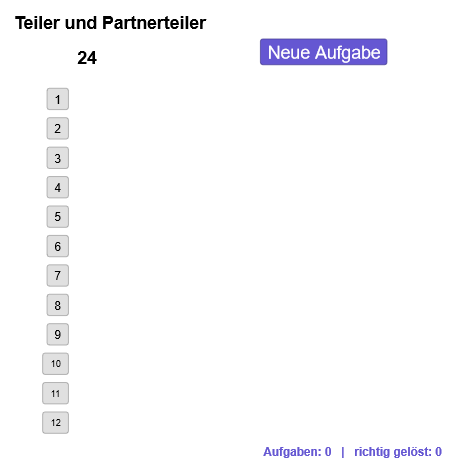
① This interactive GeoGebra example demonstrates how to find all divisors of a given integer and display them in pairs (e.g., 1 and n, 2 and n/2), clarifying the concept of divisor pairs. ② The core mathematical concepts include integer factorization, divisor pairs, prime factorization, and the pattern of divisor counts, rooted in arithmetic and elementary number theory. ③ Construction highlights: the example uses GeoGebra commands such as DivisorsList to generate the divisor list, Factors for prime factorization, RandomElement to pick a random target number from a preset set, Sequence and Length to manage list sizes, Textfield for user input, and If for conditional display. Multiple text objects (Teiler1, Teiler2, ErsteTeiler) and a slider (w) dynamically show paired divisors. ④ It is suitable for upper primary to middle school students, serving as a visual teaching aid in classrooms and as an interactive tool for self-exploration of divisor patterns.
GeoGebra Commands & Parameters
Take(Unique[{If[IsInteger[ppt1], ppt1, 0], If[IsInteger[ppt2], ppt2, 0], If[IsInteger[ppt3], ppt3, 0], If[IsInteger[ppt4], ppt4, 0], If[IsInteger[ppt5], ppt5, 0], If[IsInteger[ppt6], ppt6, 0], If[IsInteger[ppt7], ppt7, 0], If[IsInteger[ppt8], ppt8, 0], If[IsInteger[ppt9], ppt9, 0], If[IsInteger[ppt10], ppt10, 0], If[IsInteger[ppt11], ppt11, 0], If[IsInteger[ppt12], ppt12, 0]}], 2) → Faktor2Take(Unique[{If[w1 ≟ 1, 1, 0], If[w2 ≟ 1, 2, 0], If[w3 ≟ 1, 3, 0], If[w4 ≟ 1, 4, 0], If[w5 ≟ 1, 5, 0], If[w6 ≟ 1, 6, 0], If[w7 ≟ 1, 7, 0], If[w8 ≟ 1, 8, 0], If[w9 ≟ 1, 9, 0], If[w10 ≟ 1, 10, 0], If[w11 ≟ 1, 11, 0], If[w12 ≟ 1, 12, 0]}], 2) → Faktor1RandomElement(Zahlenvorrat) → zahlDivisorsList(zahl) → TeilermengeFactors(zahl) →Take(Teilermenge, 1, ceil(Length[Teilermenge] / 2)) → Teiler1Take(Teilermenge, floor(Length[Teilermenge] / 2 + 1)) → Teiler2Sequence(w) → ErsteTeilerLength(Unique[Append[Teilermenge, 2]]) → t2Length(Teilermenge) → tTextfield(ppt1) → pt1Textfield(ppt2) → pt2Textfield(ppt3) → pt3Textfield(ppt4) → pt4Textfield(ppt5) → pt5Textfield(ppt6) → pt6Textfield(ppt7) → pt7Textfield(ppt8) → pt8Take(Unique[Flatten[{Faktor1, Faktor2}]], 2) → FaktorenIf(Faktor1 ≟ Teiler1 ∧ Faktor2 ≟ Teiler2, 1, 0) → hurraTextfield(ppt9) → pt9Textfield(ppt10) → pt10Textfield(ppt11) → pt11Textfield(ppt12) → pt12
AI Drawing Prompt Reference
Create a graphic that displays the divisor pairs of a randomly selected integer. The graphic includes a slider to control divisor display, two text boxes showing the first and second divisors, a list showing all divisors, and a text box showing prime factorization. This graphic helps visualize the concept of divisor pairs, such as 1 and n, 2 and n/2, etc., to understand the relationship between divisors and divisor pairs.
The prompt above was compiled from the original drawing commands and is for reference only.