
Feuerbach Point Dynamic Demonstration
Loading the math board and drawing, please wait…
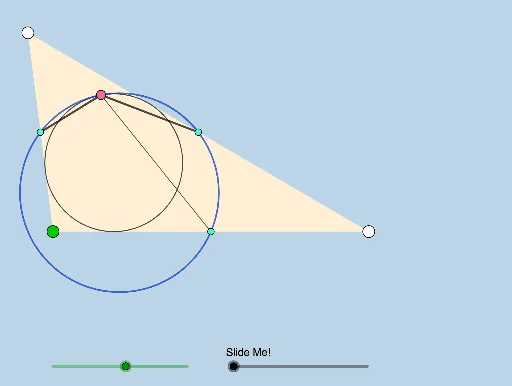
This example dynamically illustrates the property of the Feuerbach point of any triangle. It involves core mathematical concepts like triangle, incircle, midpoint, angle bisector, circle intersections, etc. Construction highlights commands such as Segment, Rotate, Circle, Intersect, Polygon, Incircle, Midpoint from the summary. Suitable for high school and above students to understand the relationship between the Feuerbach point and the nine-point circle, and the dynamic changes in geometric constructions.
GeoGebra Commands & Parameters
Segment(A, B) → fRotate(B, (a * π / 180), A) → B'Angle(B, A, B') → αRay(A, B') → gPoint(g) → CPolygon(A, B, C) → t1, c, a_1, bSegment(A, B) → hSegment(B, C) → iSegment(C, A) → jIncircle(A, B, C) → dMidpoint(j) → DMidpoint(h) → EMidpoint(i) → FOrthogonalLine(C, h) → kOrthogonalLine(B, j) → lOrthogonalLine(A, i) → mIntersect(k, l) → GLineBisector(h) → nLineBisector(i) → pLineBisector(j) → qLine(A, B) → rLine(B, C) → sLine(C, A) → tIntersect(m, s) → HIntersect(l, t) → IIntersect(k, r) → JMidpoint(G, B) → KMidpoint(G, C) → LMidpoint(G, A) → MCircle(L, K, M) → eIntersect(d, e) → N, O, ,Segment(N, D) → f_1Segment(N, F) → g_1Segment(N, E) → h_1Max({f_1, g_1, h_1}) → uCircle(N, g_1) → c_1Intersect(c_1, f_1, 1) → PAngle(F, N, D) → βLine(P, h_1) → i_1Rotate(N, If[0 < v ≤ 1, (v * β), β], N) → N'Rotate(F, If[0 < v ≤ 1, (v * β), β], N) → F'Segment(N', F') → j_1Dilate(N', If[1 < v ≤ 2, 2 - v, 0], F') → N''Vector(N, N'') → wTranslate(N, w) → N'_1Translate(E, w) → E'Segment(N'_1, E') → k_1Line(F', h_1) → l_1Point(l_1) → QAngle(D, F', Q) → γRotate(N'_1, If[2 < v ≤ 3, ((-(v - 2)) * γ), (-γ)], F') → RRotate(E', If[2 < v ≤ 3, ((-(v - 2)) * γ), (-γ)], F') → E''Segment(R, E'') → m_1Segment(N, F) → n_1Segment(N, E) → p_1Segment(N, D) → q_1Circle(N, E) → d_1Intersect(d_1, n_1, 1) → SAngle(E, N, S) → δRotate(N, If[0 < v ≤ 1, (v * δ), δ], N) → N'_2Rotate(E, If[0 < v ≤ 1, (v * δ), δ], N) → E'_1Segment(N'_2, E'_1) → r_1Dilate(N, If[1 < v ≤ 2, 2 - v, 0], E'_1) → N'_3Vector(N, N'_3) → u_1Translate(N, u_1) → N'_4Translate(D, u_1) → D'Segment(N'_4, D') → s_1Angle(F, N, D) → εRotate(N'_4, If[2 < v ≤ 3, ((-(v - 2)) * ε), (-ε)], E'_1) → TRotate(D', If[2 < v ≤ 3, ((-(v - 2)) * ε), (-ε)], E'_1) → D''Segment(T, D'') → t_1Segment(N, E) → b_1Segment(N, F) → e_1Segment(N, D) → f_2Angle(D, N, E) → ζRotate(N, If[0 < v ≤ 1, (v * ζ), ζ], N) → N'_5Rotate(D, If[0 < v ≤ 1, (v * ζ), ζ], N) → D'_1Segment(N'_5, D'_1) → g_2Dilate(N, If[1 < v ≤ 2, 2 - v, 0], D'_1) → N'_6Vector(N, N'_6) → v_1Translate(N, v_1) → N'_7Translate(F, v_1) → F'_1Segment(N'_7, F'_1) → h_2Angle(D'_1, N, F) → ηRotate(N'_7, If[2 < v ≤ 3, ((-(v - 2)) * η), (-η)], D'_1) → WRotate(F'_1, If[2 < v ≤ 3, ((-(v - 2)) * η), (-η)], D'_1) → ZSegment(W, Z) → i_2