
Factor Theorem: Geometric Demonstration of Polynomial Factorization
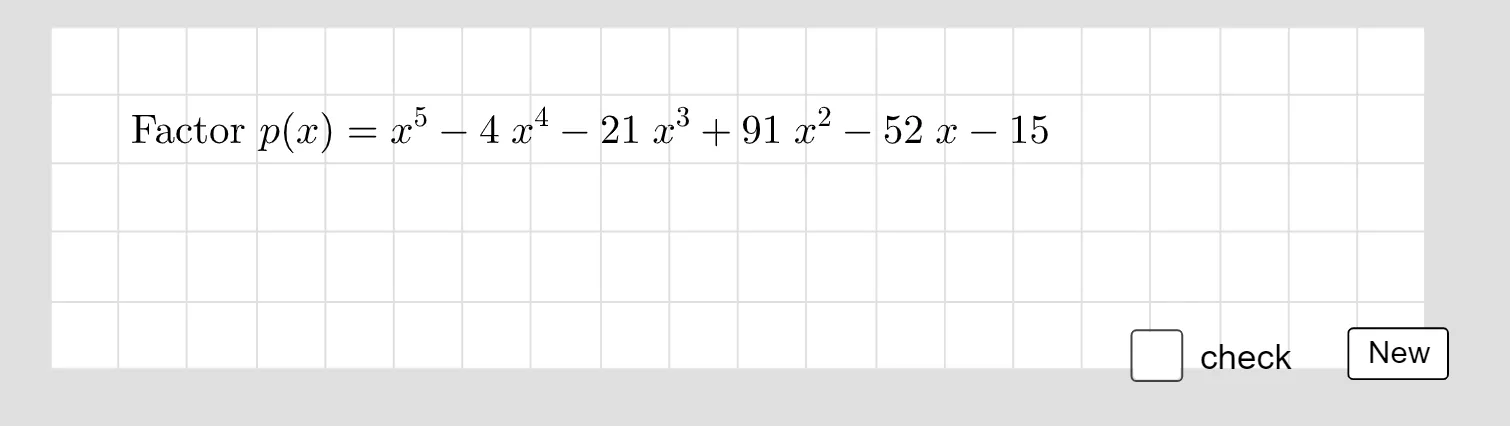
Loading the math board and drawing, please wait…
In collections
Grade 12 PreCalculus BC
This example dynamically demonstrates the geometric significance of polynomial factorization using GeoGebra. Key mathematical concepts include the Factor Theorem, algebraic polynomials, and their geometric representations. Construction involves commands like Random, Expand, and Polygon to create polynomial graphs, while Shuffle and Simplify verify factorization results. Suitable for high school students learning polynomial properties or as a tool for mathematical modeling.
GeoGebra Commands & Parameters
Random(1, 5) → r1Random(1, 5) → r2Random(1, 5) → r3Random(-5, -1) → r4Random(-5, -1) → r5RandomElement({-8, -10, 0, 0, 0, 8, 9, 10}) → r6Shuffle(rlist) → rshlist, {5, 3, 1, -1, -5, 8}Element(rshlist, 1) → rr1Element(rshlist, 2) → rr2Element(rshlist, 3) → rr3Element(rshlist, 4) → rr4Element(rshlist, 5) → rr5RandomElement(listf) → fExpand(f) → gPolygon(A, B, C, D) → q1, a_1, b, c, dSimplify(f) → ff
AI Drawing Prompt Reference
Create a dynamic visualization showing the geometric significance of polynomial factorization, including randomly generated polynomial function graphs and their factorization geometric representations, constructed by selecting random coefficients, displaying key points with polygons, and simplifying to verify factorization results, suitable for high school students learning polynomial properties.
The prompt above was compiled from the original drawing commands and is for reference only.