
Extraneous Solutions for Quadratic Equations by Steve Phelps
Loading the math board and drawing, please wait…
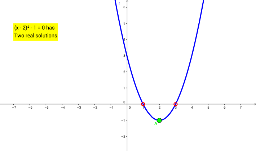
This example illustrates extraneous solutions in quadratic equations. It involves the core mathematical concepts of solving quadratic equations. Using GeoGebra's If, Root commands, the solutions of the quadratic equation are constructed, and extraneous solutions are observed. Suitable for students at the junior high school level and above.
GeoGebra Commands & Parameters
If(y(A) < 0, "Two real solutions", If[y(A) ≟ 0, "One real solution (multiplicity 2)", "Two complex conjugate solutions"]) → text1Root(f) → B, C
AI Drawing Prompt Reference
Draw the graph of a quadratic function, with its parabola opening according to the leading coefficient. Mark the points where the parabola intersects the x-axis, representing the real solutions of the equation. Add a dynamic text label on the graph that displays the nature of the solutions based on the discriminant: if the discriminant is negative, show "Two real solutions"; if zero, show "One real solution (multiplicity 2)"; if positive, show "Two complex conjugate solutions". The image should clearly show the parabola, the x-axis, the intersection points, and the text label, making it easy to observe the solution cases.
The prompt above was compiled from the original drawing commands and is for reference only.