
Exterior Angles of Polygons by Kelly Haydukewich
Loading the math board and drawing, please wait…
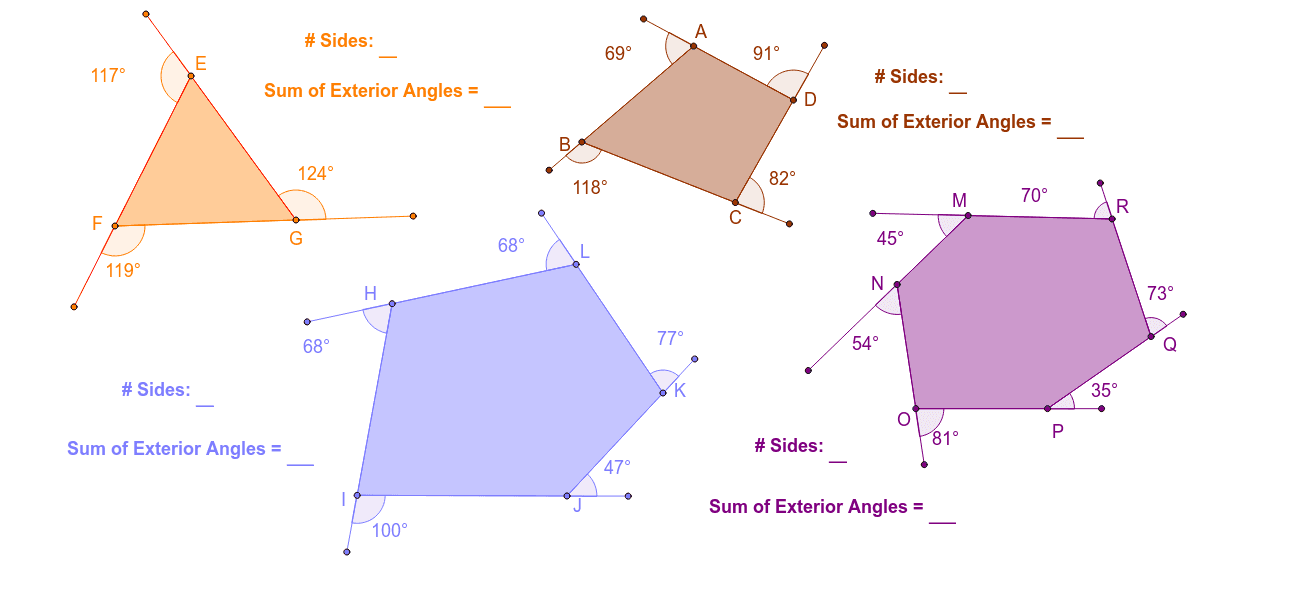
This example demonstrates the sum of exterior angles in polygons. Key math concepts include exterior angles and the polygon interior angle sum theorem. It is constructed using GeoGebra commands like Polygon, Ray, Point, Segment, and Angle. Suitable for middle school and above students to learn polygon geometric properties, ideal for classroom demonstrations and concept understanding.
GeoGebra Commands & Parameters
Polygon(A, B, C, D) → poly1, a, b, c, dPolygon(E, F, G) → poly2, g, e, fPolygon(H, I, J, K, L) → poly3, h, i, j, k, lPolygon(M, N, O, P, Q, R) → poly4, m, n, o, p, q, rRay(F, G) → sRay(G, E) → tRay(E, F) → a_1Ray(B, C) → b_1Ray(C, D) → c_1Ray(D, A) → d_1Ray(A, B) → e_1Ray(K, L) → f_1Ray(L, H) → g_1Ray(H, I) → h_1Ray(I, J) → i_1Ray(J, K) → j_1Ray(N, O) → k_1Ray(O, P) → l_1Ray(P, Q) → m_1Ray(Q, R) → n_1Ray(R, M) → p_1Ray(M, N) → q_1Point(f_1) → SPoint(g_1) → TPoint(h_1) → UPoint(i_1) → VPoint(j_1) → WPoint(q_1) → ZPoint(k_1) → A_1Point(m_1) → B_1Point(n_1) → C_1Point(p_1) → D_1Point(l_1) → E_1Point(b_1) → F_1Point(c_1) → G_1Point(d_1) → H_1Point(e_1) → I_1Point(s) → J_1Point(t) → K_1Point(a_1) → L_1Segment(G, K_1) → r_1Segment(E, L_1) → s_1Segment(F, J_1) → t_1Segment(C, G_1) → a_2Segment(D, H_1) → b_2Segment(A, I_1) → c_2Segment(B, F_1) → d_2Segment(H, U) → e_2Segment(I, V) → f_2Angle(K_1, E, F) → αAngle(L_1, F, G) → βAngle(J_1, G, E) → γAngle(H_1, A, I_1) → δAngle(I_1, B, C) → εAngle(F_1, C, D) → ζAngle(G_1, D, A) → ηSegment(S, K) → g_2Segment(L, T) → h_2Segment(J, W) → i_2Angle(S, L, T) → θAngle(T, H, I) → ιAngle(V, J, K) → λAngle(W, K, L) → μSegment(Q, C_1) → j_2Segment(R, D_1) → k_2Segment(M, Z) → l_2Segment(N, A_1) → m_2Segment(O, E_1) → n_2Segment(P, B_1) → p_2Angle(C_1, R, M) → νAngle(D_1, M, N) → ξAngle(Z, N, O) → οAngle(A_1, O, P) → ρAngle(E_1, P, Q) → σAngle(B_1, Q, R) → τAngle(U, I, J) → κ
AI Drawing Prompt Reference
Draw several polygons of different numbers of sides and illustrate the sum of their exterior angles. For each vertex, draw rays to form the exterior angles. Connect these exterior angle vertices and adjacent vertices to create new shapes. Highlight the property that the sum of exterior angles is 360 degrees using different colors or line styles, suitable for educational demonstrations.
The prompt above was compiled from the original drawing commands and is for reference only.