
Exterior Angles of a Hexagon
Loading the math board and drawing, please wait…
In collections
Polygons & Angles
Polygons & Angles
Polygons & Angles ( s n attar)
Polygons & Angles
Polygons & Angles
Polygons & Angles
Polygons & Angles
Geometry: Polygons & Angles
Geometry: Polygons & Angles
Polygons & Angles
Polygons & Angles
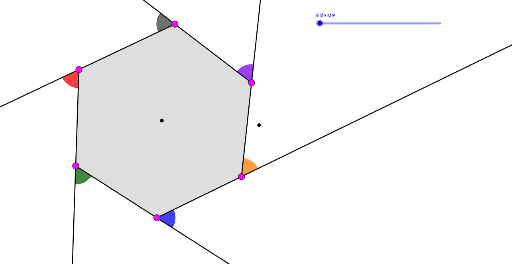
This example demonstrates the properties and calculation of exterior angles in a hexagon. It involves core mathematical concepts such as the sum of exterior angles theorem, angle measurement, and geometric construction. Key GeoGebra commands used include Circle, Point, Line, Rotate, Angle, CircleArc, Ray, Intersect, CircleSector, and Polygon. Suitable for middle school students and above learning polygon geometry or for classroom demonstrations.
GeoGebra Commands & Parameters
Circle(A, 8 - a) → cPoint(c) → BLine(A, B) → bRotate(B, 60°, A) → B'Angle(B, A, B') → αRotate(B', 60°, A) → B''Angle(B', A, B'') → βRotate(B'', 60°, A) → B'''Angle(B'', A, B''') → γRotate(B''', 60°, A) → CAngle(B''', A, C) → δRotate(C, 60°, A) → C'Angle(C, A, C') → εCircleArc(A, B, B') → dCircleArc(A, B', B'') → eCircleArc(A, B'', B''') → fCircleArc(A, B''', C) → gCircleArc(A, C, C') → hCircleArc(A, C', B) → kPoint(d) → DPoint(e) → EPoint(f) → FPoint(g) → GPoint(h) → HPoint(k) → IRay(D, E) → iRay(E, F) → jRay(F, G) → lRay(G, H) → mRay(H, I) → nRay(I, D) → pCircle(E, 1.5) → qCircle(F, 1.5) → rCircle(G, 1.5) → sCircle(H, 1.5) → tCircle(I, 1.5) → c_1Circle(D, 1.5) → d_1Intersect(r, j, 1) → JIntersect(r, l, 1) → KIntersect(s, l, 2) → LIntersect(s, m, 1) → MIntersect(r, j, 2) → NIntersect(t, m, 2) → OIntersect(t, n, 1) → PIntersect(c_1, n, 2) → QIntersect(c_1, p, 1) → RIntersect(d_1, p, 2) → SIntersect(d_1, i, 1) → TIntersect(q, j, 1) → UIntersect(q, i, 2) → VCircleSector(F, N, K) → e_1CircleSector(G, L, M) → f_1CircleSector(H, O, P) → g_1CircleSector(I, Q, R) → h_1CircleSector(D, S, T) → k_1CircleSector(E, V, U) → p_1Polygon(G, H, I, D, E, F) → poly1, g_2, h_2, i_1, d_2, e_2, f_2
AI Drawing Prompt Reference
Draw a hexagon, then rotate each vertex 60 degrees to form the exterior angles. Next, draw arcs for each exterior angle using circular arcs and circles. Finally, find points on the circumscribed circle of the hexagon through intersections to form the circumscribed circle.
The prompt above was compiled from the original drawing commands and is for reference only.