
Exterior Angles Investigation
Loading the math board and drawing, please wait…
In collections
Polygons & Angles
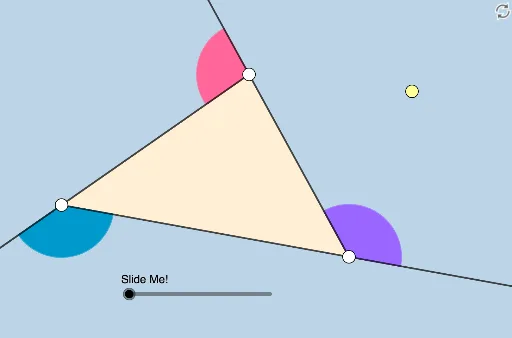
This example demonstrates the properties and patterns of exterior angles of polygons through a dynamic and modifiable investigation. It explores the relationship between the sum of exterior angles and the number of sides of a polygon. Key math concepts include polygons, exterior angles, and angle sums. The construction utilizes GeoGebra commands and objects such as Ray, Polygon, Min, Circle, Intersect, CircleSector, Dilate, Vector, Translate, and Angle. Suitable for middle school and above mathematics education, ideal for geometric exploration and discovery.
GeoGebra Commands & Parameters
Ray(A, B) → fRay(B, C) → gRay(C, A) → hPolygon(A, B, C) → t1, c, a, bMin({a, b, c}) → dCircle(C, (0.25 * d)) → eCircle(A, (0.25 * d)) → kCircle(B, (0.25 * d)) → pIntersect(e, g, 2) → EIntersect(e, h, 1) → FIntersect(k, h, 2) → GIntersect(k, f, 1) → HIntersect(p, f, 2) → IIntersect(p, g, 1) → JCircleSector(C, E, F) → qCircleSector(A, G, H) → rCircleSector(B, I, J) → sDilate(A, If[0 < u ≤ 1, 1 - u, 0], D) → A'Dilate(B, If[0 < u ≤ 1, 1 - u, 0], D) → B'Dilate(C, If[0 < u ≤ 1, 1 - u, 0], D) → C'Vector(C, C') → vVector(A, A') → wVector(B, B') → iTranslate(q, v) → q'Translate(r, w) → r'Translate(s, i) → s'CircleSector(C, F, E) → tCircleSector(A, H, G) → c_1CircleSector(B, J, I) → d_1Angle(A, C, B) → αTranslate(c_1, w) → e_1Translate(t, v) → t'Translate(d_1, i) → f_1
AI Drawing Prompt Reference
Draw a triangle and extend rays from each vertex to form three exterior angles. Create three small circles centered at the triangle's center, intersecting the rays at six points. Connect these points to form three sectors, representing the exterior angles. Extend the triangle's vertices along the rays and translate the sectors to show the relationship between interior and exterior angles, exploring the sum of exterior angles.
The prompt above was compiled from the original drawing commands and is for reference only.