
Exterior Angle Theorem
Loading the math board and drawing, please wait…
In collections
CLASS IX CBSE MATHS ACTIVITIES
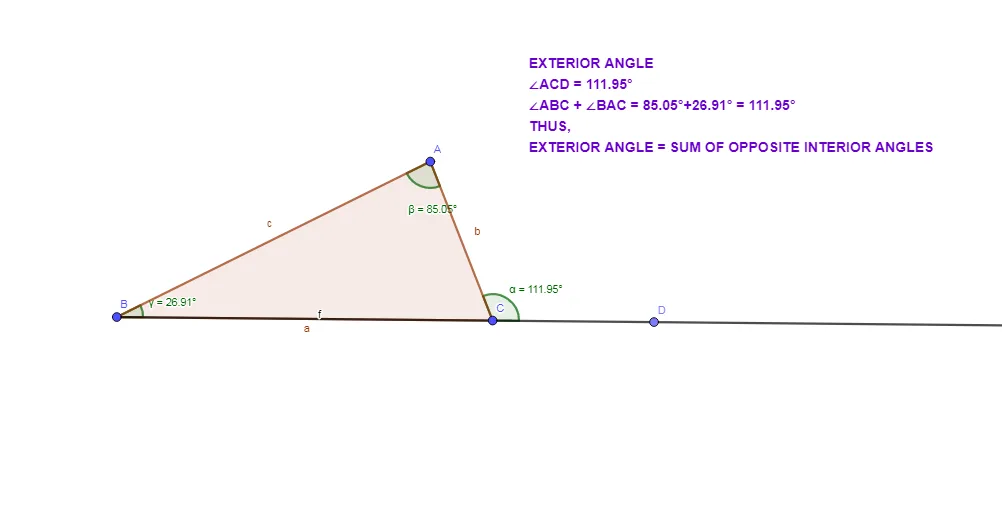
This example illustrates the exterior angle theorem, which states that an exterior angle of a triangle is equal to the sum of the two non-adjacent interior angles. It involves the core mathematical concept of the properties of exterior angles in a triangle. Using GeoGebra commands such as Polygon, Ray, Point, and Angle, it dynamically demonstrates the properties of the exterior angle. Suitable for students at the junior high school level and above.
GeoGebra Commands & Parameters
Polygon(A, B, C) → t1, c, a, bRay(B, C) → fPoint(f) → DAngle(D, C, A) → αAngle(B, A, C) → βAngle(C, B, A) → γ
AI Drawing Prompt Reference
Draw a triangle and extend one of its sides outward from a vertex to create a ray. Place a point on this ray so that it forms an exterior angle with the triangle's vertex and the other endpoint of the side. Then mark the exterior angle and the two non-adjacent interior angles of the triangle, using arcs or angle symbols to show their measures, illustrating that the exterior angle equals the sum of the two opposite interior angles.
The prompt above was compiled from the original drawing commands and is for reference only.