
Exterior Angle Sum of a Polygon is 360°
Loading the math board and drawing, please wait…
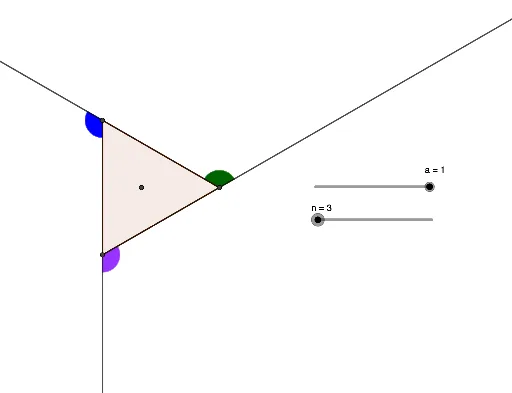
① This applet visually demonstrates that the sum of the exterior angles of any polygon (including concave ones) is always 360 degrees. ② The core mathematical concept is the polygon exterior angle sum theorem, involving the definition of exterior angles, rotational direction, and angle accumulation. ③ Construction highlights: uses the Polygon command to create the polygon, Ray and Angle commands to mark exterior angles, Rotate to show how the angles fit together, and Intersect and Circle for auxiliary construction; objects include vertices A, B, C, etc., and multiple angle objects f, g, h, etc. ④ Suitable for middle school to high school students learning geometry theorems, and for teachers to demonstrate an intuitive proof of the exterior angle sum in class.
GeoGebra Commands & Parameters
Intersect(xAxis, yAxis) → ACircle(A, a) → cIntersect(c, xAxis, 2) → BRotate(B, ca, A) → B'Polygon(B, B', n) → poly1, f, q, C, D, E, F, G, H, I, J, g, h, i, j, k, l, m, pRay(B, B') → rRay(B', C) → sRay(C, D) → tRay(D, E) → bRay(E, F) → dRay(F, G) → eRay(G, H) → f_1Ray(H, I) → g_1Ray(I, J) → h_1Ray(J, B) → i_1Ray(H, B) → j_1Ray(G, B) → k_1Ray(F, B) → l_1Ray(E, B) → m_1Ray(D, B) → n_1Ray(C, B) → p_1Circle(A, 2) → c_1Intersect(c_1, r, 1) → KIntersect(c_1, s, 1) → LIntersect(c_1, t, 1) → MIntersect(c_1, b, 1) → NIntersect(c_1, d, 1) → OIntersect(c_1, e, 1) → PIntersect(c_1, f_1, 1) → QIntersect(c_1, j_1, 1) → RAngle(K, B', L) → αAngle(L, C, M) → βAngle(M, D, N) → γAngle(N, E, O) → δAngle(O, F, P) → εAngle(Q, G, P) → ζIntersect(c_1, k_1, 1) → SAngle(S, G, P) → ιAngle(S, B, K) → κIntersect(c_1, l_1, 1) → TIntersect(c_1, m_1, 1) → UAngle(N, E, U) → ξIntersect(c_1, n_1, 1) → VIntersect(c_1, p_1, 1) → WAngle(K, B, W) → σAngle(L, C, W) → τAngle(K, B, V) → ρAngle(M, D, V) → οAngle(U, B, K) → νAngle(K, B, T) → λAngle(T, F, O) → μAngle(R, H, Q) → ηAngle(K, B, R) → θ