
Exponential Functions and the Natural Base e
Loading the math board and drawing, please wait…
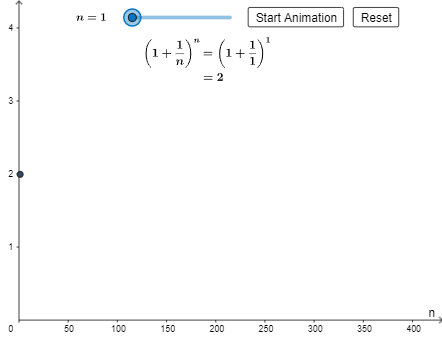
This example demonstrates the relationship between exponential functions and the natural base e. Key mathematical concepts include exponential functions, logarithms, and geometric construction. The construction involves GeoGebra commands such as f, A, B, C, D, E, F, n, a, etc. It is suitable for high school mathematics courses to understand the properties of exponential functions and their graphical representation.
GeoGebra Commands & Parameters
f(x) = (1 + 1 / x)^(x)(1, f(1))(4, f(4))(12, f(12))(26, f(26))(52, f(52))(365, f(356))Numeric n(1)f(n)Numeric time(2)g(x) = If[1 ≤ x ≤ n, f(x)]h(x) = If[0 ≤ x ≤ 10000, ℯ](55.54895, 4.24486)(40.54895, 4.24486)
AI Drawing Prompt Reference
Draw a graph showing the relationship between exponential functions and the natural base e, plotting key points of the function f(x) = (1 + 1/x)^x at x=1, 4, 12, 26, 52, 356, and include a slider to control the value of n, defining a new function g(x) that takes f(x) within the range 1 to n. Also plot the constant function h(x)=e from 0 to 10000, and mark the specific points (55.54895, 4.24486) and (40.54895, 4.24486).
The prompt above was compiled from the original drawing commands and is for reference only.