
Exponential and Logarithmic Functions Interactive Demo by Varada Vaughan
Loading the math board and drawing, please wait…
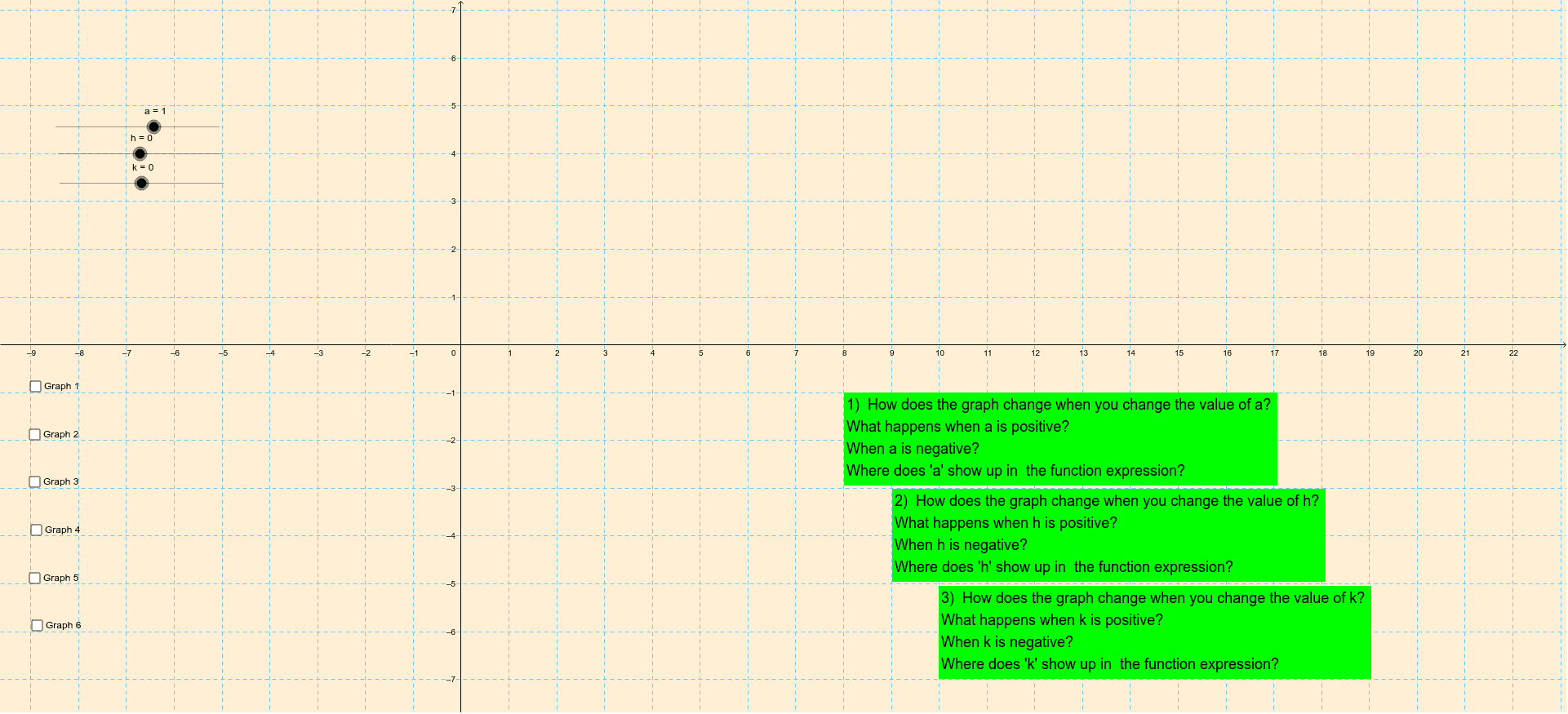
① This GeoGebra example dynamically demonstrates exponential and logarithmic functions and their transformations, clearly showing the graphical features and reciprocal relationships of these two fundamental elementary functions. ② Core mathematical concepts include exponential functions, logarithmic functions, horizontal/vertical shifts and stretches controlled by parameters a, h, k, as well as elements from differential calculus such as derivatives and tangents, along with ellipses, roots, polynomial functions, and angles. ③ Construction highlights: from the construction summary, numerous objects are used—parameter sliders a, h, k; function objects f and g; text labels (text1–text8, text11); a button (button1); and auxiliary objects q, m, n, p, b, c, d, e, i, j—likely to build an interactive interface that updates function graphs in real time as parameters change. ④ Suitable for high school to early college students to explore properties of exponential and logarithmic functions, graph transformations, and connections with derivatives and geometric elements, also useful for classroom demonstrations or self-directed learning.
GeoGebra Commands & Parameters
Numeric a(1.0)Numeric h(0.0)Numeric k(0.0)f(x) = (a * 2^(x - h)) + kq(x) = (a * log(x - h)) + kg(x) = (a * ld(x - h)) + km(x) = (a * 10^(x - h)) + kn(x) = (a * lg(x - h)) + kp(x) = (a * ℯ^(x - h)) + kBoolean b(false)Boolean c(false)Boolean d(false)Boolean e(false)Boolean i(false)Boolean j(false)
AI Drawing Prompt Reference
Draw dynamic graphs of exponential and logarithmic functions, with transformations controlled by parameters a, h, and k. Include functions f(x) = a * 2^(x - h) + k, q(x) = a * log(x - h) + k, m(x) = a * 10^(x - h) + k, n(x) = a * lg(x - h) + k, and p(x) = a * ℯ^(x - h) + k, and observe their graphical features and relationships.
The prompt above was compiled from the original drawing commands and is for reference only.