
Exponent and Triangle
Loading the math board and drawing, please wait…
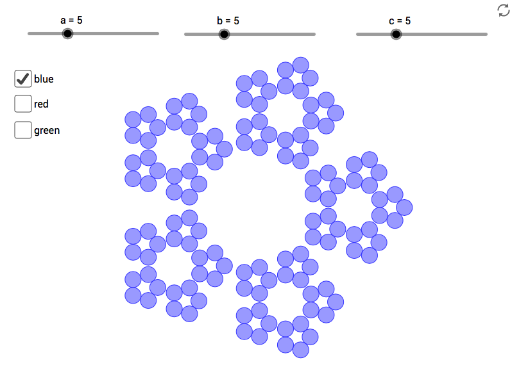
This example demonstrates the relationship between exponential functions and triangles. By adjusting parameters, one can observe the changes in the exponential function and its combination with the properties of triangles. The Sequence command is used to generate a series of objects, including triangles, circles, and solid geometry shapes. Suitable for high school mathematics education and learning.
GeoGebra Commands & Parameters
Sequence(Dilate[Circle[(0, 0), 1], t1, (cos(((2 * n) * π / a)), sin(((2 * n) * π / a)))], n, 1, a) → ring1Sequence(Dilate[ring1, t2, (cos(((2 * n) * π / b)), sin(((2 * n) * π / b)))], n, 1, b) → ring2Sequence(Dilate[ring2, t3, (cos(((2 * n) * π / c)), sin(((2 * n) * π / c)))], n, 1, c) → ring3Sequence(Dilate[Circle[(0, 0), 1], t3, (cos(((2 * n) * π / c)), sin(((2 * n) * π / c)))], n, 1, c) → shell1Sequence(Dilate[Sequence[Dilate[Circle[(0, 0), 1], t2, (cos(((2 * n) * π / b)), sin(((2 * n) * π / b)))], n, 1, b], t3, (cos(((2 * k) * π / c)), sin(((2 * k) * π / c)))], k, 1, c) → shell2