
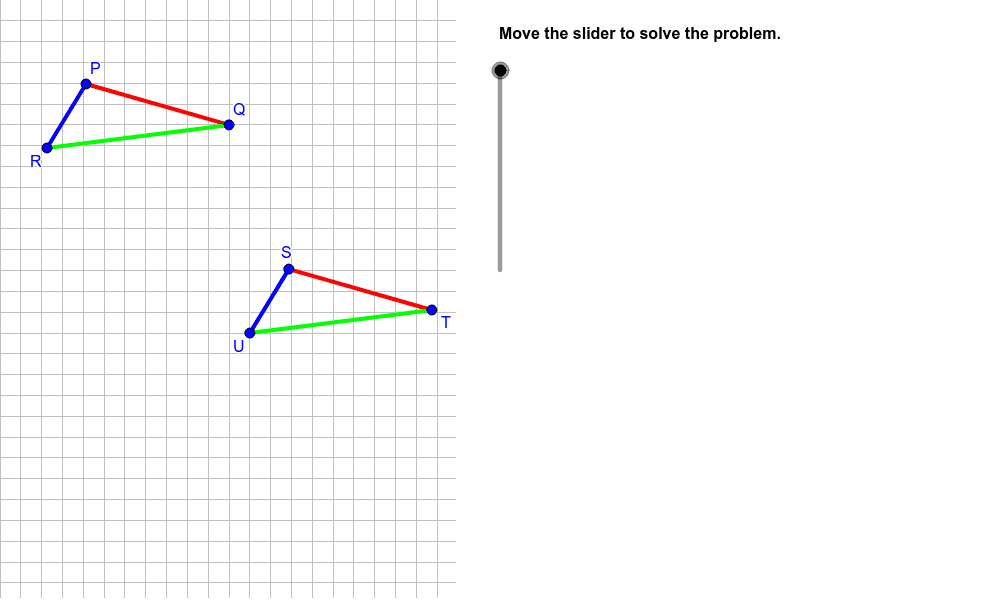
Exploring Triangle Congruence – Using Transformations to Verify PQR ≅ STU
Loading the math board and drawing, please wait…
In collections
Similarity and Congruence Year 8 Pedagogies in Practice
This GeoGebra example demonstrates how to determine whether triangles PQR and STU are congruent by applying congruence criteria (SSS, SAS, ASA) and rigid motions such as rotations and translations. The construction uses GeoGebra commands like Rotate, Translate, Vector, Polygon, Angle, and Distance, together with masks and sliders to animate the transformations and compare the figures. It is designed for high‑school geometry classes and modeling activities, offering an interactive way to understand congruence proofs.
GeoGebra Commands & Parameters
Rotate(P, rotation, R) → B_rRotate(Q, rotation, R) → C_rRotate(R, rotation, R) → A_rIf(reflection, Mirror[B_r, Line[A_r, C_r]], B_r) → Br1Vector(R, D) → translationVectorPolygon((11, y(Corner[1])), Corner[2], Corner[3], (11, y(Corner[4]))) → Mask, mask4, mask3, mask2, mask1Polygon(R, P, Q) → poly1, PQ, QR, PRPolygon(A_r, B_r, C_r) → polyR, polyRAB, polyRBC, polyRACTranslate(C_r, translationVector) → TTranslate(A_r, translationVector) → UTranslate(Br1, translationVector) → SPolygon(U, S, T) → poly2, US, ST, UTAngle(R, P, Q) → PQRAngle(P, Q, R) → QRPAngle(Q, R, P) → RPQAngle(S, T, U) → STUAngle(T, U, S) → TUSDistance(Q, R) → RAAngle(U, S, T) → UST