
Exploring Translations by Mr. Watson (6)
Loading the math board and drawing, please wait…
In collections
Geometry Transformations
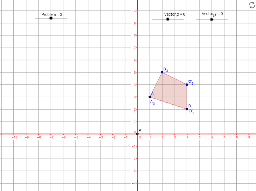
This example demonstrates geometric transformations on a coordinate grid, focusing on translation. Core math concepts include vectors, polygons, and coordinate geometry. It is constructed using GeoGebra commands like Polygon, Vector, and Translate, and objects such as A, B, C, D, and vectors. Aimed at 8-10th grade students for an introduction to geometry.
GeoGebra Commands & Parameters
Polygon(A, B, C, D) → poly1, a, b, c, dVector(E, F) → uTranslate(A_1, u) → GTranslate(B_1, u) → HTranslate(C_1, u) → ITranslate(D_1, u) → JVector(E, K) → vTranslate(A_1, v) → LTranslate(B_1, v) → MTranslate(C_1, v) → NTranslate(D_1, v) → OVector(E, P) → wTranslate(A_1, w) → QTranslate(B_1, w) → RTranslate(C_1, w) → STranslate(D_1, w) → TTranslate(A, u) → A'_1Translate(B, u) → B'_1Translate(C, u) → C'_1Translate(D, u) → D'_1Polygon(A'_1, B'_1, C'_1, D'_1) → poly1', a', b', c', d'Translate(A_1, u) → UTranslate(B_1, u) → VTranslate(C_1, u) → WTranslate(D_1, u) → ZPolygon(U, V, W, Z) → poly2, u_1, v_1, w_1, zTranslate(A, v) → A'_2Translate(B, v) → B'_2Translate(C, v) → C'_2Translate(D, v) → D'_2Polygon(A'_2, B'_2, C'_2, D'_2) → poly1'_1, a'_1, b'_1, c'_1, d'_1Translate(A_1, v) → E_1Translate(B_1, v) → F_1Translate(C_1, v) → G_1Translate(D_1, v) → H_1Polygon(E_1, F_1, G_1, H_1) → poly3, e_1, f_1, g_1, h_1Translate(A, w) → A'_3Translate(B, w) → B'_3Translate(C, w) → C'_3Translate(D, w) → D'_3Polygon(A'_3, B'_3, C'_3, D'_3) → poly1'_2, a'_2, b'_2, c'_2, d'_2Translate(A_1, w) → I_1Translate(B_1, w) → J_1Translate(C_1, w) → K_1Translate(D_1, w) → L_1Polygon(I_1, J_1, K_1, L_1) → poly4, i_1, j_1, k_1, l_1Translate(A'_3, Vector[(0, 0)]) → A''Polygon(A_4, B_4, C_4, D_4) → poly1_2, a_2, b_2, c_2, d_2Polygon(A_3, B_3, C_3, D_3) → poly1_3, a_3, b_3, c_3, d_3Polygon(A_5, B_5, C_5, D_5) → poly1_4, a_4, b_4, c_4, d_4Polygon(A_6, B_6, C_6, D_6) → poly1_5, a_5, b_5, c_5, d_5
AI Drawing Prompt Reference
Draw a quadrilateral ABCD, then translate it along vector u to get quadrilateral A'B'C'D', and along vector v to get quadrilateral A''B''C''D''. Next, translate quadrilateral A'''B'''C'''D''' back to the origin to get the final quadrilateral A''B''C''D''.
The prompt above was compiled from the original drawing commands and is for reference only.