
Exploring the Parallel Lines Proportionality Theorem
Loading the math board and drawing, please wait…
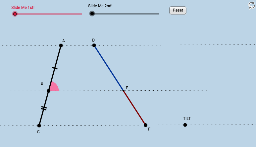
This GeoGebra applet allows students to informally discover the parallel lines proportionality theorem through hands-on activities. Key mathematical concepts include parallel lines and proportional relationships. Using commands like Line, Slope, PointIn, Segment, Point, Distance, students can measure distances and angles to verify the theorem. Suitable for middle school and above students for geometric construction and theorem exploration.
GeoGebra Commands & Parameters
Line(C, B_1) → aSlope(a) → bPointIn(d) → ASegment(A, C) → iPoint(i) → BDistance(A, B) → nCircle(A, 1) → fLine(A, a) → eIntersect(f, e, 2) → D_1Intersect(f, e, 1) → E_1Ray(A, D_1) → gRay(A, E_1) → hPoint(g) → DRay(C, B_1) → j_1Point(j_1) → FCircle(C, 1) → kIntersect(k, a, 1) → ILine(B, a) → lSegment(D, F) → mIntersect(l, m) → ECircle(B, 1) → pIntersect(p, l, 2) → KIntersect(p, i, 1) → LCircleSector(B, K, L) → qDilate(B, If[0 < j ≤ 1, 1 - j, 0], A) → H'Vector(B, H') → uTranslate(q, u) → q'Rotate(q', If[1 < j ≤ 2, (((j - 1) * 180))°, 180°], A) → q''Dilate(B, If[2 < j ≤ 3, 3 - j, 0], C) → H'_1Vector(B, H'_1) → vTranslate(q, v) → q'_1Segment(B, A) → rSegment(B, C) → sSegment(D, E) → tSegment(E, F) → a_1Ray(C, I) → b_1Dilate(D, If[0 < o ≤ 1, 1 - o, 0], A) → F'Vector(D, F') → wTranslate(D, w) → F'_1Translate(E, w) → E'Segment(F'_1, E') → t'Translate(E, w) → J'_1Translate(F, w) → G'_1Segment(J'_1, G'_1) → c_1Polygon(B, A, E') → poly1, j', h_1, c_2Dilate(B, o - 1.5, A) → H'_2Dilate(A, o - 1.5, A) → C'Dilate(E', o - 1.5, A) → J''Dilate(A, o - 0.5, A) → C'_1Dilate(E', o - 0.5, A) → J''_1Dilate(A, ((o - 0.5) * e_1), A) → C'_2Dilate(E', ((o - 0.5) * e_1), A) → J''_2Dilate(B, If[1.5 < o ≤ 2.5, 2.5 - o, 0], C) → H'_3Dilate(E', If[1.5 < o ≤ 2.5, 2.5 - o, 0], G'_1) → J''_3Polygon(H'_3, A, J''_3) → poly2, j''_3, h'_3, c_3Dilate(E', If[1.5 < o ≤ 2.5, 2.5 - o, 0], G'_1) → E''
AI Drawing Prompt Reference
Draw two parallel lines and select points on them to construct segments. Measure and verify the proportional relationships of the segments. Use perpendiculars, circles, and intersection points to illustrate the theorem of proportional segments created by parallel lines. Include dynamic transformations like rotation and dilation to explore the theorem's generality.
The prompt above was compiled from the original drawing commands and is for reference only.