
Exploring Symmetry and Translation with Cutouts and Folds
Loading the math board and drawing, please wait…
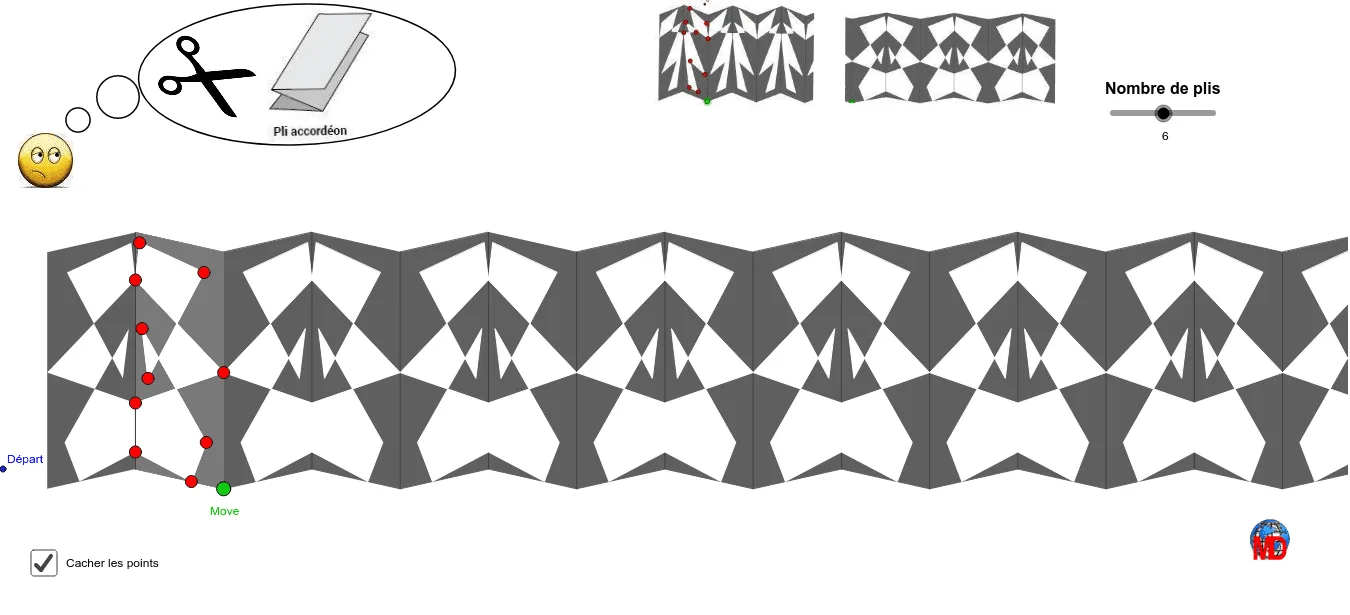
This example uses cutouts and folds to explore symmetry and translation. It involves key concepts such as symmetry and translation. Using GeoGebra commands like Circle, Line, Intersect, Mirror, Vector, Translate, etc., a series of geometric shapes can be constructed. Suitable for middle school and above students or teachers.
GeoGebra Commands & Parameters
Circle(Départ, b) → eLine(Départ, xAxis) → dLine(Départ, yAxis) → b_1Intersect(e, b_1) → B, CLine(B, d) → gCircle(Départ, a) → cIntersect(c, d) → D, EMirror(Départ, E) → A'Line(E, b_1) → fIntersect(g, f) → FVector(E, F) → u_2CircleArc(F, Départ, A') → hPoint(h) → MoveTranslate(Move, u_2) → G'Midpoint(G', Move) → IPolygon(G', F, E, Move) → poly1, g', f_1, e_1, g_1Intersect(g_1, d) → HMirror(E, H) → E'Translate(E', u_2) → E''Polygon(E'', E', Move, G') → poly2, e'', e', g_2, g'_1Angle(Départ, E, Move) → αVector(Départ, E) → uLine(G', Move) → i_2Intersect(i_2, d) → I_2Vector(E, I_2) → vVector(E, E') → wSequence(Polygon[Translate[E'', Vector[(s * w)]], Translate[E', Vector[(s * w)]], Translate[Move, Vector[(s * w)]], Translate[G', Vector[(s * w)]]], s, 0, Nombre, 1) → liste2Sequence(Polygon[Translate[G', Vector[(s * w)]], Translate[F, Vector[(s * w)]], Translate[E, Vector[(s * w)]], Translate[Move, Vector[(s * w)]]], s, 0, Nombre) → liste7Segment(G', Move) → aa_1PointIn(poly1) → JPointIn(poly1) → KPointIn(poly1) → LPointIn(poly1) → MPointIn(poly1) → NPointIn(poly1) → OPointIn(poly1) → PPointIn(poly1) → QPointIn(poly1) → RPointIn(poly1) → SPolygon(J, K, M, O, P, S, R, Q, N, L) → poly3, j, l, k, m, o, p, s, r, q, n_1Mirror(J, aa_1) → J'Mirror(K, aa_1) → K'Mirror(M, aa_1) → M'Mirror(O, aa_1) → O'Mirror(P, aa_1) → P'Mirror(S, aa_1) → S'Mirror(R, aa_1) → R'Mirror(Q, aa_1) → Q'Mirror(N, aa_1) → N'Mirror(L, aa_1) → L'Polygon(J', K', M', O', P', S', R', Q', N', L') → poly3', j', l', k', m', o', p', s', r', q', n'Sequence(Polygon[Translate[J, Vector[(s * w)]], Translate[K, Vector[(s * w)]], Translate[M, Vector[(s * w)]], Translate[O, Vector[(s * w)]], Translate[P, Vector[(s * w)]], Translate[S, Vector[(s * w)]], Translate[R, Vector[(s * w)]], Translate[Q, Vector[(s * w)]], Translate[N, Vector[(s * w)]], Translate[L, Vector[(s * w)]]], s, 0, Nombre) → liste1Sequence(Polygon[Translate[J', Vector[(s * w)]], Translate[K', Vector[(s * w)]], Translate[M', Vector[(s * w)]], Translate[O', Vector[(s * w)]], Translate[P', Vector[(s * w)]], Translate[S', Vector[(s * w)]], Translate[R', Vector[(s * w)]], Translate[Q', Vector[(s * w)]], Translate[N', Vector[(s * w)]], Translate[L', Vector[(s * w)]]], s, 0, Nombre) → liste3Sequence(Segment[Translate[Move, Vector[(s * w)]], Translate[G', Vector[(s * w)]]], s, 0, Nombre) → liste4Segment(F, E) → aaSequence(Segment[Translate[E'', Vector[(s * w)]], Translate[E', Vector[(s * w)]]], s, 0, Nombre) → liste5Mirror(G', f_1) → G''Mirror(F, f_1) → F'Mirror(E, f_1) → E'_1Mirror(G', f_1) → G''_1Mirror(F, f_1) → F'_1Mirror(E, f_1) → E'_2Line(F, E) → iMirror(G', i) → G''_2Mirror(F, i) → F'_2Mirror(E, i) → E'_3Mirror(Move, i) → G'_1Polygon(G''_2, F'_2, E'_3, G'_1) → poly1', g''_2, f'_2, e'_3, g'_2Mirror(J, i) → J'_1Mirror(K, i) → K'_1Mirror(M, i) → M'_1Mirror(O, i) → O'_1Mirror(P, i) → P'_1Mirror(S, i) → S'_1Mirror(R, i) → R'_1Mirror(Q, i) → Q'_1Mirror(N, i) → N'_1Mirror(L, i) → L'_1Polygon(J'_1, K'_1, M'_1, O'_1, P'_1, S'_1, R'_1, Q'_1, N'_1, L'_1) → poly3'_1, j'_1, l'_1, k'_1, m'_1, o'_1, p'_1, s'_1, r'_1, q'_1, n'_1Ellipse(C_1, D_1, E_1) → c_1Circle(F_1, G_1) → d_1Circle(H_1, I_1) → h_1