
Exploring Slopes of Perpendicular Lines via Rotation
Loading the math board and drawing, please wait…
In collections
A1.ACE.1 - Create and solve equations and inequalities
Expressing Geometric Properties with Equations (GPE) Cluster
Parallel Lines and Planes
Slope
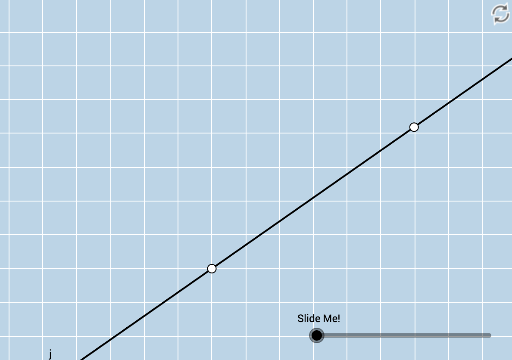
This example explores the relationship between the slopes of perpendicular lines through rotation. Key concepts include slope, rotation, and angles. Commands used include Circle, Rotate, Line, Intersect, OrthogonalLine, Segment, Dilate, etc. Suitable for middle school and above students for geometric exploration and function graphing.
GeoGebra Commands & Parameters
Circle(A, a_2) → cRotate(B, α, A) → B'Line(A, B') → jRotate(j, If[3.5 < b_1 ≤ 4.5, ((b_1 - 3.5) * π / 2), π / 2], A) → kIntersect(c, j, 2) → COrthogonalLine(C, g) → hIntersect(g, h) → DLine(D, j) → i_1Intersect(k, i_1) → PSegment(C, D) → lSegment(A, D) → j_1Dilate(C, If[0 < b_1 ≤ 1, 1 - b_1, 0], D) → C'Segment(C, C') → bMin(b, j_1) → k_2Circle(D, (0.2 * k_2)) → eIntersect(e, l, 1) → FAngle(F, D, P) → δIntersect(e, g, 2) → ECircleSector(D, E, F) → pRotate(p, If[2 < b_1 ≤ 3, ((b_1 - 2) * π / 2), π / 2], D) → p'Angle(B, A, B') → βPolygon(A, D, C) → poly1, c_1, a_1, dPoint(g) → GRay(D, G) → mPoint(m) → HRay(D, H) → nDilate(D, If[1 < b_1 ≤ 2, 2 - b_1, 0], A) → D'Segment(D, D') → aRay(D, I) → iIntersect(e, i, 1) → JCircleSector(D, F, J) → qCircle(C, (0.2 * k_2)) → rCircle(A, (0.2 * k_2)) → sIntersect(s, j_1, 1) → KIntersect(s, j, 2) → LIntersect(r, l, 1) → MIntersect(r, j, 1) → NCircleSector(C, N, M) → tCircleSector(A, K, L) → d_1Rotate(q, If[2 < b_1 ≤ 3, ((-(b_1 - 2)) * π / 2), ((-π)) / 2], D) → q'CircleSector(C, M, N) → e_1CircleSector(A, L, K) → f_1Rotate(A, If[3.5 < b_1 ≤ 4.5, ((b_1 - 3.5) * π / 2), π / 2], A) → A'Rotate(D, If[3.5 < b_1 ≤ 4.5, ((b_1 - 3.5) * π / 2), π / 2], A) → D'_1Rotate(C, If[3.5 < b_1 ≤ 4.5, ((b_1 - 3.5) * π / 2), π / 2], A) → C'_1Polygon(A', D'_1, C'_1) → poly1', c'_1, a', d'_1Rotate(C, If[3.5 < b_1 ≤ 4.5, ((b_1 - 3.5) * π / 2), π / 2], A) → C'_2Rotate(C', If[3.5 < b_1 ≤ 4.5, ((b_1 - 3.5) * π / 2), π / 2], A) → C''Segment(C'_2, C'') → b'Rotate(D, If[3.5 < b_1 ≤ 4.5, ((b_1 - 3.5) * π / 2), π / 2], A) → D'_2Rotate(D', If[3.5 < b_1 ≤ 4.5, ((b_1 - 3.5) * π / 2), π / 2], A) → D''Segment(D'_2, D'') → a'_1Rotate(d_1, If[4.5 < b_1 ≤ 5.5, ((b_1 - 4.5) * π / 2), π / 2], A) → g_1CircleArc(A, K, L) → h_1Rotate(p', If[3.5 < b_1 ≤ 4.5, ((b_1 - 3.5) * π / 2), π / 2], A) → p''Rotate(t, If[5.5 < b_1 ≤ 6.5, ((-(b_1 - 5.5)) * π), (-π)], C) → t'CircleArc(C, N, M) → k_1Dilate(C, If[6.5 < b_1 ≤ 7.5, 7.5 - b_1, 0], A) → C'_3Vector(C, C'_3) → uTranslate(t', u) → t''Dilate(D, If[9 < b_1 ≤ 10, 10 - b_1, 0], A) → D'_3Vector(D, D'_3) → vRotate(p', If[8 < b_1 ≤ 9, ((b_1 - 8) * δ), δ], D) → p''_1Translate(p''_1, v) → p_1Point(k) → ORotate(C, If[3.5 < b_1 ≤ 4.5, ((b_1 - 3.5) * π / 2), π / 2], A) → C'_4