
Exploring Similar Right Triangles by Tim Brzezinski
Loading the math board and drawing, please wait…
In collections
Similarity Theorems!
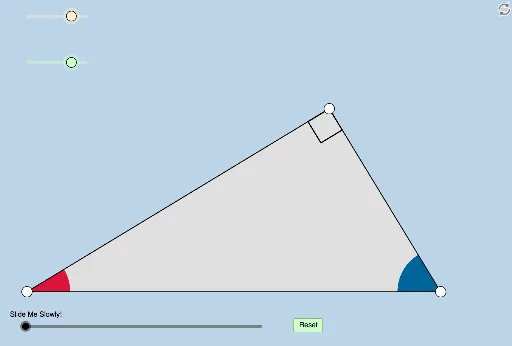
This GeoGebra applet allows students to explore the similarity of right triangles by drawing the altitude to the hypotenuse. Key mathematical concepts include similar triangles, geometric mean, and triangle properties. Using commands like Segment, LineBisector, CircleArc, students can dynamically explore the properties of right triangles. Suitable for middle school and above students learning about geometric transformations and similar triangles.
GeoGebra Commands & Parameters
Segment(A, B) → aLineBisector(a) → s_3Midpoint(a) → C_1Semicircle(A, B) → dIntersect(d, s_3, 1) → J_2CircleArc(C_1, B, J_2) → t_3Point(t_3) → CSegment(C, B) → fSegment(A, C) → eMin(a, f) → mMin(a, e) → lMin(l, m) → nOrthogonalLine(C_1, a) → bCircle(C_1, A) → cOrthogonalLine(C, a) → gIntersect(g, a) → ESegment(C, E) → hAngle(B, E, C) → αAngle(A, C, B) → βPolygon(A, E, C) → poly1, d_1, a_1, e_1Polygon(E, B, C) → poly2, d_2, e_2, b_1Circle(A, (0.2 * n)) → kCircle(C, (0.2 * n)) → pCircle(B, (0.2 * n)) → qIntersect(p, e_1, 1) → FIntersect(a_1, b_1) → GIntersect(a_1, b_1) → HIntersect(p, h, 1) → IIntersect(p, f, 1) → JIntersect(q, a, 1) → KIntersect(q, f, 1) → LIntersect(k, a, 1) → MIntersect(k, e, 1) → NCircleSector(A, M, N) → rDilate(C, If[-2 < i < -1, -1 - i, 0], E) → D'Segment(C, D') → jCircleSector(B, L, K) → tAngle(C, E, A) → γDilate(A, If[-0.5 < i ≤ 0.5, 0.5 - i, 0], C) → A'Vector(A, A') → uTranslate(r, u) → r'CircleArc(A, M, N) → f_1Dilate(B, If[1.5 < i ≤ 2.5, 2.5 - i, 0], C) → B'Vector(B, B') → vTranslate(t, v) → t'CircleArc(B, L, K) → g_1Polygon(A, B, C) → poly3, d_3, a_2, b_2Rotate(r', If[0.5 < i ≤ 1.5, ((-(i - 0.5)) * π / 2), -1.5707963267948966], C) → r''Translate(t, v) → t'_1Rotate(t'_1, If[2.5 < i ≤ 3.5, (((i - 2.5) * 90))°, 90°], C) → sMirror(E, f) → E'Mirror(E, e) → E'_1Dilate(E, If[4 < i ≤ 5, 5 - i, 0], E'_1) → E'_2Segment(C, E'_2) → h_1Segment(E'_2, A) → i_1Polygon(A, C, E'_2) → t1, e'_2, a_3, c_1Segment(A, C) → j_1Angle(A, E'_1, C) → δDilate(E, If[6 < i ≤ 7, 7 - i, 0], E') → E'_3Segment(C, E'_3) → k_1Segment(E'_3, B) → l_1Segment(C, B) → m_1Polygon(B, E'_3, C) → t2, c_2, b_3, e'_3Angle(C, E', B) → εAngle(E, A, C) → ζCentroid(t1) → DCentroid(t2) → OCentroid(poly3) → PRotate(s, If[7 < i ≤ 8, ((-(i - 7)) * (π / 2 - ζ)), ζ - π / 2], C) → s'Rotate(r'', If[8 < i ≤ 9, ((i - 8) * ζ), ζ], C) → r'''Dilate(D, If[10 < i ≤ 11, 11 - i, 0], P) → D'_1Vector(D, D'_1) → wTranslate(A, w) → A'_1Translate(C, w) → C'Translate(E'_2, w) → QPolygon(A'_1, C', Q) → t1', q_1, a'_1, c'Translate(C, w) → C'_1Translate(E'_2, w) → RSegment(C'_1, R) → n_1Translate(E'_2, w) → STranslate(A, w) → A'_2Segment(S, A'_2) → p_1Translate(A, w) → A'_3Translate(C, w) → C'_2Segment(A'_3, C'_2) → r_1Translate(s', w) → s''Rotate(A'_1, If[10 < i ≤ 11, ((-(i - 10)) * ζ), (-ζ)], D'_1) → TRotate(C', If[10 < i ≤ 11, ((-(i - 10)) * ζ), (-ζ)], D'_1) → C''Rotate(Q, If[10 < i ≤ 11, ((-(i - 10)) * ζ), (-ζ)], D'_1) → Q'Polygon(T, C'', Q') → t1'', q', t_1, c''Rotate(C'_1, If[10 < i ≤ 11, ((-(i - 10)) * ζ), (-ζ)], D'_1) → URotate(R, If[10 < i ≤ 11, ((-(i - 10)) * ζ), (-ζ)], D'_1) → R'Segment(U, R') → s_1Rotate(S, If[10 < i ≤ 11, ((-(i - 10)) * ζ), (-ζ)], D'_1) → S'Rotate(A'_2, If[10 < i ≤ 11, ((-(i - 10)) * ζ), (-ζ)], D'_1) → VSegment(S', V) → f_2Rotate(A'_3, If[10 < i ≤ 11, ((-(i - 10)) * ζ), (-ζ)], D'_1) → WRotate(C'_2, If[10 < i ≤ 11, ((-(i - 10)) * ζ), (-ζ)], D'_1) → ZSegment(W, Z) → g_2Rotate(s'', If[10 < i ≤ 11, ((-(i - 10)) * ζ), (-ζ)], D'_1) → s'''Angle(T, S', U) → ηDilate(O, If[11 < i ≤ 12, 12 - i, 0], P) → O'Vector(O, O') → u_1Translate(B, u_1) → B'_1Translate(E'_3, u_1) → A_1Translate(C, u_1) → C'_3Polygon(B'_1, A_1, C'_3) → t2', c'_3, b'_1, a_4Translate(C, u_1) → C'_4Translate(E'_3, u_1) → D_1Segment(C'_4, D_1) → h_2Translate(E'_3, u_1) → E_1Translate(B, u_1) → B'_2Segment(E_1, B'_2) → i_2Translate(C, u_1) → C'_5Translate(B, u_1) → B'_3Segment(C'_5, B'_3) → j_2Translate(r''', u_1) → k_2Rotate(B'_1, If[11 < i ≤ 12, ((i - 11) * (π / 2 - ζ)), π / 2 - ζ], O') → B_1Rotate(A_1, If[11 < i ≤ 12, ((i - 11) * (π / 2 - ζ)), π / 2 - ζ], O') → F_1Rotate(C'_3, If[11 < i ≤ 12, ((i - 11) * (π / 2 - ζ)), π / 2 - ζ], O') → G_1Polygon(B_1, F_1, G_1) → t2'', g_3, b_4, f_3Rotate(C'_4, If[11 < i ≤ 12, ((i - 11) * (π / 2 - ζ)), π / 2 - ζ], O') → H_1Rotate(D_1, If[11 < i ≤ 12, ((i - 11) * (π / 2 - ζ)), π / 2 - ζ], O') → I_1Segment(H_1, I_1) → l_2Rotate(E_1, If[11 < i ≤ 12, ((i - 11) * (π / 2 - ζ)), π / 2 - ζ], O') → J_1Rotate(B'_2, If[11 < i ≤ 12, ((i - 11) * (π / 2 - ζ)), π / 2 - ζ], O') → K_1Segment(J_1, K_1) → m_2Rotate(C'_5, If[11 < i ≤ 12, ((i - 11) * (π / 2 - ζ)), π / 2 - ζ], O') → L_1Rotate(B'_3, If[11 < i ≤ 12, ((i - 11) * (π / 2 - ζ)), π / 2 - ζ], O') → M_1Segment(L_1, M_1) → n_2Rotate(k_2, If[11 < i ≤ 12, ((i - 11) * (π / 2 - ζ)), π / 2 - ζ], O') → p_2Angle(G_1, J_1, B_1) → θDilate(T, If[13 < i ≤ 14, 14 - i, 0], A) → T'Vector(T, T') → v_1Translate(T, v_1) → T'_1Translate(C'', v_1) → C'''Translate(Q', v_1) → Q''Polygon(T'_1, C''', Q'') → t1''', q'', t'_2, c'''Translate(S', v_1) → S''Translate(V, v_1) → V'Segment(S'', V') → q_2Translate(W, v_1) → W'Translate(Z, v_1) → Z'Segment(W', Z') → r_2Translate(U, v_1) → U'Translate(R', v_1) → R''Segment(U', R'') → s_2Translate(s''', v_1) → t_2Angle(Z', R'', V') → ιDilate(G_1, If[13 < i ≤ 14, 14 - i, 0], A) → N_1Vector(G_1, N_1) → w_1Translate(B_1, w_1) → O_1Translate(F_1, w_1) → P_1Translate(G_1, w_1) → Q_1Polygon(O_1, P_1, Q_1) → t2''', q_3, o_1, p_3Translate(p_2, w_1) → c_3Translate(H_1, w_1) → R_1Translate(I_1, w_1) → S_1Segment(R_1, S_1) → h_3Translate(J_1, w_1) → T_1Translate(K_1, w_1) → U_1Segment(T_1, U_1) → i_3Translate(L_1, w_1) → V_1Translate(M_1, w_1) → W_1Segment(V_1, W_1) → j_3Angle(R_1, T_1, O_1) → κDilate(Z', If[15 < i ≤ 16, 16 - i, 0], B) → Z''Vector(Z', Z'') → u_2Translate(T'_1, u_2) → Z_1Translate(C''', u_2) → A_2Translate(Q'', u_2) → Q'''Polygon(Z_1, A_2, Q''') → t3, q''', z_1, a_5Translate(t_2, u_2) → e_3Translate(U', u_2) → U''Translate(R'', u_2) → R'''Segment(U'', R''') → k_3Translate(S'', u_2) → S'''Translate(V', u_2) → V''Segment(S''', V'') → l_3Angle(V'', S''', U'') → λDilate(O_1, If[15 < i ≤ 16, 16 - i, 0], B) → B_2Vector(O_1, B_2) → v_2Translate(O_1, v_2) → C_2Translate(P_1, v_2) → D_2Translate(Q_1, v_2) → E_2Polygon(C_2, D_2, E_2) → t4, e_4, c_4, d_4Translate(c_3, v_2) → r_3Translate(R_1, v_2) → F_2Translate(S_1, v_2) → G_2Segment(F_2, G_2) → m_3Translate(T_1, v_2) → H_2Translate(U_1, v_2) → I_2Segment(H_2, I_2) → n_3Angle(F_2, H_2, B_2) → μ
AI Drawing Prompt Reference
Draw a right triangle with a horizontal hypotenuse and its right-angle vertex above it. Drop a perpendicular from the right-angle vertex to the hypotenuse, dividing it into two segments. Construct a semicircle with the hypotenuse as diameter, placing the right-angle vertex on the semicircle. Draw a perpendicular at the midpoint of the hypotenuse, intersecting the semicircle, and use this to create an arc. Place small circles at the three vertices, and construct sectors at their intersections with triangle sides and the perpendicular. Add a slider to move the right-angle vertex along the arc, while the three small sectors translate or rotate accordingly, illustrating the dynamic similarity of the right triangles.
The prompt above was compiled from the original drawing commands and is for reference only.