
Exploring Properties of Parallelogram Diagonals
Loading the math board and drawing, please wait…
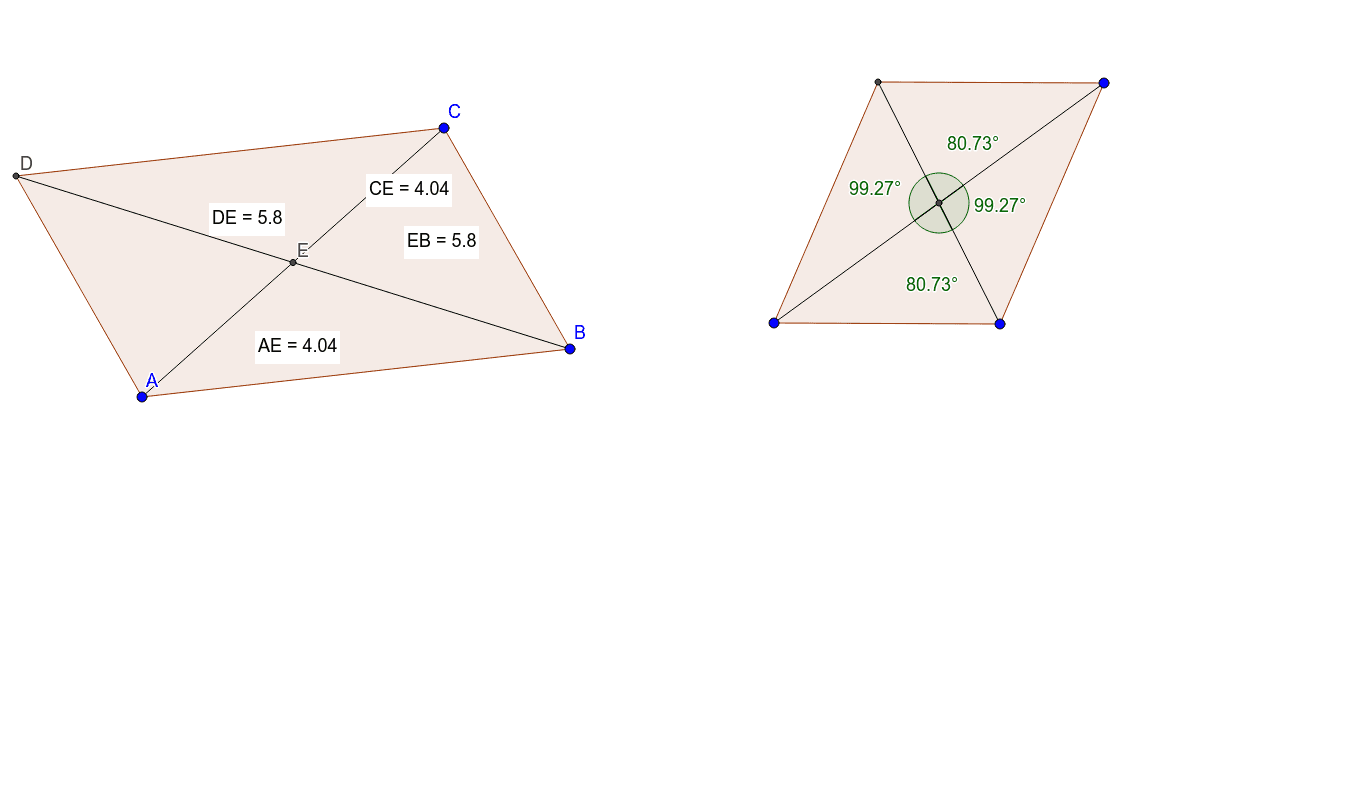
① This GeoGebra example dynamically demonstrates that the diagonals of a parallelogram bisect each other and divide the parallelogram into four triangles of equal area. ② Core mathematical concepts include parallelogram properties, diagonal bisection, congruent triangles, midpoints, and area relationships. ③ Construction highlights: using GeoGebra commands such as Line, Intersect, Polygon, Segment, Distance, and Angle to build the parallelogram and its diagonals, measuring segment lengths (AE, CE, DE, EB) and angles, and displaying distance values via text objects to visually confirm that intersection point E is the midpoint of both diagonals. ④ Suitable for middle school geometry lessons, student self-exploration, or teacher demonstrations to reinforce understanding of parallelogram diagonal properties and dynamic geometry thinking.
GeoGebra Commands & Parameters
Line(A, B) → aLine(B, C) → bLine(C, a) → cLine(A, b) → dIntersect(c, d) → DPolygon(D, C, B, A) → poly1, d_1, c_1, b_1, a_1Segment(D, B) → eSegment(C, A) → fIntersect(e, f) → EDistance(C, E) → distanceCEDistance(D, E) → distanceDEDistance(E, B) → distanceEBDistance(A, E) → distanceAELine(F, G) → gLine(G, H) → hLine(H, g) → iLine(F, h) → jIntersect(i, j) → IPolygon(I, H, G, F) → poly2, i_1, h_1, g_1, f_1Segment(I, G) → kSegment(H, F) → lIntersect(k, l) → JAngle(H, J, I) → αAngle(I, J, F) → βAngle(F, J, G) → γAngle(G, J, H) → δ