
Diagonals of Rectangles
Loading the math board and drawing, please wait…
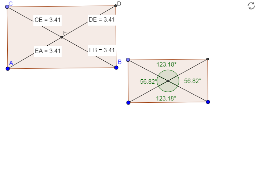
This GeoGebra example dynamically demonstrates the key properties of rectangle diagonals: they are equal in length and bisect each other, while also revealing angle relationships in the triangles formed by the diagonals and sides. Core mathematical concepts include rectangle definition, diagonal properties, congruent triangles, segment midpoints, and angle measurement. Construction details: using GeoGebra commands such as Line, OrthogonalLine, Point, Intersect, Polygon, Segment, Distance, and Angle, the rectangle and its diagonals are constructed, with Distance and Angle tools measuring segment lengths and angles, displayed as text labels. Suitable for middle school geometry instruction, this interactive applet helps students visually verify the equal-length and bisecting properties of rectangle diagonals, and can also be used to explore rotational symmetry.
GeoGebra Commands & Parameters
Line(A, B) → aOrthogonalLine(B, a) → bOrthogonalLine(A, a) → cPoint(c) → COrthogonalLine(C, c) → dIntersect(b, d) → DPolygon(A, B, D, C) → poly1, a_1, b_1, d_1, c_1Segment(C, B) → eSegment(D, A) → fIntersect(e, f) → EDistance(C, E) → distanceCEDistance(E, B) → distanceEBDistance(D, E) → distanceDEDistance(E, A) → distanceEALine(F, G) → gOrthogonalLine(G, g) → hOrthogonalLine(F, g) → iPoint(i) → HOrthogonalLine(H, i) → jIntersect(h, j) → IPolygon(H, I, G, F) → poly2, h_1, i_1, g_1, f_1Segment(H, G) → kSegment(I, F) → lIntersect(k, l) → JAngle(I, J, H) → αAngle(H, J, F) → βAngle(F, J, G) → γAngle(G, J, I) → δ
AI Drawing Prompt Reference
Draw a rectangle and its diagonals. Show the midpoints of the diagonals and prove they bisect each other. Also, display the triangles formed by the diagonals and sides, measuring their interior angles to verify the equal lengths of the diagonals and angle relationships.
The prompt above was compiled from the original drawing commands and is for reference only.