
Exploring Polygon Angle Sums: Triangle to Octagon
Loading the math board and drawing, please wait…
In collections
Congruence (CO) Cluster
Polygons & Angles
Polygons & Angles ( s n attar)
Year 9 Mathematics
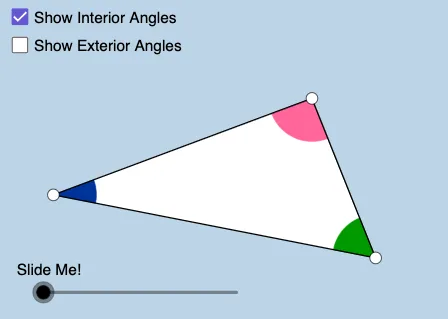
This example dynamically illustrates the sum of interior and exterior angles for polygons ranging from triangles to octagons. It covers core concepts like polygons, angles, rotation, and geometric transformations. Construction involves commands like Segment, Polygon, Circle, Intersect, Rotate, Line, and Vector. Suitable for middle school and above students to visually grasp polygon angle properties and for geometric teaching demonstrations.
GeoGebra Commands & Parameters
Segment(B, C) → eSegment(C, A) → fMin(f, e) → mSegment(A, B) → dMin(d, f) → oMin(m, o) → uPolygon(A, B, C) → poly1, c, a, bRay(A, B) → hRay(B, C) → iRay(C, A) → jCircle(C, (0.25 * u)) → pCircle(A, (0.25 * u)) → qCircle(B, (0.25 * u)) → rIntersect(p, f) → D,Intersect(p, e, 1) → EIntersect(r, e, 1) → FIntersect(r, d, 1) → GIntersect(q, d, 1) → HIntersect(q, f, 1) → IIntersect(r, h, 2) → JIntersect(q, j, 2) → KIntersect(p, i, 2) → LMidpoint(f) → MMidpoint(e) → NCircleSector(A, H, I) → sCircleSector(B, F, G) → tCircleSector(C, D, E) → c_1Angle(A, C, B) → αCircleSector(C, E, D) → d_1CircleSector(A, I, H) → e_1CircleSector(B, G, F) → f_1Min(d, e) → nRotate(s, If[0 < l ≤ 1, ((-l) * 180°), -180°], M) → s'Rotate(A, If[0 < l ≤ 1, ((-l) * 180°), -180°], M) → A'Segment(M, A') → a_1Rotate(H, -180°, M) → H'Line(H', C) → b_1Rotate(B, If[0 < l ≤ 1, (l * 180°), 180°], N) → B'Rotate(t, If[0 < l ≤ 1, (l * 180°), 180°], N) → t'Segment(N, B') → g_1Segment(C, M) → h_1Segment(M, A) → i_1Segment(C, N) → j_1Segment(N, B) → k_1Rotate(A, If[0 < l ≤ 1, (l * 180°), -180°], M) → A'_1Rotate(B, If[0 < l ≤ 1, ((-l) * 180°), -180°], N) → B'_1Segment(N, B'_1) → l_1Segment(M, A'_1) → m_1Rotate(e_1, If[0 < l ≤ 1, (l * 180°), -180°], M) → p_1Rotate(f_1, If[0 < l ≤ 1, ((-l) * 180°), -180°], N) → q_1CircleSector(C, L, D) → r_1CircleSector(A, K, H) → s_1CircleSector(B, J, F) → t_1CircleSector(A, H, K) → c_2CircleSector(B, F, J) → d_2CircleSector(C, D, L) → e_2Dilate(A, 1 - v, C) → A'_2Dilate(B, 1 - v, C) → B'_2Vector(A, A'_2) → wVector(B, B'_2) → u_1Translate(s_1, w) → f_2CircleArc(A, K, H) → g_2Translate(t_1, u_1) → h_2CircleArc(B, J, F) → k_2Translate(c_2, w) → p_2CircleArc(A, H, K) → q_2Translate(d_2, u_1) → r_2CircleArc(B, F, J) → s_2
AI Drawing Prompt Reference
Draw a triangle and extend rays from each vertex to form three sectors. Inside the triangle, draw three small circles and mark the intersection points between the circles and the triangle's sides. Connect these points to form a new polygon. Finally, rotate the sectors around the triangle's center to illustrate the sum of interior angles of the polygon.
The prompt above was compiled from the original drawing commands and is for reference only.