
Exploring Multiplying Fractions: A Visual Geometric Approach
Loading the math board and drawing, please wait…
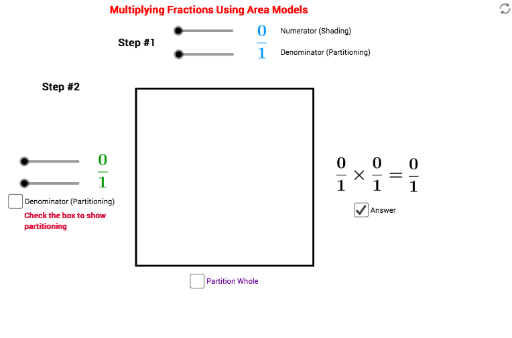
① This GeoGebra example dynamically visualizes the process and result of multiplying fractions, turning abstract arithmetic into tangible geometric area or length relationships. ② Core mathematical concepts include fraction multiplication, ratio, area models, and the connection between geometry and algebra, alongside basic geometric elements such as polygons, sequences, and intersection points. ③ Construction highlights: uses Intersect to create intersection points, Point to define key vertices, Polygon to build polygonal regions, and Sequence to generate ordered lists; objects include cylinders, roots, equilateral triangles, and inequalities, but the focus is on a geometric model for fraction multiplication. ④ Suitable for upper elementary to middle school students to grasp the meaning of fraction multiplication, and also valuable for teachers creating interactive lessons that let learners explore fraction operations through visual manipulation.
GeoGebra Commands & Parameters
Intersect(xAxis, yAxis) → APoint(xAxis) → BPolygon(A, B, 4) → poly1, f, g, h, j, C, DSequence((x(B), y(B) + (i * g / d)), i, 0, d) → pointrightSequence((x(A), y(A) + (i * j / d)), i, 0, d) → pointleftSequence(Segment[Element[pointleft, i], Element[pointright, i]], i, 1, d + 1) → list2Sequence((x(D) + (i * h / b), y(D)), i, 0, b) → pointtopSequence((x(A) + (i * f / b), y(A)), i, 0, b) → pointbottomSequence(Segment[Element[pointtop, i], Element[pointbottom, i]], i, 1, b + 1) → list1Intersect(Element[list1, a + 1], Element[list2, c + 1]) → EPolygon(A, D, Element[pointtop, a + 1], Element[pointbottom, a + 1]) → poly2, a_1, d_1, i, kPolygon(A, Element[pointbottom, a + 1], E, Element[pointleft, c + 1]) → poly3, p, q, r, sIntersect(Element[list1, a + 1], f) → FSequence((x(F), y(F) + (i * g / d)), i, 0, d) → list3Sequence(Segment[Element[pointleft, i], Element[list3, i]], i, 1, d + 1) → list4