
Exploring Interior and Exterior Angles of a Quadrilateral
Loading the math board and drawing, please wait…
In collections
Interior and Exterior Angles of Polygons
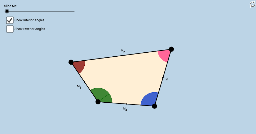
This example demonstrates the geometric properties of the sum of interior and exterior angles in a quadrilateral. It involves core mathematical concepts such as the polygon angle sum theorem, exterior angle theorem, and geometric transformations. The construction utilizes GeoGebra commands and objects like Ray, Point, Circle, Intersect, Segment, Angle, CircleSector, Vector, Translate, Dilate, If, Line, Polygon, Rotate, Mirror, Midpoint, CircleArc. Suitable for middle school and above students to visually understand the angle relationships and transformation characteristics of quadrilaterals.
GeoGebra Commands & Parameters
Ray(P, A) → h_1Point(h_1) → RRay(A, R) → j_1Ray(A, B) → aCircle(A, 1.5) → gIntersect(g, j_1) → I_1,Intersect(g, a, 1) → HSegment(P, A) → l_1Intersect(g, l_1, 1) → H_1Segment(P, C) → k_1Circle(C, 1.5) → kIntersect(k, k_1) → Z,Ray(B, C) → bIntersect(k, b) → M, NPoint(a) → D_1Point(b) → E_1Ray(B, D_1) → eRay(C, E_1) → fPoint(e) → DPoint(f) → EAngle(A, C, B) → γAngle(D, B, C) → εAngle(E, C, A) → ζCircle(B, 1.5) → hIntersect(h, b, 1) → JIntersect(h, a, 1) → KIntersect(h, a, 2) → LCircleSector(B, J, K) → qCircleSector(B, L, J) → tVector(B, C) → uCircleSector(A, I_1, H) → c_1Vector(A, C) → vTranslate(q, u) → q'Segment(B, C) → lDilate(C, If[0 < j ≤ 1, j, 0], B) → C'Vector(B, C') → wTranslate(q, w) → q'_1Dilate(A, If[1 < j ≤ 2, 2 - j, 0], C) → C'_1Vector(A, C'_1) → mDilate(C, If[0 < n ≤ 1, n, 0], B) → C'_2Dilate(A, If[1 < n ≤ 2, 2 - n, 0], C) → A'Vector(B, C'_2) → u_1Vector(A, A') → v_1If(0 < n ≤ 1, Translate[t, u_1], Translate[t, u]) → e_1If(1 < n ≤ 2, Translate[c_1, v_1], Translate[c_1, v]) → f_1Ray(C, P) → g_1Point(g_1) → QRay(P, Q) → i_1Point(i_1) → SPoint(j_1) → TCircle(P, 1.5) → p_1Intersect(p_1, l_1) → U,Intersect(p_1, i_1) → V,Intersect(p_1, k_1) → W,CircleSector(P, U, W) → q_1Intersect(k, b, 2) → A_1Line(P, b) → b_1Intersect(p_1, b_1) → C_1, G_1Angle(B, A, P) → αVector(P, C) → iDilate(P, If[2 < j ≤ 3, 3 - j, 0], C) → P'Vector(P, P') → w_1Translate(q_1, w_1) → r_1CircleSector(C, N, Z) → sCircleSector(P, V, U) → t_1Dilate(P, If[2 < n ≤ 3, 3 - n, 0], C) → P'_1Vector(P, P'_1) → m_1If(2 < n ≤ 3, Translate[t_1, m_1], Translate[t_1, w_1]) → e_2Angle(H, A, I_1) → δAngle(V, P, U) → ηAngle(U, P, W) → θPolygon(A, B, C, P) → poly1, a_2, b_2, c_2, p_2Segment(A, C) → n_1Intersect(g, n_1) → F,Intersect(k, n_1) → G,Line(P, n_1) → cLine(B, n_1) → dCircleSector(C, Z, G) → d_1CircleSector(C, G, M) → s_1CircleSector(A, H, F) → d_2If(0 < j ≤ 1, Dilate[C, 1 - j, B]) → IIf(1 < j ≤ 2, Dilate[A, 2 - j, P]) → OIf(1 < j ≤ 2, Dilate[C, 2 - j, P]) → B_1Vector(C, I) → rVector(A, O) → u_2Translate(s_1, r) → h_2Rotate(d_2, 180°, A) → k_2Vector(A, B) → v_2Vector(C, B) → w_2Translate(s_1, w_2) → s_2Mirror(s_2, B) → t_2Vector(A, P) → i_2Vector(C, P) → j_2CircleSector(A, F, H_1) → f_2Translate(f_2, i_2) → d_3Vector(C, B_1) → l_2Translate(d_1, j_2) → f_3Mirror(f_3, P) → g_3Translate(f_2, u_2) → h_3Translate(d_1, l_2) → k_3Segment(A, B) → m_2Polygon(A, B, C) → poly2, c_4, a_3, b_3Polygon(A, C, P) → poly3, p_4, a_4, c_5Midpoint(m_2) → M_4Midpoint(l) → J_1Midpoint(k_1) → M_2Midpoint(l_1) → M_3Segment(J, C) → n_2Segment(J_1, C) → i_3Rotate(J_1, If[0 < j ≤ 1, (((-j) * 180))°, -180°], J_1) → M_1Rotate(C, If[0 < j ≤ 1, (((-j) * 180))°, -180°], J_1) → C'_3Segment(M_1, C'_3) → j_3Rotate(s_1, If[0 < j ≤ 1, (((-j) * 180))°, -180°], J_1) → r_3Segment(J_1, B) → r_2Rotate(d_2, If[0 < j ≤ 1, ((j * 180))°, 180°], M_4) → pRotate(A, If[0 < j ≤ 1, ((j * 180))°, 180°], M_4) → A'_1Segment(M_4, A'_1) → g_2Rotate(C, If[1 < j ≤ 2, (((j - 1) * 180))°, 180°], M_2) → C'_4Segment(M_2, C'_4) → q_2Rotate(d_1, If[1 < j ≤ 2, (((j - 1) * 180))°, 180°], M_2) → c_3Rotate(A, If[1 < j ≤ 2, (((-(j - 1)) * 180))°, 180°], M_3) → A'_2Segment(M_3, A'_2) → e_3Rotate(f_2, If[1 < j ≤ 2, (((-(j - 1)) * 180))°, 180°], M_3) → p_3CircleArc(C, G, M) → q_3CircleArc(A, H, F) → s_3CircleArc(C, Z, G) → t_3CircleArc(A, F, H_1) → d_4Segment(M_2, C) → l_3Segment(M_2, P) → m_3Segment(P, M_3) → n_3Segment(M_3, A) → b_4Segment(A, M_4) → e_4Segment(M_4, B) → f_4