
Interior and Exterior Angles of a Hexagon
Loading the math board and drawing, please wait…
In collections
Interior and Exterior Angles of Polygons
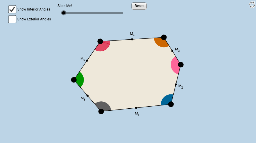
This applet dynamically demonstrates the sum of the interior and exterior angles of a hexagon, focusing on polygon angle properties. Using GeoGebra commands such as Polygon, Vector, and Rotate, students can visually understand these concepts. Suitable for middle school and above students learning geometry.
GeoGebra Commands & Parameters
Circle(C, 1.5) → hRay(C, D) → cIntersect(h, c, 1) → PRay(A, B) → aRay(B, C) → bRay(E, A) → eCircle(A, 1.5) → fCircle(B, 1.5) → gCircle(D, 1.5) → kCircle(E, 1.5) → pSegment(C, A) → iSegment(C, E) → jIntersect(f, a, 1) → FIntersect(f, i, 1) → GIntersect(f, e, 1) → HIntersect(f, e, 2) → IIntersect(p, e) → J,Intersect(p, j) → K,Intersect(k, c, 2) → OIntersect(h, j, 1) → QIntersect(h, i, 1) → RIntersect(h, b, 1) → SIntersect(g, a, 2) → TIntersect(g, b, 1) → UIntersect(g, a, 1) → VCircleSector(A, F, G) → qCircleSector(A, G, H) → rCircleSector(B, U, V) → sCircleSector(C, Q, R) → c_1CircleSector(C, R, S) → d_1Intersect(k, c, 1) → WCircleSector(E, J, K) → h_1CircleSector(A, I, F) → p_1CircleSector(B, T, U) → q_1Intersect(h, b, 2) → ZCircleSector(C, Z, P) → r_1Vector(A, B) → uVector(C, B) → vVector(E, D) → wVector(C, D) → u_1Vector(C, E) → v_1Vector(A, E) → w_1Translate(d_1, v) → s_1Dilate(C, If[1 < l ≤ 2, 2 - l, 0], E) → C'_1Dilate(C, If[2 < l ≤ 3, 3 - l, 0], D) → C'_2Dilate(E, If[2 < l ≤ 3, 3 - l, 0], D) → E'Vector(A, B) → a_1Vector(E, E') → j_1Vector(C, C'_2) → l_1Vector(C, C'_1) → m_1Translate(r, w_1) → r'_2Translate(c_1, v_1) → f_2Translate(c_1, m_1) → g_2Translate(q, a_1) → r'Vector(D, C) → u_2Vector(E, C) → v_2Vector(A, C) → w_2Vector(B, C) → l_2Dilate(B, If[0 < o < 1, 1 - o, 0], C) → B'Dilate(A, If[1 < o < 2, 2 - o, 0], C) → A'_2Dilate(E, If[2 < o < 3, 3 - o, 0], C) → E'_1Dilate(D, If[3 < o < 4, 4 - o, 0], C) → D'Vector(B, B') → m_2Vector(A, A'_2) → n_2Vector(E, E'_1) → s_2Vector(D, D') → t_2Translate(q_1, m_2) → c_3Translate(q_1, l_2) → d_3Translate(p_1, w_2) → e_3If(1 < o < 2, Translate[p_1, n_2]) → h_3Ray(D, A_1) → a_3Ray(A_1, E) → b_3Circle(A_1, 1.5) → q_3Intersect(q_3, b_3, 1) → NIntersect(q_3, a_3, 2) → B_1Intersect(k, c, 2) → C_1Intersect(k, a_3, 1) → D_1Intersect(k, c, 1) → E_1Intersect(p, b_3, 1) → F_1Dilate(C, If[2 < l < 3, 3 - l, 0], A_1) → C'_3Vector(E, A_1) → f_1Vector(C, A_1) → g_1Vector(C, C'_3) → b_2Intersect(q_3, a_3, 1) → I_1CircleSector(D, D_1, E_1) → k_3Vector(C, D) → j_2Vector(A_1, D) → u_3Intersect(p, b_3, 2) → J_1Polygon(A, B, C) → poly1, c_4, a_4, b_4Polygon(A, C, E) → poly2, e_4, a_5, c_5Polygon(E, C, A_1) → poly3, a_6, e_5, c_6Polygon(A_1, C, D) → poly4, d_4, a_7, c_7Polygon(A, B, C, D, A_1, E) → poly5, a_8, b_5, c_8, d_5, a_9, e_6Intersect(e, e_6) → K_1Intersect(p, e, 1) → L_1CircleSector(E, J_1, L_1) → f_4CircleSector(A_1, B_1, N) → g_4CircleSector(D, C_1, D_1) → h_4Vector(E, C) → j_3Vector(A_1, C) → l_3Vector(D, C) → m_3Translate(f_4, j_3) → k_4Translate(g_4, l_3) → p_4Translate(h_4, m_3) → q_4Dilate(E, If[2 < o < 3, 3 - o, 0], C) → E'_3Dilate(A_1, If[3 < o < 4, 4 - o, 0], C) → M_7Dilate(D, If[4 < o < 5, 5 - o, 0], C) → D'_1Vector(E, E'_3) → n_3Vector(A_1, M_7) → u_4Vector(D, D'_1) → v_4If(2 < o < 3, Translate[f_4, n_3]) → r_4If(3 < o < 4, Translate[g_4, u_4]) → s_4If(4 < o < 5, Translate[h_4, v_4]) → t_4Ray(C, A_1) → l_4Ray(C, E) → m_4Point(l_4) → N_1Point(m_4) → O_1Segment(D, C) → n_4Segment(C, B) → f_5Segment(B, A) → g_5Segment(A, E) → h_5Segment(E, A_1) → i_5Segment(A_1, D) → j_5Midpoint(f_5) → M_2Midpoint(g_5) → M_1Rotate(d_1, If[0 < l ≤ 1, (((-l) * 180))°, -180°], M_2) → dRotate(C, If[0 < l ≤ 1, (((-l) * 180))°, -180°], M_2) → C'Segment(M_2, C') → tRotate(q, If[0 < l ≤ 1, ((l * 180))°, 180°], M_1) → q'Rotate(A, If[0 < l ≤ 1, ((l * 180))°, 180°], M_1) → A'Segment(M_1, A') → e_1Rotate(R, 180°, M_2) → R'Line(B, R') → k_1Ray(E, O_1) → i_1Midpoint(h_5) → M_6Rotate(r, If[1 < l ≤ 2, (((-(l - 1)) * 180))°, -180°], M_6) → r'_1Rotate(A, If[1 < l ≤ 2, (((-(l - 1)) * 180))°, -180°], M_6) → A'_1Segment(M_6, A'_1) → n_1CircleSector(E, K, F_1) → c_2Midpoint(i_5) → M_5Rotate(E, If[2 < l ≤ 3, (((-(l - 2)) * 180))°, -180°], M_5) → E'_2Segment(M_5, E'_2) → a_2Rotate(c_2, If[2 < l ≤ 3, (((-(l - 2)) * 180))°, -180°], M_5) → d_2Segment(A_1, C) → e_2Intersect(h, e_2, 1) → U_1CircleSector(C, U_1, Q) → h_2CircleSector(C, P, U_1) → k_2Vector(C, C'_3) → t_1Translate(h_2, t_1) → p_2Intersect(q_3, e_2, 1) → R_1CircleSector(A_1, N, R_1) → q_2CircleSector(A_1, R_1, I_1) → r_2Vector(C, A_1) → i_2Translate(U_1, i_2) → S_1Ray(A_1, S_1) → f_3Midpoint(j_5) → M_4Midpoint(n_4) → M_3Rotate(k_2, If[3 < l ≤ 4, (((l - 3) * 180))°, 180°], M_3) → g_3Rotate(C, If[3 < l ≤ 4, (((l - 3) * 180))°, 180°], M_3) → C'_4Rotate(U_1, 180°, M_3) → W_1Segment(M_3, C'_4) → i_3Rotate(r_2, If[3 < l ≤ 4, (((-(l - 3)) * 180))°, -180°], M_4) → p_3Rotate(A_1, If[3 < l ≤ 4, (((-(l - 3)) * 180))°, -180°], M_4) → Z_1Segment(M_4, Z_1) → r_3Line(D, W_1) → s_3CircleArc(C, R, S) → t_3CircleArc(A, F, G) → k_5CircleArc(C, Q, R) → p_5CircleArc(A, G, H) → q_5CircleArc(C, U_1, Q) → r_5CircleArc(E, K, F_1) → s_5CircleArc(C, P, U_1) → t_5CircleArc(A_1, R_1, I_1) → d_6
AI Drawing Prompt Reference
Draw a hexagon to dynamically demonstrate the sum of its interior and exterior angles. Start by drawing a circle and then a ray from its center. Mark the intersection point on the circle with the ray, and use this point to draw two more rays to form the hexagon. Next, draw small circles centered at each vertex of the hexagon, and find intersection points with the rays on these circles. Connect these points to create sectors representing the interior and exterior angles. Finally, use vector tools to indicate the directions of key sides and color-code the regions for clarity.
The prompt above was compiled from the original drawing commands and is for reference only.