
Exploring Equal Vectors
Loading the math board and drawing, please wait…
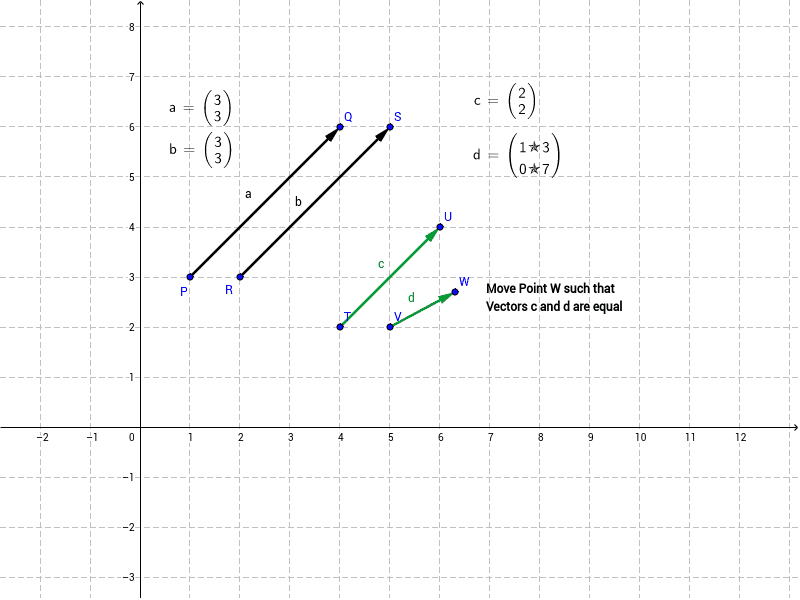
This example demonstrates the geometric meaning of vector equality for students. Key math concepts include vector equality, understanding vector origins, endpoints, and directions. Construction involves commands like Vector and LaTeX for text display (text1, text2, etc.), with parameters (a, b, c, d) and auxiliary objects (T, U, V, W). Suitable for high school vector lessons to visually clarify abstract concepts.
GeoGebra Commands & Parameters
Vector(P, Q) → aLaTeX(a, true, true) → text1Vector(R, S) → bLaTeX(b, true, true) → text2Vector(T, U) → cVector(V, W) → dLaTeX(c, true, true) → text3LaTeX(d, true, true) → text4
AI Drawing Prompt Reference
Draw two parallel vectors starting from different points and label their endpoints to demonstrate the concept of vector equality. Annotate the coordinates of each vector's starting and ending points, and add auxiliary points to assist in the construction. Start by drawing the first vector, then the second, label their coordinates, and finally complete the entire figure using auxiliary points.
The prompt above was compiled from the original drawing commands and is for reference only.