
Exploring Congruence
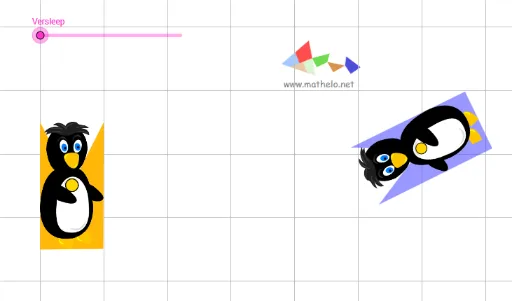
Loading the math board and drawing, please wait…
This example demonstrates how to construct congruent triangles through translation and rotation, involving core mathematical concepts like congruence, vectors, and transformations. Construction highlights include using commands such as Polygon, Vector, Translate, Rotate in GeoGebra to create shapes, and Intersect, Segment for intersection points and line segments. Suitable for middle school and above students to understand geometric transformations and congruence criteria.
GeoGebra Commands & Parameters
Polygon(A_2, C, A, B, E) → veelhoek1, a, b, c, d, eVector(F, G) → uTranslate(A_2, v) → A'Translate(C, v) → B'Translate(A, v) → C'Translate(B, v) → D'Translate(E, v) → E'Polygon(A', B', C', D', E') → veelhoek1', a', b', c', d', e'Vector(A, C') → wVector(B, D') → fVector(E, E') → gVector(A_2, A') → hVector(C, B') → iRotate(C', (-α), C') → C''Rotate(A', (-β), C') → A''_1Rotate(B', (-β), C') → B''_1Rotate(C', (-β), C') → C''_1Rotate(D', (-β), C') → D''_1Rotate(E', (-β), C') → E''_1Polygon(A''_1, B''_1, C''_1, D''_1, E''_1) → veelhoek1''_1, a''_1, b''_1, c''_1, d''_1, e''_1CircleSector(C', B''_1, B') → qCircleSector(C', A''_1, A') → rCircleSector(C', E''_1, E') → sCircleSector(C', D''_1, D') → tCircleArc(C', A''_1, A') → c_1CircleArc(C', E''_1, E') → d_1CircleArc(C', D''_1, D') → e_1CircleArc(C', B''_1, B') → f_1AngularBisector(I, H, J) → jCircleArc(K, L, M) → g_1Point(g_1) → NCircle(N, 0.5) → h_1Intersect(g_1, h_1) → O, P_1, ,Rotate(O, 30°, N) → O'Rotate(O, (-(30°)), N) → O'_1Segment(N, O'_1) → lSegment(N, O') → mBoogmetpijl(C', D''_1, D') → r_1, s_1, t_1Boogmetpijl(C', E''_1, E') → c_2, a_1, b_1Boogmetpijl(C', B''_1, B') → d_2, f_2, g_2Boogmetpijl(C', A''_1, A') → e_2, h_2, i_2Translate(A, u) → PTranslate(A_2, u) → A'_1Translate(C, u) → B'_1Translate(A, u) → C'_2Translate(B, u) → D'_1Translate(E, u) → E'_1Polygon(A'_1, B'_1, C'_2, D'_1, E'_1) → veelhoek1'_1, a'_1, b'_1, c'_2, d'_1, e'_1Rotate(C'_2, α, P) → SRotate(A'_1, (-α), P) → QRotate(B'_1, (-α), P) → RRotate(C'_2, (-α), P) → TRotate(D'_1, (-α), P) → URotate(E'_1, (-α), P) → VPolygon(Q, R, T, U, V) → veelhoek2, q_1, r_2, t_2, u_1, v_1Translate(afbeelding3, h) → afbeelding3'Rotate(afbeelding3', (-β), C') → afbeelding3''Line(E_1, F_1) → k_1Mirror(afbeelding3'', k_1) → afbeelding3'''Mirror(afbeelding2, k_1) → afbeelding2'Mirror(Q, k_1) → Q'Mirror(R, k_1) → R'Mirror(T, k_1) → T'Mirror(U, k_1) → U'Mirror(V, k_1) → V'Polygon(Q', R', T', U', V') → veelhoek2', q', r', t', u', v'Translate(A_2, h) → H_1Rotate(H_1, (-β), C') → I_1Mirror(I_1, k_1) → J_1Mirror(I_1, k_1) → L_1Segment(I_1, Q') → n
AI Drawing Prompt Reference
Draw two congruent triangles through translation and rotation. Start by creating a triangle using the polygon and vector commands, then generate another triangle through translation. Next, use the rotation command to rotate the triangle around a point, creating a series of new triangles. Finally, find specific points using intersection and arc commands, and draw related segments.
The prompt above was compiled from the original drawing commands and is for reference only.