
Exploring Areas of Polygons
Loading the math board and drawing, please wait…
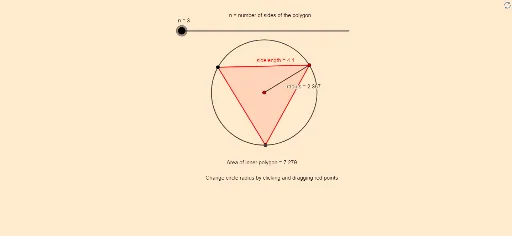
This example demonstrates how to explore the areas of polygons by rotating and constructing them. Key mathematical concepts include the area calculations of polygons, triangles, and quadrilaterals. Using GeoGebra commands such as Circle, Rotate, and Polygon, the shape and size of the polygon can be dynamically changed to observe the area variations. Suitable for middle school and above students or teachers.
GeoGebra Commands & Parameters
Circle(A, B) → cRotate(B, (360 / n)°, A) → B'Polygon(B, B', n) → poly1, sidelength, q, r, s, t, a, b, d, e, f_1, g_1, g, h_1, i_1, j_1, k_1, l_1, m_1, n_1, p_1, q_1, r_1, h, s_1, C, D, E, F, G, H, I, J, K, i, L, M, N, O, P, Q, R, S, T, U, j, V, W, Z, A_1, B_1, C_1, D_1, E_1, F_1, k, l, m, pSegment(A, B) → radiusPointIn(poly1) → Pointpoly1_1Perimeter(poly1) → perimeterpoly1PointIn(poly1) → Pointpoly1Distance(B', B) → distanceB'B
AI Drawing Prompt Reference
Draw a polygon by rotating point B around point A by 360/n degrees to form polygon poly1. Use circle c and points A and B to construct the sides of the polygon and observe the area changes.
The prompt above was compiled from the original drawing commands and is for reference only.