
Exploring AAS (Angle-Angle-Side) Congruence
Loading the math board and drawing, please wait…
In collections
D.G. 4.4 & 4.5: Triangle Congruence Shortcuts
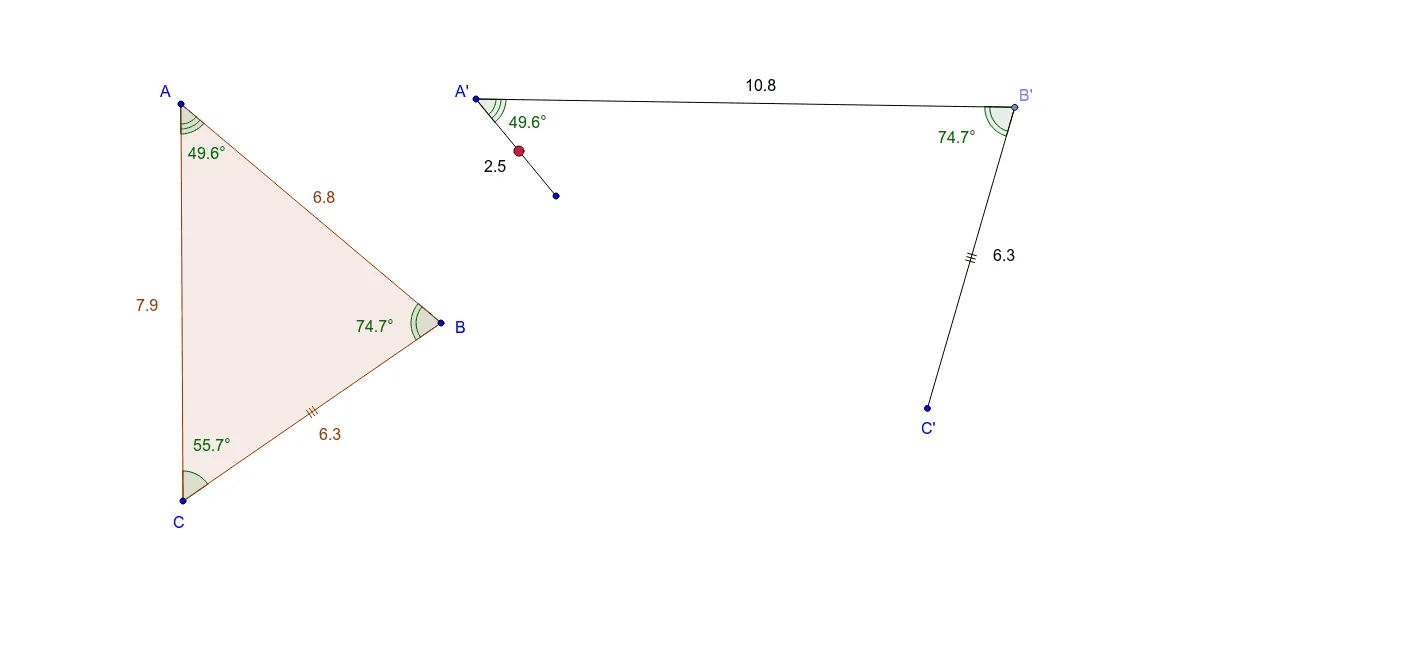
① This applet dynamically demonstrates whether two triangles are necessarily congruent when two angles and a non-included side (the AAS condition) are respectively equal. ② The core mathematical concept is the AAS (Angle-Angle-Side) triangle congruence theorem, involving corresponding angles, corresponding sides, and the construction and verification of congruent triangles. ③ Construction highlights: using GeoGebra commands such as Polygon, Point, Circle, Intersect, Ray, Segment, and Angle, an original triangle is built, then a second triangle is constructed by copying the angles and side length, with dynamic adjustments to observe congruence; objects include A, B, C, poly1, circle c, segments a and b, plus multiple auxiliary points, rays, and angle markers. ④ Suitable for middle school geometry lessons or student self-exploration, this interactive tool helps intuitively understand the sufficiency of the AAS condition and can serve as a classroom demonstration resource.
GeoGebra Commands & Parameters
Polygon(A, B, C) → poly1, c, a, bPoint(b) → EPoint(c) → FCircle(A', Segment[E, A]) → dCircle(A', Segment[F, A]) → ePoint(d) → GCircle(G, Segment[F, E]) → fIntersect(e, f, 1) → HRay(A', G) → gRay(A', H) → hPoint(h) → B'Point(c) → JPoint(a) → KCircle(B', Segment[J, B]) → kCircle(B', Segment[K, B]) → pIntersect(k, h, 1) → LCircle(L, Segment[K, J]) → qIntersect(p, q, 1) → MRay(B', M) → iCircle(B', Segment[C, B]) → rIntersect(r, i, 1) → C'Point(g) → OSegment(A', O) → jSegment(A', B') → lSegment(B', C') → mAngle(C, A, B) → αAngle(A, B, C) → βAngle(O, A', B') → γAngle(A', B', C') → δIntersect(j, m) → DAngle(B', D, A') → εAngle(B, C, A) → ζ
AI Drawing Prompt Reference
Draw a triangle, then construct a second triangle by copying two angles and a non-included side from the first. Start with the original triangle, pick a point on one side, draw a circle centered at another vertex with radius to that point, pick a point on the circle, draw another circle centered at that point with radius between the two points, intersect with the previous circle, and draw a ray from the vertex through the intersection. Place a point on the ray as a new vertex, repeat similar steps using circles and intersections to determine the other vertex, and connect points to form the second triangle. Finally, mark corresponding angle pairs and show the possible intersection of the two triangles to observe whether the angle-angle-side condition ensures congruence.
The prompt above was compiled from the original drawing commands and is for reference only.