
Explore Geometric Theorems with Dragging Points and Slider
Loading the math board and drawing, please wait…
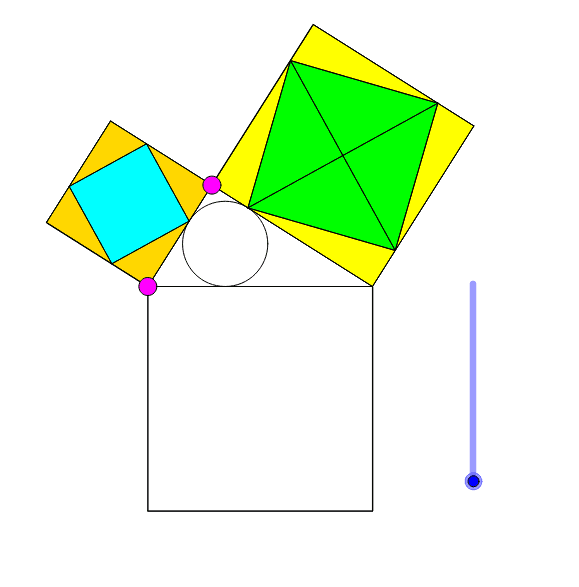
This example demonstrates geometric properties of triangles and incircles by dragging points and a slider. It involves core concepts like triangles, incircles, geometric constructions, and trigonometry. Constructed using commands like Point, CircleArc, Incircle, Midpoint, Segment, OrthogonalLine, Angle, Rotate. Suitable for high school and above students to explore geometric theorems and deepen understanding of geometric constructions.
GeoGebra Commands & Parameters
Point(xAxis) → AIntersect(xAxis, yAxis) → BCircleArc(B, D, A) → cPoint(c) → EPolygon(A, E, 4) → poly1, a, b, d, e, F, GPolygon(E, C, 4) → poly2, f, g, h, i, H, IPolygon(C, A, 4) → poly3, j, k, l, m, J, KIncircle(A, E, C) → pIntersect(p, f) → L, PIntersect(p, a) → M,Intersect(p, j) → N, OMidpoint(F, A) → QMidpoint(E, H) → RMirror(M, Q) → M'Mirror(L, R) → L'Segment(L, L') → nOrthogonalLine(R, n) → qSegment(M', M) → rOrthogonalLine(Q, r) → sIntersect(s, e) → SIntersect(s, b) → TIntersect(q, i) → UIntersect(q, g) → VPolygon(P, V, R) → poly4, r_1, p_1, vPolygon(P, U, R) → poly5, r_2, p_2, uPolygon(U, R, L') → poly6, l', u_1, r_3Polygon(R, V, L') → poly7, l'_1, r_4, v_1Polygon(U, I, L') → poly8, l'_2, u_2, i_1Polygon(U, E, P) → poly9, p_3, u_3, e_1Polygon(L', H, V) → poly10, v_2, l'_3, h_1Polygon(C, V, P) → poly11, p_4, c_1, v_3Polygon(S, M, T, M') → poly12, s_1, m_1, t, m'Polygon(S, A, M) → poly13, m_2, s_2, a_1Polygon(T, E, M) → poly14, m_3, t_1, e_2Polygon(T, M', F) → poly15, f_1, t_2, m'_1Polygon(G, M', S) → poly16, s_3, g_1, m'_2Angle(N, A, M) → αAngle(P, C, N) → βIf(0 ≤ o ≤ 1, 1 - o, If[o > 1, 0, 1]) → d1Dilate(M, d1, K) → M'_1Dilate(S, d1, J) → S'Dilate(M', d1, A) → M''Dilate(T, d1, C) → T'Vector(M, M'_1) → wVector(S, S') → w_1Vector(M', M'') → b_1Vector(T, T') → d_1Translate(S, w) → S'_1Translate(A, w) → A'Translate(M, w) → M'_2Polygon(S'_1, A', M'_2) → poly13', m'_3, s'_1, a'If(0 ≤ o ≤ 1, o - 0, If[o > 1, 1, 0]) → r1Rotate(S'_1, (-((α * r1))), M'_1) → WRotate(A', (-((α * r1))), M'_1) → A''Rotate(M'_2, (-((α * r1))), M'_1) → ZPolygon(W, A'', Z) → poly13'', z_1, w_2, a''Translate(G, w_1) → G'Translate(M', w_1) → M''_1Translate(S, w_1) → S'_2Polygon(G', M''_1, S'_2) → poly16', s'_2, g', m''_1Translate(T, b_1) → T'_1Translate(M', b_1) → M''_2Translate(F, b_1) → F'Polygon(T'_1, M''_2, F') → poly15', f', t'_1, m''_2Translate(T, d_1) → T'_2Translate(E, d_1) → E'Translate(M, d_1) → M'_3Polygon(T'_2, E', M'_3) → poly14', m'_4, t'_2, e'Rotate(G', (-((r1 * α))), S') → G''Rotate(M''_1, (-((r1 * α))), S') → A_1Rotate(S'_2, (-((r1 * α))), S') → B_1Polygon(G'', A_1, B_1) → poly16'', b_2, g'', a_2Rotate(T'_1, (-((r1 * α))), M'') → C_1Rotate(M''_2, (-((r1 * α))), M'') → D_1Rotate(F', (-((r1 * α))), M'') → F''Polygon(C_1, D_1, F'') → poly15'', f'', c_2, d_2Rotate(T'_2, (-((r1 * α))), T') → E_1Rotate(E', (-((r1 * α))), T') → E''Rotate(M'_3, (-((r1 * α))), T') → F_1Polygon(E_1, E'', F_1) → poly14'', f_2, e_3, e''If(1 ≤ o ≤ 2, 2 - o, If[o > 2, 0, 1]) → d2Dilate(E, d2, G'') → E'_1Dilate(C, d2, A'') → C'Dilate(H, d2, E'') → H'Dilate(I, d2, N) → I'Vector(E, E'_1) → j_1Vector(I, I') → k_1Vector(H, H') → l_1Vector(C, C') → n_1Translate(U, j_1) → U'Translate(E, j_1) → E'_2Translate(P, j_1) → P'Polygon(U', E'_2, P') → poly9', p', u', e'_2If(1 ≤ o ≤ 2, o - 1, If[o > 2, 1, 0]) → r2Rotate(U', (r2 * β), E'_1) → U''Rotate(E'_2, (r2 * β), E'_1) → G_1Rotate(P', (r2 * β), E'_1) → P''Polygon(U'', G_1, P'') → poly9'', p'', u'', g_2Translate(U, k_1) → U'_1Translate(I, k_1) → I'_1Translate(L', k_1) → L''Polygon(U'_1, I'_1, L'') → poly8', l'', u'_1, i'_1Rotate(U'_1, (r2 * β), I') → H_1Rotate(I'_1, (r2 * β), I') → I_1Rotate(L'', (r2 * β), I') → L'''Polygon(H_1, I_1, L''') → poly8'', l''', h_2, i_2Translate(L', l_1) → L''_1Translate(H, l_1) → H'_1Translate(V, l_1) → V'Polygon(L''_1, H'_1, V') → poly10', v', l''_1, h'_1Rotate(L''_1, (r2 * β), H') → J_1Rotate(H'_1, (r2 * β), H') → K_1Rotate(V', (r2 * β), H') → V''Polygon(J_1, K_1, V'') → poly10'', v'', j_2, k_2Translate(C, n_1) → C'_1Translate(V, n_1) → V'_1Translate(P, n_1) → P'_1Polygon(C'_1, V'_1, P'_1) → poly11', p'_1, c'_1, v'_1Rotate(C'_1, (r2 * β), C') → L_1Rotate(V'_1, (r2 * β), C') → M_1Rotate(P'_1, (r2 * β), C') → N_1Polygon(L_1, M_1, N_1) → poly11'', n_2, l_2, m_4If(2 ≤ o ≤ 3, 3 - o, If[o > 3, 0, 1]) → d3Dilate(P, d3, A_1) → P'_2Dilate(V, d3, W) → V'_2Vector(P, P'_2) → q_1Translate(P, q_1) → P'_3Translate(U, q_1) → U'_2Translate(R, q_1) → R'Polygon(P'_3, U'_2, R') → poly5', r', p'_3, u'_2If(2 ≤ o ≤ 3, o - 2, If[o > 3, 1, 0]) → r3Rotate(P'_3, (r3 * β), P'_2) → O_1Rotate(U'_2, (r3 * β), P'_2) → P_1Rotate(R', (r3 * β), P'_2) → R''Polygon(O_1, P_1, R'') → poly5'', r'', o_1, p_5Vector(V, V'_2) → q_2Translate(P, q_2) → P'_4Translate(V, q_2) → V'_3Translate(R, q_2) → R'_1Polygon(P'_4, V'_3, R'_1) → poly4', r'_1, p'_4, v'_3Rotate(P'_4, (r3 * β), V'_2) → Q_1Rotate(V'_3, (r3 * β), V'_2) → R_1Rotate(R'_1, (r3 * β), V'_2) → S_1Polygon(Q_1, R_1, S_1) → poly4'', s_4, q_3, r_5Dilate(L', d3, F_1) → L''_2Vector(L', L''_2) → w_3Translate(R, w_3) → R'_2Translate(V, w_3) → V'_4Translate(L', w_3) → L''_3Polygon(R'_2, V'_4, L''_3) → poly7', l''_3, r'_2, v'_4Rotate(R'_2, (r3 * β), L''_2) → T_1Rotate(V'_4, (r3 * β), L''_2) → U_1Rotate(L''_3, (r3 * β), L''_2) → V_1Polygon(T_1, U_1, V_1) → poly7'', v_4, t_3, u_4Dilate(U, d3, C_1) → U'_3Vector(U, U'_3) → a_3Translate(U, a_3) → U'_4Translate(R, a_3) → R'_3Translate(L', a_3) → L''_4Polygon(U'_4, R'_3, L''_4) → poly6', l''_4, u'_4, r'_3Rotate(U'_4, (r3 * β), U'_3) → W_1Rotate(R'_3, (r3 * β), U'_3) → Z_1Rotate(L''_4, (r3 * β), U'_3) → A_2Polygon(W_1, Z_1, A_2) → poly6'', a_4, w_4, z_2If(3 ≤ o ≤ 4, 4 - o, If[o > 4, 0, 1]) → d4If(3 ≤ o ≤ 4, o - 3, If[o > 4, 1, 0]) → r4Dilate(S, d4, T_1) → S'_3Vector(S, S'_3) → b_3Translate(S, b_3) → S'_4Translate(M, b_3) → M'_4Translate(T, b_3) → T'_3Translate(M', b_3) → M''_3Polygon(S'_4, M'_4, T'_3, M''_3) → poly12', s'_4, m'_5, t'_3, m''_3Rotate(S'_4, (r4 * β), S'_3) → B_2Rotate(M'_4, (r4 * β), S'_3) → C_2Rotate(T'_3, (r4 * β), S'_3) → D_2Rotate(M''_3, (r4 * β), S'_3) → E_2Polygon(B_2, C_2, D_2, E_2) → poly12'', b_4, c_3, d_3, e_4
AI Drawing Prompt Reference
Draw a triangle ABC and explore the properties of its incircle by dragging points and using a slider. Start by creating point A on the x-axis, then point B at the origin, and draw an arc centered at B intersecting the x-axis at D. Create point E and use points E, C, and A to form a polygon. Construct the incircle p of triangle ABC and find its intersections with the polygon's sides at points L, M, N, and O. Use midpoint and reflection operations to create a series of polygons and segments, forming a complex geometric figure to explore the relationship between the triangle and its incircle.
The prompt above was compiled from the original drawing commands and is for reference only.