
Exploration of Symmetry of Reference Angles
Loading the math board and drawing, please wait…
In collections
What is a Radian Anyway?
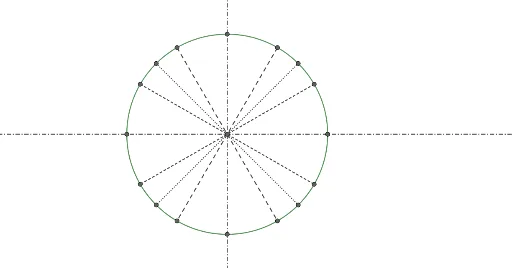
This example demonstrates the symmetry of reference angles. It involves trigonometric functions and geometric transformations. Using GeoGebra commands such as Intersect, Rotate, and Segment, a series of symmetric reference angles can be constructed. Suitable for high school mathematics education, particularly in trigonometry and geometric transformations.
GeoGebra Commands & Parameters
Intersect(xAxis, yAxis) → AIntersect(c, xAxis, 2) → BIntersect(c, yAxis, 2) → CIntersect(c, yAxis, 1) → ERotate(B, 10°, A) → B'Rotate(B', 10°, A) → B''Rotate(B'', 10°, A) → B'''Rotate(B''', 10°, A) → FRotate(F, 10°, A) → F'Rotate(F', 10°, A) → F''Rotate(F'', 10°, A) → F'''Rotate(F''', 10°, A) → GRotate(C, 10°, A) → C'Rotate(C', 10°, A) → C''Rotate(C'', 10°, A) → C'''Rotate(C''', 10°, A) → HRotate(H, 10°, A) → H'Rotate(H', 10°, A) → H''Intersect(c, xAxis, 2) → DRotate(D, 10°, A) → D'Rotate(D', 10°, A) → D''Rotate(D'', 10°, A) → D'''Rotate(D''', 10°, A) → JRotate(J, 10°, A) → J'Rotate(J', 10°, A) → J''Rotate(J'', 10°, A) → J'''Rotate(J''', 10°, A) → KRotate(K, 100°, A) → K'Rotate(H'', 10°, A) → H'''Rotate(H''', 10°, A) → IRotate(K, 20°, A) → K'_1Rotate(K'_1, 10°, A) → LRotate(L, 10°, A) → L'Rotate(L', 10°, A) → L''Rotate(L'', 10°, A) → L'''Rotate(L''', 10°, A) → MRotate(M, 10°, A) → M'Rotate(M', 10°, A) → M''Rotate(B, 45°, A) → B'_1Rotate(C, 45°, A) → C'_1Rotate(D, 45°, A) → D'_1Rotate(E, 45°, A) → E'Segment(B''', D''') → fSegment(B'_1, D'_1) → gSegment(F'', J'') → hSegment(H'', M) → iSegment(C'_1, E') → jSegment(C''', L') → kLine(D, B) → lLine(C, E) → m