
Evaluating Unknowns in Linear Equations in Two Variables and Graphing the Equati
Loading the math board and drawing, please wait…
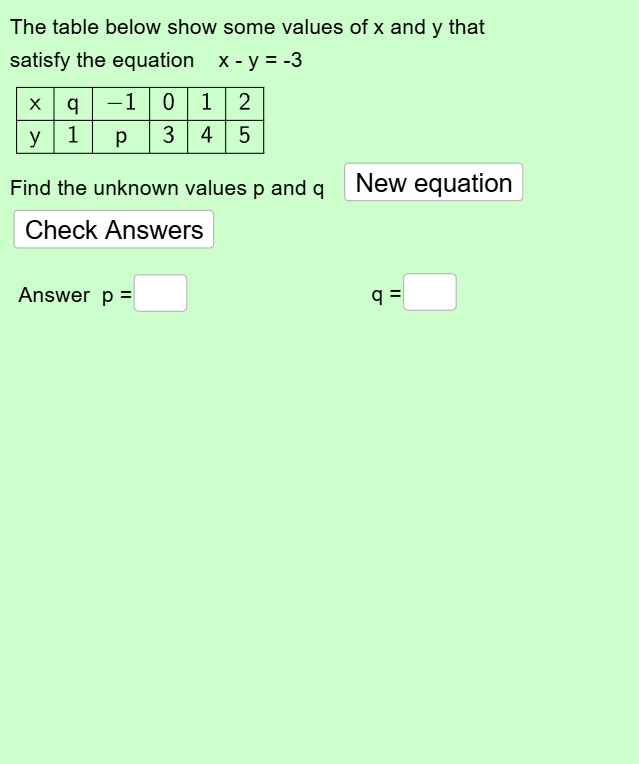
① This interactive GeoGebra activity demonstrates how to solve for unknowns in linear equations with two variables and simultaneously graphs the corresponding lines, helping students visualize the connection between algebraic solutions and geometric representations. ② Core mathematical concepts include linear equations in two variables, linear functions, slope and intercept, graphing lines on the coordinate plane, and solving for unknowns via substitution or elimination. ③ Construction highlights: The activity uses an InputBox for user answers, with commands such as TextToUnicode, Length, If, Sum, RandomElement, Simplify, Sequence, Sort, Join, Remove, Insert, Element, GCD, TableText, Textfield, CoordPointertoAxes6, IndexOf, Point, Vector, Min, and Max to parse input, generate random problems, create tables, and plot points and lines. ④ Suitable for middle school to high school students as an individual lesson review or classroom practice, and for teachers to demonstrate the integration of solving and graphing linear equations.
GeoGebra Commands & Parameters
TextToUnicode(usertxtanswerq) → listdigitsqLength(listdigitsq) → lengthlistdigitsqIf(Element[listdigitsq, 1] ≟ 45, 2, 1) → startindexqSum((If[Element[listdigitsq, 1] ≟ 45, -1, 1] * Sequence[((Element[listdigitsq, i] - 48) * 10^(lengthlistdigitsq - i)), i, startindexq, lengthlistdigitsq])) → useranswerqnumTextToUnicode(usertxtanswerp) → listdigitspIf(Element[listdigitsp, 1] ≟ 45, 2, 1) → startindexpLength(listdigitsp) → lengthlistdigitspSum((If[Element[listdigitsp, 1] ≟ 45, -1, 1] * Sequence[((Element[listdigitsp, i] - 48) * 10^(lengthlistdigitsp - i)), i, startindexp, lengthlistdigitsp])) → useranswerpnumRandomElement({-1, 1, 2, -2, -3, 3, 4, -4, -1, 1, -2, 2, 5, -5, -1, 1}) → a_1RandomElement({0, -1, 1, 2, -2, -3, 3, 0, -1, 1, -2, 2, 4, -4, 0, -1, 1, -2, 2, 5, -5, 0, -1, 1, -2, 2}) → n_3RandomElement({-1, 0, 1, 2, -2, 0, -3, 3}) → x_gRandomElement({-1, 1, 2, -2, -3, 3, 4, -4, -1, 1, -2, 2, 5, -5, -1, 1}) → b_1Simplify(If[-10 ≤ x ≤ 10, ((-(x(e_n) / y(e_n))) * x) - z(e_n) / y(e_n)]) → fSequence(abs(f(0) - (a_1 / b_1 * i) - round(f(0) - (a_1 / b_1 * i), 0)), i, 0, abs(b_1 - 1)) → listsearch1stinteger, {0, 0, 0}Sort(Sequence[xInty + (b_1 * i), i, -2, 2, 1]) → listxnoRandomElement({1, 2, 3, 4}) → shiftpostyJoin({{x}, listxno}) → listxRandomElement(Remove[{1, 2, 3, 4}, {shiftposty}]) → shiftpostxRemove(listx, {Element[listx, shiftpostx + 1]}) → listprexJoin({{y}, (m * listxno) + d}) → listyRemove(listy, {Element[listy, shiftposty + 1]}) → listpreyInsert("p", listprey, shiftposty + 1) → listypostElement(listy, shiftposty + 1) → answerpElement(listx, shiftposty + 1) → x_pGCD({a_1, b_1, c_1}) → c_gInsert("q", listprex, shiftpostx + 1) → listxpostTableText({listxpost, listypost}, "c_|h") → txtTableValuesElement(listy, shiftpostx + 1) → y_qTextfield(usertxtanswerp) → InputBox1Textfield(usertxtanswerq) → InputBox2If(useranswerpnum ≟ Element[listy, shiftposty + 1], true, false) → answerpcorrectIf(useranswerqnum ≟ Element[listx, shiftpostx + 1], true, false) → answerqcorrectElement(listx, shiftpostx + 1) → answerqCoordPointertoAxes6(P) → A, B, text2, text3, text4, text5, text6, u, vCoordPointertoAxes6(Q) → C, D, text7, text8, text9, text10, text11, w, aIndexOf("p", listypost) → indexofpIndexOf("q", listxpost) → indexofqSequence((Element[listxno, i], Element[listyno, i]), i, 1, 5) → listallpointsPoint(Circle[P_{useranswerq}, x(P_{useranswerq})]) → E_oVector(P_{useranswerq}, (x(P_{useranswerq}), 0)) → gVector(P_{useranswerp}, (0, y(P_{useranswerp}))) → bMin(Min[listxno] - ((Max[listxno] - Min[listxno]) * 0.2), Min[-2, If[Defined[useranswerqnum], useranswerqnum - 1, 0]]) → xMinMax(Max[listxno] + ((Max[listxno] - Min[listxno]) * 0.1), Max[2, If[Defined[useranswerqnum], useranswerqnum - 1, 0]]) → xMaxMax(Max[listyno] + ((Max[listyno] - Min[listyno]) * 0.1), Max[2, If[Defined[useranswerpnum], useranswerpnum + 1, 0]]) → yMaxMin(Min[listyno] - ((Max[listyno] - Min[listyno]) * 0.1), Min[-2, If[Defined[useranswerpnum], useranswerpnum - 1, 0]]) → yMinPoint(e_n) → EVector(E, (x(E), 0)) → cVector(E, (0, y(E))) → e