
Eratosthenes' Measurement of Earth's Circumference
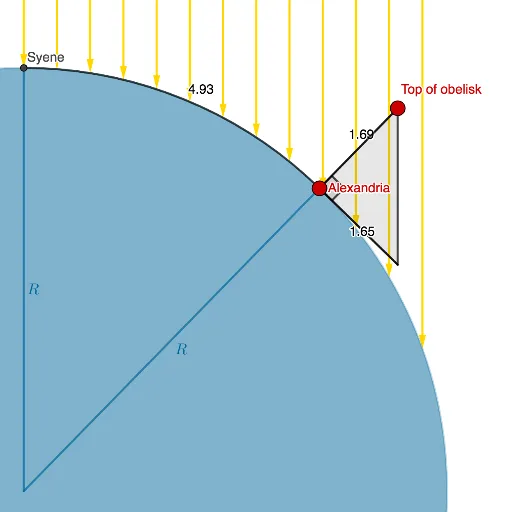
Loading the math board and drawing, please wait…
This example demonstrates how the ancient Greek scholar Eratosthenes estimated the Earth's circumference by measuring the angle of the sun's rays at two different locations. Key mathematical concepts include trigonometric functions and angle measurement. Using GeoGebra commands such as Circle, Point, Ray, Angle, etc., the geometric model of Eratosthenes' experiment can be constructed. Suitable for high school mathematics education and applications in geography, such as scale ratios.
GeoGebra Commands & Parameters
Circle((0, 0), r) → cPoint(c) → BRay(O, B) → fPoint(f) → CRay(B, C) → gPoint(g) → TOrthogonalLine(B, f) → hOrthogonalLine(T, xAxis) → iIntersect(h, i) → DAngle(D, B, T) → αCircleArc(O, B, A) → dPolygon(B, D, T) → t1, t, b, d_1Sequence(Ray[(i, 10), (i, 0)], i, -6, 6, 0.5) → L_1Sequence(Intersect[c, Element[L_1, i]], i, 1, Length[L_1]) → L_2Sequence(Vector[(i, 10), Element[L_2, (2 * i) + 13]], i, -6, 6, 0.5) → L_3Segment(O, B) → jSegment(O, A) → kMidpoint(B, O) → EMidpoint(A, O) → FSegment(B, T) → lSegment(B, D) → m