
Equivalent Fractions with Denominators 200 & 300
Loading the math board and drawing, please wait…
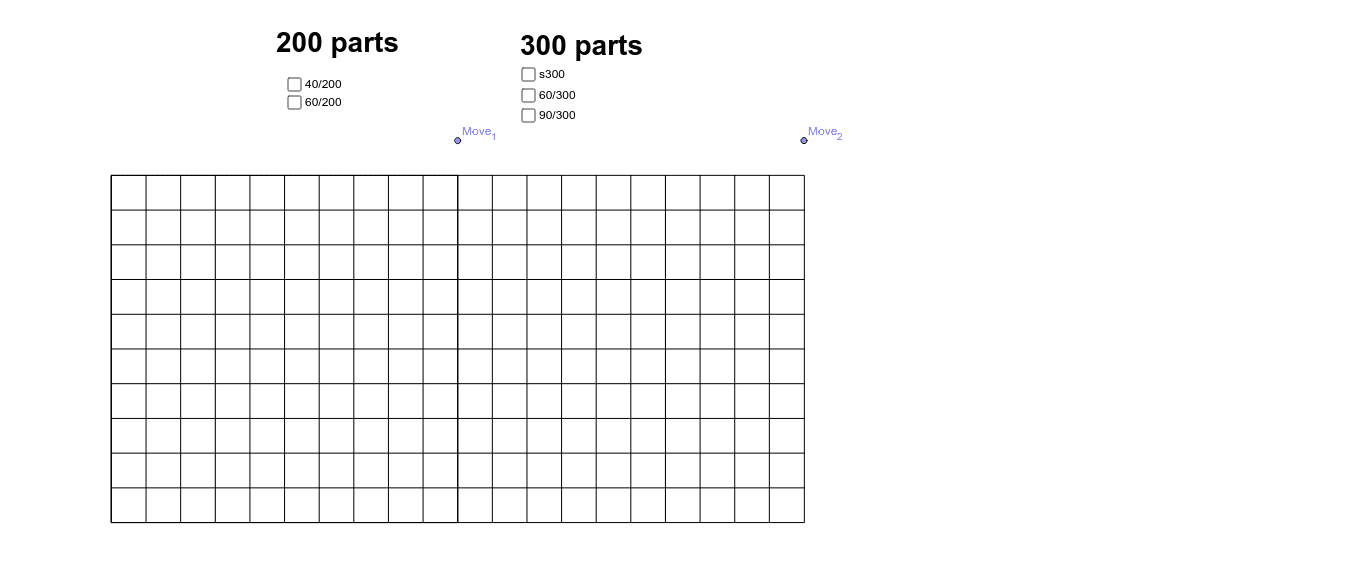
This GeoGebra applet visually demonstrates the relationship between equivalent fractions, specifically showing that 20/100, 40/200, and 60/300 are equal, as well as 30/100, 60/200, and 90/300. The core mathematical concept is fraction equivalence, where multiplying the numerator and denominator by the same factor preserves the value. The construction uses polygons to create area models, with commands such as Intersect, Point, Polygon, Midpoint, Segment, OrthogonalLine, and Mirror to divide and transform regions. It is suitable for upper elementary and middle school students learning fractions, and serves as an interactive teaching tool for teachers to illustrate the geometric meaning of equivalent fractions.
GeoGebra Commands & Parameters
Intersect(xAxis, yAxis) → APoint(xAxis) → BPolygon(A, B, 4) → poly1, a, b, c, d, C, DMidpoint(D, C) → EMidpoint(C, B) → FMidpoint(A, B) → GMidpoint(D, A) → HPoint(c) → IPoint(c) → JPoint(c) → KPoint(c) → LPoint(c) → MPoint(c) → NPoint(c) → OPoint(c) → PPoint(d) → QPoint(d) → RPoint(d) → SPoint(d) → TPoint(d) → UPoint(d) → VPoint(d) → WPoint(d) → ZPoint(b) → A_1Point(b) → B_1Point(b) → C_1Point(b) → D_1Point(b) → E_1Point(b) → F_1Point(b) → G_1Point(b) → H_1Point(a) → I_1Point(a) → J_1Point(a) → K_1Point(a) → L_1Point(a) → M_1Point(a) → N_1Point(a) → O_1Point(a) → P_1Segment(I, P_1) → eSegment(J, O_1) → fSegment(K, N_1) → gSegment(L, M_1) → hSegment(E, G) → iSegment(M, L_1) → jSegment(N, K_1) → kSegment(O, J_1) → lSegment(P, I_1) → mSegment(Q, A_1) → nSegment(R, B_1) → pSegment(S, C_1) → qSegment(T, D_1) → rSegment(H, F) → sSegment(U, E_1) → tSegment(V, F_1) → a_1Segment(W, G_1) → b_1Segment(Z, H_1) → c_1Point(yAxis) → Q_1Point(yAxis) → R_1Segment(Q_1, R_1) → d_1OrthogonalLine(R_1, d_1) → e_1Point(e_1) → Move_1OrthogonalLine(Move_1, e_1) → f_1Mirror(poly1, f_1) → poly2Mirror(I, f_1) → I'Mirror(P_1, f_1) → T_1Segment(I', T_1) → e'Mirror(J, f_1) → J'Mirror(O_1, f_1) → U_1Segment(J', U_1) → f'Mirror(K, f_1) → K'Mirror(N_1, f_1) → V_1Segment(K', V_1) → g'Mirror(L, f_1) → L'Mirror(M_1, f_1) → W_1Segment(L', W_1) → h'Mirror(E, f_1) → E'Mirror(G, f_1) → G'Segment(E', G') → i'Mirror(M, f_1) → M'Mirror(L_1, f_1) → Z_1Segment(M', Z_1) → j'Mirror(N, f_1) → N'Mirror(K_1, f_1) → A_2Segment(N', A_2) → k'Mirror(O, f_1) → O'Mirror(J_1, f_1) → B_2Segment(O', B_2) → l'Mirror(P, f_1) → P'Mirror(I_1, f_1) → C_2Segment(P', C_2) → m'Mirror(Q, f_1) → Q'Mirror(A_1, f_1) → D_2Segment(Q', D_2) → n'Mirror(R, f_1) → R'Mirror(B_1, f_1) → E_2Segment(R', E_2) → p'Mirror(S, f_1) → S'Mirror(C_1, f_1) → F_2Segment(S', F_2) → q'Mirror(T, f_1) → T'Mirror(D_1, f_1) → G_2Segment(T', G_2) → r'Mirror(H, f_1) → H'Mirror(F, f_1) → F'Segment(H', F') → s'Mirror(U, f_1) → U'Mirror(E_1, f_1) → H_2Segment(U', H_2) → t'Mirror(V, f_1) → V'Mirror(F_1, f_1) → I_2Segment(V', I_2) → g_1Mirror(W, f_1) → W'Mirror(G_1, f_1) → J_2Segment(W', J_2) → h_1Mirror(Z, f_1) → Z'Mirror(H_1, f_1) → K_2Segment(Z', K_2) → i_1Point(e_1) → Move_2OrthogonalLine(Move_2, d_1) → j_1OrthogonalLine(Move_2, e_1) → k_1Mirror(poly2, k_1) → poly3Mirror(I', k_1) → I''Mirror(T_1, k_1) → M_2Segment(I'', M_2) → e''Mirror(J', k_1) → J''Mirror(U_1, k_1) → N_2Segment(J'', N_2) → f''Mirror(K', k_1) → K''Mirror(V_1, k_1) → O_2Segment(K'', O_2) → g''Mirror(L', k_1) → L''Mirror(W_1, k_1) → P_2Segment(L'', P_2) → h''Mirror(E', k_1) → E''Mirror(G', k_1) → G''Segment(E'', G'') → i''Mirror(M', k_1) → M''Mirror(Z_1, k_1) → Q_2Segment(M'', Q_2) → j''Mirror(N', k_1) → N''Mirror(A_2, k_1) → R_2Segment(N'', R_2) → k''Mirror(O', k_1) → O''Mirror(B_2, k_1) → S_2Segment(O'', S_2) → l''Mirror(P', k_1) → P''Mirror(C_2, k_1) → T_2Segment(P'', T_2) → m''Mirror(Q', k_1) → Q''Mirror(D_2, k_1) → U_2Segment(Q'', U_2) → n''Mirror(R', k_1) → R''Mirror(E_2, k_1) → V_2Segment(R'', V_2) → p''Mirror(S', k_1) → S''Mirror(F_2, k_1) → W_2Segment(S'', W_2) → q''Mirror(T', k_1) → T''Mirror(G_2, k_1) → Z_2Segment(T'', Z_2) → r''Mirror(H', k_1) → H''Mirror(F', k_1) → F''Segment(H'', F'') → s''Mirror(U', k_1) → U''Mirror(H_2, k_1) → A_3Segment(U'', A_3) → t''Mirror(V', k_1) → V''Mirror(I_2, k_1) → B_3Segment(V'', B_3) → l_1Mirror(W', k_1) → W''Mirror(J_2, k_1) → C_3Segment(W'', C_3) → m_1Mirror(Z', k_1) → Z''Mirror(K_2, k_1) → D_3Segment(Z'', D_3) → n_1Polygon(S_1, E_3, F_3, G_3) → s60, s_1, e_3, f_3, g_3Mirror(S_1, f_1) → H_3Mirror(E_3, f_1) → I_3Mirror(F_3, f_1) → J_3Mirror(G_3, f_1) → K_3Polygon(H_3, I_3, J_3, K_3) → s60', h_3, i_3, j_3, k_3Mirror(H_3, k_1) → L_3Mirror(I_3, k_1) → M_3Mirror(J_3, k_1) → N_3Mirror(K_3, k_1) → O_3Polygon(L_3, M_3, N_3, O_3) → s60'', l_3, m_3, n_3, o_3Polygon(P_3, Q_3, R_3, S_3) → poly4, p_3, q_3, r_3, s_3Mirror(P_3, f_1) → T_3Mirror(Q_3, f_1) → U_3Mirror(R_3, f_1) → V_3Mirror(S_3, f_1) → W_3Polygon(T_3, U_3, V_3, W_3) → poly4', t_3, u_3, v_3, w_3Polygon(Z_3, A_4, B_4, C_4) → poly5, z_3, a_4, b_4, c_4Mirror(Z_3, f_1) → D_4Mirror(A_4, f_1) → E_4Mirror(B_4, f_1) → F_4Mirror(C_4, f_1) → G_4Polygon(D_4, E_4, F_4, G_4) → poly5', d_4, e_4, f_4, g_4Polygon(H_4, I_4, J_4, K_4) → poly6, h_4, i_4, j_4, k_4Mirror(H_4, f_1) → L_4Mirror(I_4, f_1) → M_4Mirror(J_4, f_1) → N_4Mirror(K_4, f_1) → O_4Polygon(L_4, M_4, N_4, O_4) → poly6', l_4, m_4, n_4, o_4Mirror(L_4, k_1) → P_4Mirror(M_4, k_1) → Q_4Mirror(N_4, k_1) → R_4Mirror(O_4, k_1) → S_4Polygon(P_4, Q_4, R_4, S_4) → poly6'', p_4, q_4, r_4, s_4
AI Drawing Prompt Reference
Draw a square with one vertex at the origin and its base along the x-axis. Divide the top and bottom edges into equal segments, and similarly divide the left and right edges. Connect corresponding division points with straight lines to form a grid. Add midlines horizontally and vertically, plus segments connecting midpoints of opposite sides, creating a symmetric partition. This area model visually represents equivalent fractions by showing proportional subdivisions under different denominators.
The prompt above was compiled from the original drawing commands and is for reference only.