
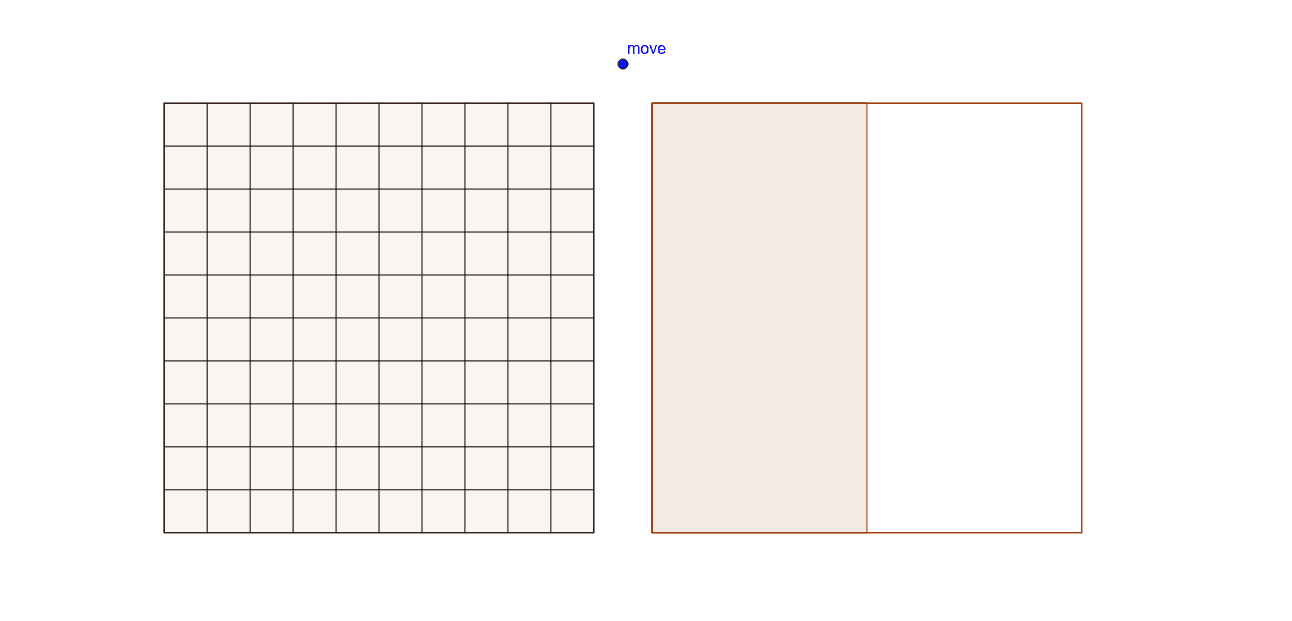
Equivalent Fractions & Percentage Template (1/2 = 50/100 = 50%)
Loading the math board and drawing, please wait…
① This template visually demonstrates the equivalence between fractions and percentages, such as 1/2 being equal to 50/100 or 50%. ② Core mathematical concepts include equivalent fractions, meaning of percentages, and conversion between fractions and percentages, fostering proportional reasoning and number sense. ③ Construction highlights: Based on the construction summary, GeoGebra commands such as Intersect, Point, Polygon, Midpoint, Segment, Line, OrthogonalLine, and Mirror are used to create a diagram with multiple points, segments, and polygons, likely partitioning a rectangle or bar to show part-whole relationships. ④ Suitable for upper elementary to middle school students learning fractions and percentages, and useful for classroom demonstrations or student exploration to build intuitive mathematical connections.
GeoGebra Commands & Parameters
Intersect(xAxis, yAxis) → APoint(xAxis) → BPolygon(A, B, 4) → poly1, a, b, c, d, C, DMidpoint(D, C) → EMidpoint(C, B) → FMidpoint(B, A) → GMidpoint(A, D) → HSegment(E, G) → eSegment(H, F) → fPoint(c) → IPoint(a) → JSegment(I, J) → gPoint(c) → KSegment(K, L) → hPoint(c) → MPoint(a) → NSegment(M, N) → iPoint(c) → OPoint(a) → PSegment(O, P) → jPoint(c) → QPoint(a) → RSegment(Q, R) → kPoint(c) → SPoint(a) → TSegment(S, T) → lPoint(c) → UPoint(a) → VSegment(U, V) → mPoint(c) → WPoint(a) → ZSegment(W, Z) → nPoint(d) → A_1Segment(A_1, B_1) → pPoint(d) → C_1Point(b) → D_1Segment(C_1, D_1) → qPoint(d) → E_1Point(b) → F_1Segment(E_1, F_1) → rPoint(d) → G_1Point(b) → H_1Segment(G_1, H_1) → sPoint(d) → I_1Point(b) → J_1Segment(I_1, J_1) → tPoint(d) → K_1Point(b) → L_1Segment(K_1, L_1) → a_1Point(d) → M_1Point(b) → N_1Segment(M_1, N_1) → b_1Point(d) → O_1Point(b) → P_1Segment(O_1, P_1) → c_1Point(yAxis) → Q_1Point(yAxis) → R_1Point(yAxis) → S_1Point(yAxis) → T_1Segment(Q_1, T_1) → d_1Line(move, d_1) → e_1OrthogonalLine(move, d_1) → f_1Mirror(R_1, e_1) → U_1Mirror(B, e_1) → B'Mirror(D, e_1) → D'Polygon(B', U_1, 4) → poly2, g_1, h_1, i_1, j_1, V_1, W_1Point(g_1) → Z_1Point(i_1) → A_2Polygon(B', Z_1, A_2, W_1) → poly3, b', z_1, a_2, w_1