
Equivalent Fractions by Ng Hwee Hwee
Loading the math board and drawing, please wait…
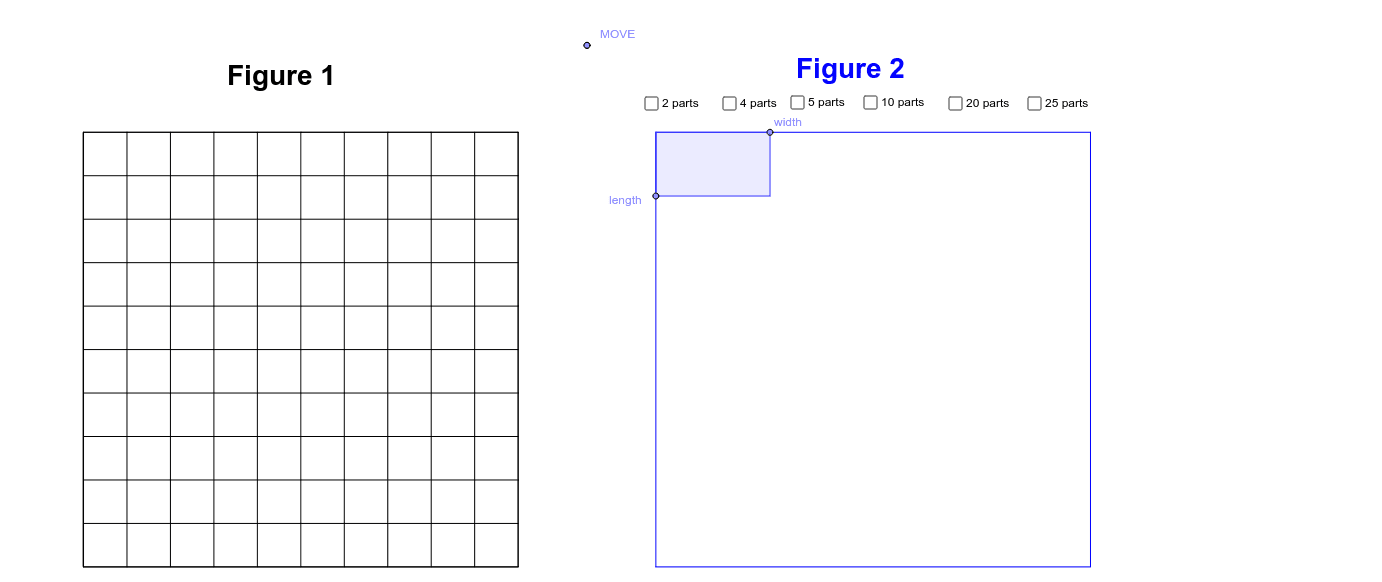
This applet demonstrates the equivalence of fractions with denominators 2, 4, 5, 10, 20, and 25 to fractions with a denominator of 100. It covers the core math concept of fraction equivalence. Constructed using GeoGebra commands such as Intersect, Point, Polygon, etc. Suitable for upper elementary and middle school students learning fraction conversion.
GeoGebra Commands & Parameters
Intersect(xAxis, yAxis) → APoint(xAxis) → BPolygon(A, B, 4) → poly1, a, b, c, d, C, DMidpoint(A, D) → EMidpoint(C, B) → FMidpoint(B, A) → GMidpoint(C, D) → HSegment(H, G) → eSegment(E, F) → fPoint(d) → ISegment(I, J) → gPoint(d) → KSegment(K, L) → hPoint(d) → MPoint(b) → NSegment(M, N) → iPoint(d) → OPoint(b) → PSegment(O, P) → jPoint(d) → QSegment(Q, R) → kPoint(d) → SPoint(b) → TSegment(S, T) → lPoint(d) → UPoint(b) → VSegment(U, V) → mPoint(d) → WPoint(b) → ZSegment(W, Z) → nPoint(c) → A_1Segment(A_1, B_1) → pPoint(c) → C_1Point(a) → D_1Segment(C_1, D_1) → qPoint(c) → E_1Point(a) → F_1Segment(E_1, F_1) → rPoint(c) → G_1Point(a) → H_1Segment(G_1, H_1) → sPoint(c) → I_1Point(a) → J_1Segment(I_1, J_1) → tPoint(c) → K_1Segment(K_1, L_1) → a_1Point(c) → M_1Point(a) → N_1Segment(M_1, N_1) → b_1Point(c) → O_1Point(a) → P_1Segment(O_1, P_1) → c_1Point(yAxis) → Q_1Point(yAxis) → R_1Segment(Q_1, R_1) → d_1OrthogonalLine(R_1, d_1) → e_1Point(e_1) → MOVELine(MOVE, d_1) → f_1Mirror(MOVE, f_1) → T_1Mirror(A, f_1) → A'Mirror(B, f_1) → B'Mirror(C, f_1) → C'Mirror(D, f_1) → D'Polygon(B', A', D', C') → poly2, b', a', d', c'Midpoint(C', D') → Z_1Midpoint(B', A') → A_2Midpoint(C', B') → B_2Midpoint(D', A') → C_2Segment(Z_1, A_2) → i_1Segment(B_2, C_2) → j_1Segment(Z_1, A_2) → k_1Midpoint(A_2, B') → I_2Point(d') → D_2Point(b') → E_2Segment(D_2, E_2) → l_1Point(d') → F_2Point(b') → G_2Segment(F_2, G_2) → m_1Point(d') → H_2Point(b') → J_2Segment(H_2, J_2) → n_1Point(d') → K_2Point(b') → L_2Segment(K_2, L_2) → p_1Point(c') → M_2Point(a') → N_2Segment(M_2, N_2) → q_1Point(c') → O_2Point(a') → P_2Segment(O_2, P_2) → r_1Point(c') → Q_2Point(a') → R_2Segment(Q_2, R_2) → s_1Point(c') → S_2Point(a') → T_2Segment(S_2, T_2) → t_1Segment(M_2, N_2) → a_2Segment(O_2, P_2) → b_2Segment(Q_2, R_2) → c_2Segment(S_2, T_2) → d_2Segment(M_2, N_2) → e_2Point(c') → U_2Point(a') → V_2Segment(O_2, P_2) → g_2Point(c') → W_2Segment(Q_2, R_2) → i_2Point(c') → A_3Point(a') → B_3Segment(S_2, T_2) → k_2Point(c') → C_3Point(a') → D_3Point(d') → G_3Segment(M_2, N_2) → h_2Segment(U_2, V_2) → j_2Segment(O_2, P_2) → l_2Segment(Q_2, R_2) → n_2Segment(A_3, B_3) → p_2Segment(S_2, T_2) → q_2Segment(C_3, D_3) → t_2Point(b') → U_1Segment(G_3, U_1) → g_1Point(b') → V_1Segment(G_3, V_1) → h_1Point(a') → W_1Segment(W_2, W_1) → f_2Point(c') → I_3Point(a') → J_3Segment(I_3, J_3) → m_2Point(d') → widthPoint(c') → lengthOrthogonalLine(width, d') → r_2OrthogonalLine(length, c') → s_2Intersect(r_2, s_2) → L_3Polygon(length, L_3, width, C') → poly3, k_3, l_3, s_3, c'_1
AI Drawing Prompt Reference
Draw a coordinate system with points on the x and y axes. Form a square using these points and the origin. Inside the square, draw two line segments to divide it into four smaller triangles. Then, outside the square, draw multiple line segments connecting the square's vertices to new points, creating various shapes to demonstrate the equivalence of fractions.
The prompt above was compiled from the original drawing commands and is for reference only.