
Equivalent Fractions by Daniel Mentrard
Loading the math board and drawing, please wait…
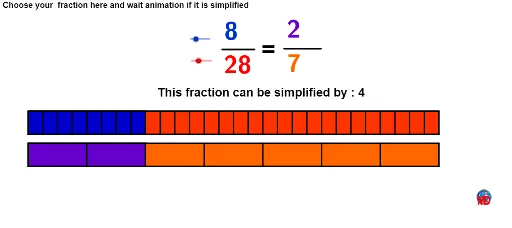
This example demonstrates the concept of equivalent fractions. Using geometric transformations and commands like GCD (Greatest Common Divisor), Segment, and RandomNormal, it helps students understand the basic properties of fractions. Suitable for high-grade elementary and junior high school students.
GeoGebra Commands & Parameters
GCD(n_1, d_1) → hSegment(A, B) → aRandomNormal(2, 4) → cRandomBinomial(2, 3) → bnCr(4, 2) → dSequence((x(D) + (i * a / d_1), y(D)), i, 0, d_1) → PointbasSequence((x(A) + (i * a / d_1), y(A)), i, 0, d_1) → PointhautSequence(Segment[Element[Pointhaut, i], Element[Pointbas, i]], i, 1, d_1 + 1) → liste1Polygon(A, B, C, D) → Total, a_2, b_1, c_1, d_4Polygon(A, D, Element[Pointbas, n_1 + 1], Element[Pointhaut, n_1 + 1]) → Morceau, a_1, d_3, i, jPolygon(E, F, H, G) → poly1, e, f_1, h_1, g_1Sequence((x(G) + (i * e / (d_1 / h)), y(G)), i, 0, d_1 / h) → L2Sequence((x(E) + (i * e / (d_1 / h)), y(E)), i, 0, d_1 / h) → L3Sequence(Segment[Element[L3, i], Element[L2, i]], i, 1, d_1 / h + 1) → liste2Polygon(E, G, Element[L2, n_1 / h + 1], Element[L3, n_1 / h + 1]) → poly2, e_1, g, f, kLine(A, yAxis) → lIf((h * h) ≟ 1, 0, 5) → VitesseSegment(I, J) → mSegment(K, L) → n