
Equal Chords Subtend Equal Angles at the Centre
Loading the math board and drawing, please wait…
In collections
CLASS IX CBSE MATHS ACTIVITIES
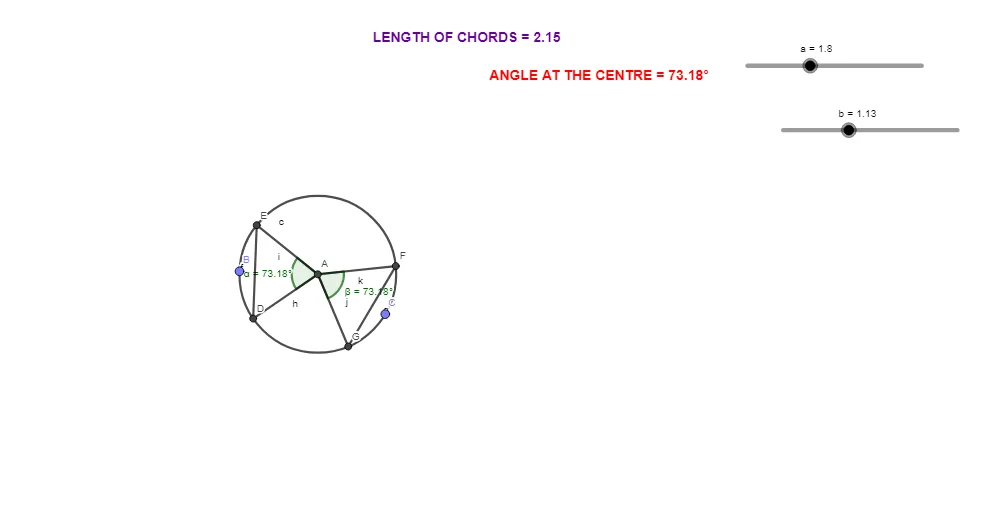
①This example demonstrates the theorem that in a circle, equal chords subtend equal angles at the centre.②Core mathematical concepts include circle properties, chord-angle relationships, and the use of congruence or symmetry in geometric reasoning.③Construction highlights: using GeoGebra commands such as Intersect, Circle, Point, Segment, and Angle, the applet builds a circle with two chords of equal length, then measures the central angles α and β, allowing dynamic dragging to confirm the equality.④Suitable for middle school geometry classes or self-study, it provides an interactive visual proof and helps students grasp the invariant relationship between chord length and central angle.
GeoGebra Commands & Parameters
Intersect(xAxis, yAxis) → ACircle(A, a) → cPoint(c) → BPoint(c) → CCircle(B, b) → dCircle(C, b) → eIntersect(c, d) → D, E, ,Intersect(c, e) → F, G, ,Segment(E, D) → fSegment(G, F) → gSegment(D, A) → hSegment(E, A) → iSegment(G, A) → jSegment(A, F) → kAngle(E, A, D) → αAngle(G, A, F) → β
AI Drawing Prompt Reference
Draw a circle and create two equal chords inside it by connecting the center to the endpoints of each chord, forming two central angles. Measure the angles and show that they are equal. Drag the endpoints of the chords to verify that the central angles remain equal as the chord length changes, demonstrating the theorem that equal chords subtend equal angles at the center.
The prompt above was compiled from the original drawing commands and is for reference only.