
Ellipse Animation with Foci
Loading the math board and drawing, please wait…
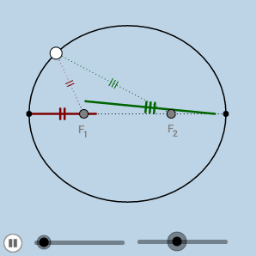
This example demonstrates the relationship between an ellipse's foci and vertices through animation. It involves core concepts like ellipse definition, foci, vertices, Pythagorean theorem, and vector operations. Construction highlights include commands like Focus, Vertex, Segment, Translate, Vector, and Intersect. Suitable for high school mathematics education to understand elliptical properties and algebraic expressions.
GeoGebra Commands & Parameters
Focus(c) → F_1, F_2Vertex(c) → C, D, E, FSegment(C, D) → dTranslate(C, (0, b + 4)) → C'Translate(D, (0, b + 4)) → D'Point(c) → GSegment(G, F_1) → eSegment(G, F_2) → fTranslate(C, (b + 4, 0)) → C'_1Vector(C, C') → uVector(D, D') → vDilate(C, If[0 < n < 1, 1 - n, 0], C') → C'_2Dilate(D, If[0 < n < 1, 1 - n, 0], D') → D'_2Dilate(F_1, If[1 < n < 2, 2 - n, 1], C') → A'Vector(F_1, A') → wTranslate(G, w) → G'Segment(A', G') → mAngle(F_2, F_1, G) → αRotate(A', If[1 < n < 2, ((-(2 - n)) * α)], A') → A''Rotate(A', If[1 < n < 2, ((-(n - 2)) * α), 0], A'') → A''_1Rotate(A', If[1 < n < 2, ((-(n - 1)) * α), (-α)], A') → A''_2Rotate(G', If[1 < n < 2, ((-(n - 1)) * α), (-α)], A') → G''Circle(C', e) → qSegment(F_1, G) → sDilate(F_2, If[2 < n < 3, 3 - n, 1], D') → B'Vector(F_2, B') → tTranslate(G, t) → G'_2Translate(F_2, t) → B'_1Segment(G'_2, B'_1) → f'Angle(G, F_2, F_1) → βRotate(G'_2, If[2 < n < 3, ((n - 2) * β)], B') → LRotate(B'_1, If[2 < n < 3, ((n - 2) * β)], B') → MSegment(G, F_2) → b_1Center(c) → ASegment(A, G) → c_1Segment(A, G) → d_1Dilate(A, If[1 < n < 2, 2 - n, 0], C') → A'_1Vector(F_1, A'_1) → u_1Translate(A, u_1) → A'_2Angle(D, F_1, G) → γRotate(A'_2, ((-(n - 1)) * γ), A'_2) → BCircle(C, e) → pIntersect(p, d, 1) → HDilate(F_1, If[0 < n < 1, 1 - n, 1], C) → IVector(F_1, I) → lTranslate(G, l) → G'_1Translate(F_1, l) → JSegment(G'_1, J) → e'Rotate(G'_1, If[0 < n < 1, (-((n * α))), (-α)], I) → KRotate(J, If[0 < n < 1, (-((n * α))), (-α)], I) → J'Segment(K, J') → e''Segment(C, H) → rDilate(F_2, If[1 < n < 2, 2 - n, 1], D) → NVector(F_2, N) → v_1Translate(G, v_1) → G'_3Translate(F_2, v_1) → OSegment(G'_3, O) → f'_1Rotate(G'_3, If[1 < n < 2, ((n - 1) * β), β], N) → PRotate(O, If[1 < n < 2, ((n - 1) * β), β], N) → O'Segment(P, O') → a_1Segment(D, H) → e_1Dilate(F_1, 1 - n, C) → QVector(F_1, Q) → hTranslate(A, h) → A'_3Translate(G, h) → G'_4Segment(A'_3, G'_4) → iAngle(D, Center[c], G) → δRotate(A'_3, If[0 < n < 1, (-((n * δ)))], Q) → RRotate(G'_4, If[0 < n < 1, (-((n * δ)))], Q) → SSegment(R, S) → i'Dilate(F_2, If[1 < n < 2, 2 - n], D) → TVector(F_1, T) → w_1Translate(A, w_1) → A'_4Translate(G, w_1) → G'_5Segment(A'_4, G'_5) → f_1Angle(G, Center[c], C) → εRotate(A'_4, If[1 < n < 2, ((n - 1) * ε)], A'_4) → URotate(G'_5, If[1 < n < 2, ((n - 1) * ε)], A'_4) → VSegment(U, V) → g_1