
Dynamic Triangle Area Formulas with Interactive Language Support
Loading the math board and drawing, please wait…
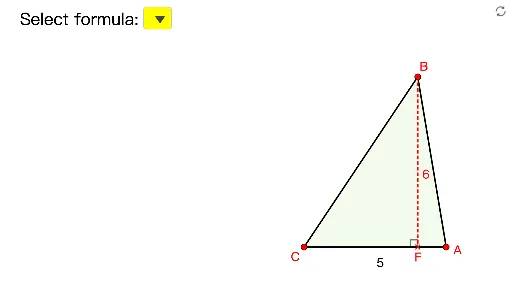
This GeoGebra example provides an interactive visualization of various triangle area formulas, allowing users to explore how the area is computed from base-height, Heron's formula, and coordinate-based methods. The core mathematical concepts include the standard area formula (1/2 × base × height), Heron's formula, the centroid and barycenter of a triangle, linear equations for sides, and the relationships between angles and sides. The construction uses GeoGebra commands such as Polygon to create the triangle, Angle to mark interior angles, Line and Intersect to draw altitudes and find their feet, Segment to connect key points, and InteriorAngles to compute angle measures. Interactive elements include sliders for adjusting triangle dimensions, buttons for toggling between different formulas and languages, and conditional statements (If) with lists to control which formula is displayed. This resource is ideal for middle and high school mathematics teachers demonstrating area concepts, students exploring geometric formulas dynamically, and anyone interested in visual mathematics. It supports bilingual learning (Chinese/English) and helps learners grasp the geometric intuition behind algebraic area formulas.
GeoGebra Commands & Parameters
Polygon(A, B, C) → t1, c, a, bAngle(A, C, B) → θIf(lang ≟ 1, {" ", "$\frac{\text{ 底 }×\text{ 高 }}{2}$", "$\frac{1}{2}ab\sin{C}$", "$\text{希羅公式}$"}, {" ", "$\frac{\text{ base }×\text{ height }}{2}$", "$\frac{1}{2}ab\sin{C}$", "$\text{Heron's Formula}$"}) → listFLine(A, C) → fIntersect(f, OrthogonalLine[B, f]) → FSegment(B, F) → hInteriorAngles(t1) → α, β, γAngle(C, F, B) → δ
AI Drawing Prompt Reference
Draw a dynamic triangle with three draggable vertices, showing its three sides and interior angles. From one vertex, drop a perpendicular to the opposite side, marking the foot of the altitude, and connect the vertex to that foot to form the height segment. Display a list of area formulas—half base times height, half product of two sides times sine of included angle, and Heron's formula—with a toggle for Chinese or English labels. Also mark one interior angle and the right angle formed by the altitude and base, with all measurements updating as vertices move.
The prompt above was compiled from the original drawing commands and is for reference only.