
Dynamic Rhombus & Incircle Illustration
Loading the math board and drawing, please wait…
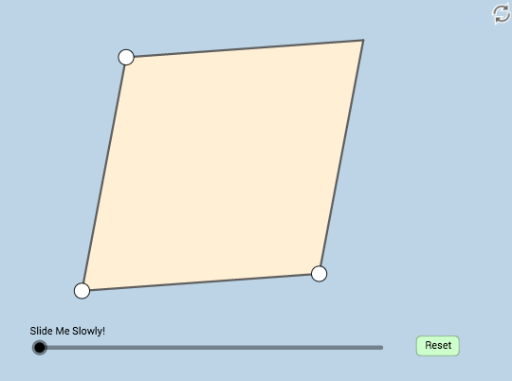
This example dynamically illustrates the geometric properties of a rhombus and its inscribed circle, involving concepts like symmetry, circle properties, angle calculations, and geometric transformations. It uses commands such as Line, Circle, Intersect, Rotate, and Dilate. Suitable for high school mathematics education to enhance spatial reasoning and understanding of geometric transformations and properties.
GeoGebra Commands & Parameters
Line(A, B) → bCircle(A, B) → cIntersect(c, b, 2) → CCircleArc(A, B, C) → dPoint(d) → DCircle(D, A) → eSegment(D, B) → sCircle(B, A) → fIntersect(e, f, 2) → EAngle(D, E, B) → βAngle(E, B, A) → αSegment(A, E) → nIntersect(n, s) → LRotate(L, If[13 < l ≤ 14, ((-(l - 13)) * π), -3.141592653589793], L) → L'_2Dilate(L, If[12 < l ≤ 13, 13 - l, 0], E) → L'_1Segment(L, L'_1) → j_1Dilate(L, If[10 < l ≤ 11, 11 - l, 0], B) → L'Rotate(L', If[13 < l ≤ 14, ((-(l - 13)) * π), -3.141592653589793], L) → L''Segment(L'_2, L'') → l_1Rotate(B, If[1 < l ≤ 2, ((-(l - 1)) * α), α], B) → B'_1Rotate(B'_1, If[2 < l ≤ 3, ((-(l - 2)) * β), (-β)], E) → JRotate(J, If[3 < l ≤ 4, ((-(l - 3)) * α), (-α)], D) → J'Dilate(B, If[0 < l ≤ 1, 1 - l, 0], A) → B'Rotate(B', If[1 < l ≤ 2, ((-(l - 1)) * α), (-α)], B) → B''Rotate(B'', If[2 < l ≤ 3, ((-(l - 2)) * β), (-β)], E) → B'''Rotate(B''', If[3 < l ≤ 4, ((-(l - 3)) * α), (-α)], D) → KSegment(J', K) → m'''Segment(J, B''') → m''OrthogonalLine(L, m'') → n_1Intersect(n_1, m'') → B_1Circle(L, B_1) → g_2Intersect(g_2, j_1) → I_1,Intersect(g_2, l_1) → H_1,Intersect(g_2, m''', 1) → C_1Segment(C_1, I_1) → a_2Segment(B'_1, B'') → m'Intersect(g_2, m', 1) → E_1Segment(H_1, E_1) → t_2Intersect(a_2, t_2) → Q_1Segment(A, B) → aSegment(A, D) → gSegment(D, E) → hSegment(E, B) → iMin(g, h) → jSegment(B, B') → mCircle(B, (0.2 * j)) → kCircle(E, (0.2 * j)) → pIntersect(p, m'', 1) → FIntersect(p, m', 1) → GIntersect(k, m', 1) → HIntersect(k, m, 1) → ICircleSector(B, H, I) → qCircleSector(E, F, G) → rPolygon(A, B, E, D) → poly1, a_1, b_1, e_1, d_1Dilate(B, If[5 < l ≤ 6, 6 - l, 0], D) → B'_2Vector(B, B'_2) → uTranslate(q, u) → q'Rotate(q', If[6 < l ≤ 7, ((l - 6) * π), 3.141592653589793], D) → q''Dilate(E, If[7 < l ≤ 8, 8 - l, 0], A) → E'Vector(E, E') → vTranslate(r, v) → r'Rotate(r', If[8 < l ≤ 9, ((-(l - 8)) * π), -3.141592653589793], A) → r''Dilate(D, If[9 < l ≤ 10, 10 - l, 0], L) → D'Vector(D, D') → wMin(n / 2, s / 2) → oCircle(L, (0.2 * o)) → tIntersect(t, s, 2) → MIntersect(t, n, 2) → NCircleSector(L, M, N) → c_1Segment(D, D') → f_1Circle(D, (0.2 * j)) → h_1Intersect(k, s) → P,Intersect(s, f_1) → QIntersect(h_1, s, 1) → OCircle(A, (0.2 * j)) → k_1Intersect(k_1, m, 1) → RIntersect(k_1, n, 1) → SIntersect(k_1, m''', 1) → TIntersect(h_1, m'', 1) → UCircleSector(D, O, U) → q_1Dilate(A, If[11 < l ≤ 12, 12 - l, 0], L) → A'Segment(A, A') → i_1Intersect(p, m'', 1) → VIntersect(p, n, 1) → WCircleSector(A, S, T) → s_1CircleSector(B, P, I) → p_1Intersect(p, m', 1) → ZCircleSector(E, W, Z) → r_1Segment(L, L') → g_1Rotate(L, If[14 < l ≤ 15, ((-(l - 14)) * π), 3.141592653589793], L) → L'_3Rotate(L'_1, If[14 < l ≤ 15, ((-(l - 14)) * π), 3.141592653589793], L) → A_1Segment(L'_3, A_1) → m_1Rotate(q_1, If[15 < l ≤ 16, ((-(l - 15)) * α / 2), ((-α)) / 2], D) → t_1Rotate(p_1, If[15 < l ≤ 16, ((-(l - 15)) * α / 2), ((-α)) / 2], B) → c_2Rotate(s_1, If[16 < l ≤ 17, ((-(l - 16)) * β / 2), ((-β)) / 2], A) → d_2Rotate(r_1, If[16 < l ≤ 17, ((-(l - 16)) * β / 2), ((-β)) / 2], E) → e_2Rotate(c_1, If[17 < l ≤ 18, ((l - 17) * π / 2), 1.5707963267948966], L) → f_2Intersect(g_2, m, 1) → D_1Segment(L, D_1) → h_2Dilate(L, If[20 < l ≤ 21, 21 - l, 0], D_1) → L'_4Segment(L, L'_4) → i_2Line(L, m) → j_2Point(j_2) → F_1Angle(D, L, F_1) → γDilate(L, If[21 < l ≤ 22, 22 - l, 0], D_1) → L'_5Vector(L, L'_5) → u_1Translate(f_2, u_1) → k_2Rotate(k_2, If[22 < l ≤ 23, ((l - 22) * γ), γ], D_1) → p_2Rotate(D_1, If[23 < l ≤ 24, (((l - 23) * 2) * π), (2 * π)], L) → G_1CircleArc(L, D_1, G_1) → q_2Angle(D_1, L, E_1) → δCircle(D_1, (0.2 * o)) → r_2Intersect(r_2, m) → J_1, K_1Rotate(B, 45°, D_1) → B'_3Angle(B, D_1, B'_3) → εRay(D_1, B'_3) → l_2Intersect(m', l_2) → M_1Intersect(r_2, l_2, 1) → N_1Dilate(D_1, If[24 < l ≤ 25, 25 - l, 0], M_1) → L_1Segment(D_1, L_1) → m_2Intersect(r_2, i_2) → O_1,CircleSector(D_1, N_1, O_1) → s_2Dilate(C_1, If[25 < l ≤ 26, 26 - l, 0], Q_1) → P_1Segment(C_1, P_1) → n_2Dilate(Q_1, If[26 < l ≤ 27, 27 - l, 0], I_1) → R_1Segment(Q_1, R_1) → b_2Dilate(E_1, If[27 < l ≤ 28, 28 - l, 0], Q_1) → S_1Segment(E_1, S_1) → f_3Dilate(Q_1, If[28 < l ≤ 29, 29 - l, 0], H_1) → T_1Segment(Q_1, T_1) → g_3Rotate(s_2, If[30.5 < l ≤ 31.5, ((-(l - 30.5)) * π / 4), ((-π)) / 4], D_1) → c_3Line(Q_1, m_2) → h_3Point(h_3) → U_1Angle(I_1, Q_1, U_1) → θDilate(D_1, If[32 < l ≤ 33, 33 - l, 0], Q_1) → V_1Vector(D_1, V_1) → v_1Translate(c_3, v_1) → d_3Rotate(d_3, If[33 < l ≤ 34, ((-(l - 33)) * θ), (-θ)], Q_1) → e_3
AI Drawing Prompt Reference
Draw a rhombus ABCD with points A, B, C, and D as its vertices. Draw a circle centered at A with radius AB, intersecting the diagonals at point E. Draw another circle centered at D with radius DA, intersecting the first circle at point F. Use rotation and dilation operations to construct the incircle of the rhombus, intersecting the sides and diagonals to form a series of auxiliary lines and points, ultimately creating the intersection points of the incircle with the sides and diagonals of the rhombus.
The prompt above was compiled from the original drawing commands and is for reference only.