
Dynamic Relationship of a Right-Triangle Problem
Loading the math board and drawing, please wait…
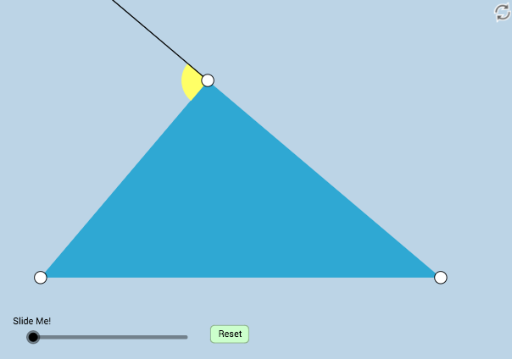
This example demonstrates the dynamic relationship of a right-triangle problem set posted by Antonio Gutierrez on Twitter. It showcases important properties and relationships of right triangles. Key mathematical concepts include properties of right triangles, similar triangles, midpoints, and circle properties. Using various GeoGebra commands such as semicircle, point, segment, midpoint, orthogonal line, circle, intersect, circle sector, dilate, vector, polygon, rotate, ray, line, translate, etc., dynamic exploration of these properties is possible. Suitable for middle and high school students learning geometric construction and dynamic geometry.
GeoGebra Commands & Parameters
Semicircle(A, B) → dPoint(d) → CSegment(C, B) → fSegment(A, C) → eSegment(A, B) → aMin(a, f) → mMin(a, e) → lMin(l, m) → nMidpoint(a) → C_1OrthogonalLine(C_1, a) → bCircle(C_1, A) → cOrthogonalLine(C, a) → gIntersect(g, a) → ESegment(C, E) → hCircle(A, (0.2 * n)) → kCircle(C, (0.2 * n)) → pCircle(B, (0.2 * n)) → qIntersect(p, h, 1) → IIntersect(p, f, 1) → JIntersect(q, a, 1) → KIntersect(q, f, 1) → LIntersect(k, a, 1) → MIntersect(k, e, 1) → NCircleSector(A, M, N) → rDilate(C, If[-2 < i < -1, -1 - i, 0], E) → D'Dilate(A, If[-0.5 < i ≤ 0.5, 0.5 - i, 0], C) → A'Vector(A, A') → uDilate(B, If[1.5 < i ≤ 2.5, 2.5 - i, 0], C) → B'Vector(B, B') → vPolygon(A, B, C) → poly3, d_3, a_2, b_2Angle(C, B, A) → δRotate(C, δ / 2, B) → C'Angle(C, B, C') → εRay(B, C') → h_1Intersect(e, h_1) → DAngle(B, A, C) → ζRotate(B, ζ / 2, A) → B'_1Angle(B, A, B'_1) → ηRay(A, B'_1) → i_1Intersect(f, i_1) → OIntersect(h_1, i_1) → PIntersect(q, h_1, 1) → QIntersect(q, f, 1) → RIntersect(k, a, 1) → SIntersect(k, i_1, 1) → TCircleSector(A, S, T) → c_1CircleSector(B, R, Q) → k_1Polygon(A, B, C) → poly1, c_2, a_1, b_1OrthogonalLine(P, a) → jIntersect(a, j) → FAngle(P, F, A) → αLine(B, C) → j_1Circle(C, 1) → d_1Intersect(d_1, j_1, 2) → GRay(C, G) → l_1Circle(C, (0.5 * Radius[k])) → e_1Intersect(e_1, e, 1) → HIntersect(e_1, l_1, 1) → UCircleSector(C, U, H) → p_1Rotate(p_1, If[0 < i ≤ 1, (i * π / 2), π / 2], C) → sDilate(A, If[1 < i ≤ 2, 2 - i, 0], P) → A'_1Dilate(B, If[1 < i ≤ 2, 2 - i, 0], P) → B'_2Segment(A, T) → tSegment(B, B'_2) → f_1Segment(A, A'_1) → g_1OrthogonalLine(P, g_1) → m_1Line(C, m_1) → n_1Line(C, g_1) → q_1Rotate(k_1, If[2.5 < i ≤ 3.5, ((i - 2.5) * ε), ε], B) → r_1Rotate(c_1, If[3.5 < i ≤ 4.5, ((i - 3.5) * ζ / 2), ζ / 2], A) → s_1Intersect(m_1, a) → VDilate(P, If[4.5 < i ≤ 5.5, 5.5 - i, 0], V) → P'Segment(P, P') → t_1Dilate(C, If[5.5 < i ≤ 6.5, 6.5 - i, 0], P) → C'_1Vector(C, C'_1) → u_1Translate(s, u_1) → s'Point(q_1) → WAngle(W, C, A) → βRotate(s', If[6.5 < i ≤ 7.5, ((-(i - 6.5)) * β), (-β)], P) → s''Segment(C, B) → g_2OrthogonalLine(V, l_1) → h_2Line(C, B) → i_2Intersect(i_2, h_2) → ZDilate(V, If[7.5 < i ≤ 8.5, 8.5 - i, 0], Z) → V'Segment(V, V') → j_2Dilate(C, If[8.5 < i ≤ 9.5, 9.5 - i, 0], Z) → C'_2Vector(C, C'_2) → v_1Translate(s, v_1) → s'_1Line(A, C) → k_2OrthogonalLine(P, k_2) → l_2Intersect(k_2, l_2) → A_1Dilate(P, If[9.5 < i ≤ 10.5, 10.5 - i, 0], A_1) → P'_1Segment(P, P'_1) → f_2Dilate(C, If[10.5 < i ≤ 11.5, 11.5 - i, 0], A_1) → C'_3Vector(C, C'_3) → w_1Translate(s, w_1) → s'_2Dilate(A_1, If[11.5 < i ≤ 12.5, 12.5 - i, 0], C) → B_1Vector(A_1, B_1) → u_2Translate(P, u_2) → P'_2Translate(P'_1, u_2) → D_1Segment(P'_2, D_1) → m_2Dilate(A_1, If[12.5 < i ≤ 13.5, 13.5 - i, 0], P'_2) → E_1Vector(A_1, E_1) → v_2Translate(P, v_2) → P'_3Translate(P'_1, v_2) → F_1Segment(P'_3, F_1) → n_2