
Dynamic Relationship Between Triangle's Altitudes, Circumcircle, and Tangent
Loading the math board and drawing, please wait…
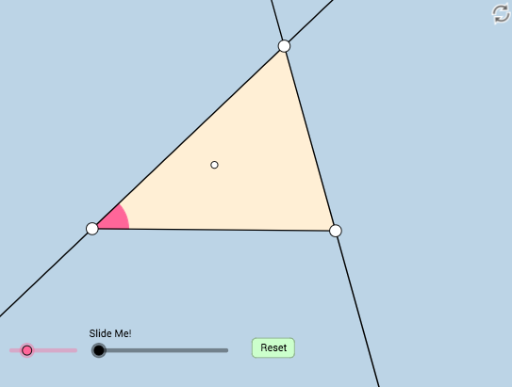
This example demonstrates the dynamic and modifiable relationship between two altitudes of a triangle, its circumcircle, and a tangent drawn through its third vertex. Key math concepts include circumcircle, multiplication, division, altitudes, tangents, rotation, vectors, and more. Construction highlights GeoGebra commands like Rotate, Ray, Point, Segment, Line, OrthogonalLine, Intersect, Min, Circle, Angle, LineBisector, CircleArc, Dilate, CircleSector, Vector, Translate, and Polygon. Suitable for high school and above students exploring geometric relationships and dynamic geometry software applications.
GeoGebra Commands & Parameters
Rotate(B, (a * π / 180), A) → B'Ray(A, B') → gPoint(g) → CSegment(A, C) → q_1Line(C, B) → rLine(A, C) → qOrthogonalLine(B, q) → f_1Intersect(q, f_1) → HSegment(C, H) → r_1Min(q_1, r_1) → vCircle(C, (0.4 * v)) → s_1Intersect(s_1, r) → O, PIntersect(s_1, q) → M, NAngle(M, C, P) → ζSegment(C, B) → jLineBisector(j) → kSegment(A, C) → iLineBisector(i) → lIntersect(k, l) → DLine(D, C) → mOrthogonalLine(C, m) → nIntersect(s_1, n) → Q, RAngle(A, C, Q) → κAngle(B, A, B') → αRay(A, B) → fSegment(A, B) → hRotate(C, If[0 < b ≤ 2, ((b - 2) * π), (2 * π)], D) → C'CircleArc(D, C, C') → cCircle(D, C) → dCircle(C, 3) → eIntersect(e, n, 1) → EIntersect(e, n, 2) → FAngle(D, C, E) → βDilate(D, If[2 < b ≤ 3, 3 - b, 0], C) → D'Segment(D, D') → pOrthogonalLine(A, r) → sIntersect(r, s) → GAngle(A, G, B) → γDilate(A, If[3 < b ≤ 4, 4 - b, 0], G) → A'Segment(A, A') → tDilate(B, If[4 < b ≤ 5, 5 - b, 0], H) → B'_1Segment(B, B'_1) → g_1Angle(A, H, B) → δDilate(H, If[5 < b ≤ 6, 6 - b, 0], G) → H'Segment(H, H') → h_1Line(H, G) → i_1Segment(H, C) → j_1Segment(H, A) → k_1Intersect(d, i_1) → I, JSegment(H, G) → l_1Segment(H, I) → m_1Min({j_1, k_1, l_1, m_1}) → oCircle(H, (0.4 * o)) → c_1Intersect(c_1, q, 1) → KIntersect(c_1, i_1, 2) → LAngle(K, H, L) → εRotate(K, If[7 < b ≤ 8, ((b - 7) * ε), ε], H) → K'CircleSector(H, K, K') → d_1Dilate(H, If[8.5 < b ≤ 9.5, 9.5 - b, 0], C) → H'_1Vector(H, H'_1) → uTranslate(d_1, u) → e_1Polygon(A, B, C) → poly1, c_2, a_1, b_1Segment(A, B) → n_1Segment(A, H) → p_1Rotate(M, If[7 < b ≤ 8, ((b - 7) * κ), κ], C) → M'CircleSector(C, M, M') → t_1Dilate(C, If[8.5 < b ≤ 9.5, 9.5 - b, 0], H) → C'_1Vector(C, C'_1) → wTranslate(t_1, w) → d_2Dilate(D, If[-1 < b < 0, (-b), 0], C) → D'_1Segment(D, D'_1) → f_2Rotate(D, If[0 < b ≤ 2, ((b - 2) * π), (2 * π)], D) → D'_2Rotate(D'_1, If[0 < b ≤ 2, ((b - 2) * π), (2 * π)], D) → TSegment(D'_2, T) → g_2Segment(C, A) → h_2Min(h_2, n_1) → o_1Circle(A, (0.15 * o_1)) → e_2Intersect(e_2, n_1) → U,Intersect(e_2, h_2) → V,CircleSector(A, U, V) → k_2