
Dynamic Relationship Between Circle and Cyclic Quadrilateral
Loading the math board and drawing, please wait…
In collections
Circles (Theorems)
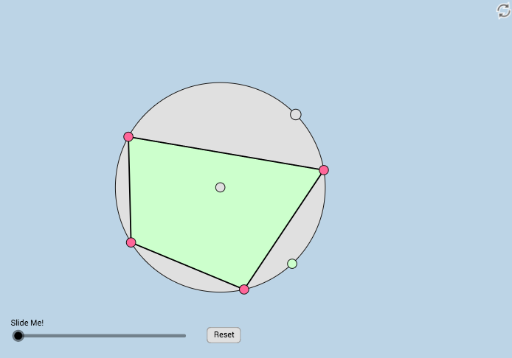
This example demonstrates the dynamic relationship between a circle and a cyclic quadrilateral. Through transformations such as rotation, translation, and dilation, the position of the quadrilateral on the circle is shown to change. Key mathematical concepts include circles, quadrilaterals, and angles. GeoGebra commands used include Circle, Point, Rotate, Intersect, and Dilate. Suitable for students at the middle school level and above for learning geometric transformations and dynamic geometry.
GeoGebra Commands & Parameters
Circle(A, B) → cPoint(c) → CRotate(C, 2°, A) → C'CircleArc(A, C', C) → dPoint(d) → DCircleArc(A, D, C) → ePoint(e) → ECircleArc(A, E, C) → fPoint(f) → FCircleArc(A, F, C) → gPoint(g) → GSegment(D, E) → bSegment(E, F) → hSegment(D, G) → aSegment(G, F) → iCircle(F, (0.2 * Distance[A, B])) → kCircle(E, (0.2 * Distance[A, B])) → pCircle(G, (0.2 * Distance[A, B])) → qCircle(D, (0.2 * Distance[A, B])) → rIntersect(k, i, 1) → HIntersect(k, h, 1) → IIntersect(p, h, 1) → JIntersect(p, b, 1) → KIntersect(r, a, 1) → LIntersect(r, b, 1) → MIntersect(q, a, 1) → NIntersect(q, i, 1) → OCircle(A, B) → e_1Dilate(E, If[0 < j ≤ 1, 1 - j, 0], G) → E'Vector(E, E') → uTranslate(J, u) → J'Angle(O, G, J') → αRay(D, G) → lPoint(l) → PDilate(F, If[2 < j ≤ 3, 3 - j, 0], D) → F'Vector(F, F') → vRay(G, D) → nPoint(n) → QTranslate(I, v) → I'Angle(I', D, M) → βPolygon(G, D, E, F) → poly1, g_2, d_2, e_2, f_2Ray(F, D) → i_1Ray(G, E) → j_1Point(i_1) → ROrthogonalLine(R, i_1) → l_1OrthogonalLine(G, j_1) → m_1Intersect(e_1, m_1) → S, TIntersect(e_1, l_1) → U, VIntersect(l_1, j_1) → WIntersect(i_1, m_1) → ZSegment(F, W) → n_1Point(n_1) → A_1Segment(A_1, Z) → p_1Segment(W, G) → mSegment(G, Z) → sSegment(V, S) → tSegment(W, Z) → f_1Line(E, D) → g_1Line(F, W) → h_1Intersect(h_1, g_1) → B_1Line(G, Z) → k_1Intersect(g_1, k_1) → C_1Line(V, S) → q_1Line(W, Z) → r_1Circle(V, 2) → c_1Circle(B_1, 2) → d_1Circle(W, 2) → s_1Intersect(s_1, r_1, 1) → D_1Intersect(d_1, g_1, 1) → E_1Intersect(c_1, q_1, 1) → F_1Ray(W, D_1) → t_1Ray(B_1, E_1) → b_1Ray(V, F_1) → h_2Segment(V, B_1) → i_2Segment(B_1, W) → j_2Min(i_2, j_2) → oCircle(V, (0.35 * o)) → c_2Intersect(c_2, h_2, 1) → G_1Line(W, V) → k_2Intersect(c_2, k_2, 1) → H_1Dilate(F, If[0 < j ≤ 1, 1 - j, 0], V) → F'_1Segment(F, F'_1) → l_2Dilate(V, If[1 < j ≤ 2, 2 - j, 0], W) → V'Segment(V, V') → m_2Dilate(F, If[0 < j ≤ 1, 1 - j, 0], D) → E'_1Segment(F, E'_1) → n_2Angle(D, F, V) → γDilate(D, If[1 < j ≤ 2, 2 - j, 0], Z) → D'Segment(D, D') → p_2Angle(Z, G, W) → δDilate(G, If[2 < j ≤ 3, 3 - j, 0], S) → G'Segment(G, G') → q_2Dilate(G, If[2 < j ≤ 3, 3 - j, 0], E) → G'_1Segment(G, G'_1) → r_2Intersect(c_2, k_2) → I_1, J_1Dilate(E, If[3 < j ≤ 4, 4 - j, 0], W) → E'_2Dilate(S, If[3 < j ≤ 4, 4 - j, 0], Z) → S'Segment(E, E'_2) → s_2Segment(S, S') → t_2Dilate(S, If[4 < j ≤ 5, 5 - j, 0], V) → S'_1Segment(S, S'_1) → a_1Dilate(D, If[5 < j ≤ 6, 6 - j, 0], C_1) → D'_1Dilate(E, If[5 < j ≤ 6, 6 - j, 0], B_1) → E'_3Dilate(Z, If[6 < j ≤ 7, 7 - j, 0], W) → Z'Segment(Z, Z') → a_2Segment(D, D'_1) → b_2Segment(E, E'_3) → f_3Angle(F_1, V, J_1) → εRotate(J_1, If[7 < j ≤ 8, ((-(j - 7)) * ε), (-ε)], V) → K_1CircleSector(V, G_1, J_1) → c_3CircleSector(V, K_1, J_1) → d_3Dilate(V, If[8.5 < j ≤ 9.5, 9.5 - j, 0], B_1) → V'_1Dilate(B_1, If[9.5 < j ≤ 10.5, 10.5 - j, 0], W) → L_1Vector(V, V'_1) → wTranslate(d_3, w) → e_3Vector(B_1, L_1) → u_1Translate(e_3, u_1) → g_3