
Dynamic Regular Nonagon Demonstration
Loading the math board and drawing, please wait…
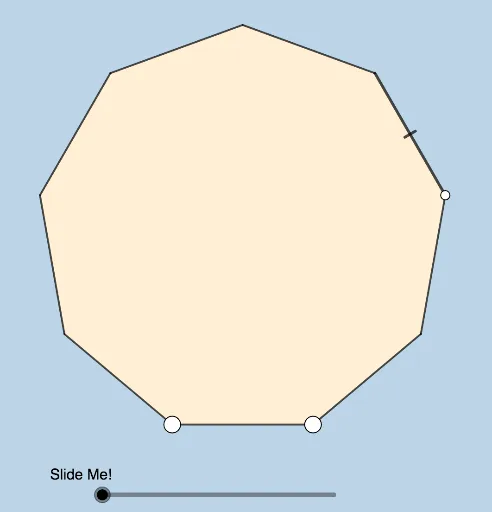
This example dynamically demonstrates the geometric construction and properties of a regular nonagon. It involves core mathematical concepts such as polygon construction, symmetry, rotations, and dilations. The construction uses commands like Polygon, Line, Segment, Circle, Intersect, Rotate, and Dilate in GeoGebra. Suitable for high school mathematics education to illustrate the symmetry and transformation properties of regular polygons.
GeoGebra Commands & Parameters
Polygon(A, B, 9) → poly1, f, C, D, E, F, G, H, I, g, h, i, j, k, l, m, nLine(F, D) → pLine(F, B) → qLine(D, B) → rSegment(F, E) → sCircle(F, E) → cIntersect(c, q, 2) → JLine(E, I) → tSegment(F, G) → aSegment(G, H) → bSegment(H, I) → dSegment(I, A) → eSegment(A, B) → f_1Segment(B, C) → g_1Segment(C, D) → h_1Segment(D, E) → i_1Rotate(B, If[0 < o ≤ 1, ((o * 2) * π / 9), (2 * π / 9)], Center[Circle[D, E, F]]) → B'Rotate(C, If[0 < o ≤ 1, ((o * 2) * π / 9), (2 * π / 9)], Center[Circle[D, E, F]]) → C'Segment(B', C') → j_1Rotate(C, If[0 < o ≤ 1, ((o * 2) * π / 9), (2 * π / 9)], Center[Circle[D, E, F]]) → C'_1Rotate(D, If[0 < o ≤ 1, ((o * 2) * π / 9), (2 * π / 9)], Center[Circle[D, E, F]]) → D'Segment(C'_1, D') → k_1Rotate(D, If[0 < o ≤ 1, ((o * 2) * π / 9), (2 * π / 9)], Center[Circle[D, E, F]]) → D'_1Rotate(E, If[0 < o ≤ 1, ((o * 2) * π / 9), (2 * π / 9)], Center[Circle[D, E, F]]) → E'Segment(D'_1, E') → l_1Rotate(F, If[0 < o ≤ 1, ((o * 2) * π / 9), (2 * π / 9)], Center[Circle[D, E, F]]) → F'Rotate(E, If[0 < o ≤ 1, ((o * 2) * π / 9), (2 * π / 9)], Center[Circle[D, E, F]]) → E'_1Segment(F', E'_1) → s'Rotate(F, If[0 < o ≤ 1, ((o * 2) * π / 9), (2 * π / 9)], Center[Circle[D, E, F]]) → F'_1Rotate(G, If[0 < o ≤ 1, ((o * 2) * π / 9), (2 * π / 9)], Center[Circle[D, E, F]]) → G'Segment(F'_1, G') → a'Rotate(G, If[0 < o ≤ 1, ((o * 2) * π / 9), (2 * π / 9)], Center[Circle[D, E, F]]) → G'_1Rotate(H, If[0 < o ≤ 1, ((o * 2) * π / 9), (2 * π / 9)], Center[Circle[D, E, F]]) → H'Segment(G'_1, H') → b'Rotate(H, If[0 < o ≤ 1, ((o * 2) * π / 9), (2 * π / 9)], Center[Circle[D, E, F]]) → H'_1Rotate(I, If[0 < o ≤ 1, ((o * 2) * π / 9), (2 * π / 9)], Center[Circle[D, E, F]]) → I'Segment(H'_1, I') → d'Rotate(I, If[0 < o ≤ 1, ((o * 2) * π / 9), (2 * π / 9)], Center[Circle[D, E, F]]) → I'_1Rotate(A, If[0 < o ≤ 1, ((o * 2) * π / 9), (2 * π / 9)], Center[Circle[D, E, F]]) → A'Segment(I'_1, A') → e'Rotate(A, If[0 < o ≤ 1, ((o * 2) * π / 9), (2 * π / 9)], Center[Circle[D, E, F]]) → A'_1Rotate(B, If[0 < o ≤ 1, ((o * 2) * π / 9), (2 * π / 9)], Center[Circle[D, E, F]]) → B'_1Segment(A'_1, B'_1) → n_1Rotate(poly1, If[1.5 < o ≤ 2.5, (((o - 1.5) * 2) * π / 9), (2 * π / 9)], Center[Circle[A, B, C]]) → poly1'Dilate(E'_1, If[3 < o ≤ 4, 4 - o, 0], J) → KSegment(E', K) → m_1Dilate(J, If[4 < o ≤ 5, 5 - o, 0], A'_1) → J'Segment(J, J') → p_1Dilate(C'_1, If[5 < o ≤ 6, 6 - o, 0], A'_1) → LSegment(C'_1, L) → q_1Rotate(D'_1, If[7 < o ≤ 8, ((-(o - 7)) * π / 3), ((-π)) / 3], E'_1) → MRotate(E', If[7 < o ≤ 8, ((-(o - 7)) * π / 3), ((-π)) / 3], E'_1) → E''Segment(M, E'') → r_1Rotate(C'_1, If[8 < o ≤ 9, (((o - 8) * 2) * π / 9), (2 * π / 9)], A'_1) → NRotate(L, If[8 < o ≤ 9, (((o - 8) * 2) * π / 9), (2 * π / 9)], A'_1) → L'Segment(N, L') → s_1
AI Drawing Prompt Reference
Draw a dynamic regular nonagon to demonstrate its geometric construction and symmetry. Start by creating a central nonagon and connecting its adjacent vertices with line segments. From one vertex, draw a circle centered at the midpoint of a side, intersecting adjacent sides to get new points. Rotate and scale these points dynamically to illustrate the symmetry and transformation properties of the nonagon.
The prompt above was compiled from the original drawing commands and is for reference only.