
Dynamic Proof of SSS Triangle Congruence Theorem by Tim Brzezinski
Loading the math board and drawing, please wait…
In collections
Congruence (CO) Cluster
Congruence (Vol 1)
Congruence (Vol 1) Over 80 Resources
Geometry (Congruence) Volume 1
CCSS High School: Geometry (Congruence) Volume 1 S N ATTAR
CCSS High School: Geometry (Congruence) Volume 1
CCSS High School: Geometry (Congruence) Volume 1
CCSS High School: Geometry (Congruence) Volume 1
CCSS High School: Geometry (Congruence) Volume 1
CCSS High School: Geometry (Congruence) Volume 1
CCSS High School: Geometry (Congruence) Volume 1
CCSS High School: Geometry (Congruence) Volume 1
CCSS High School: Geometry (Congruence) Volume 1
CCSS High School: Geometry (Congruence) Volume 1
CCSS High School: Geometry (Congruence) Volume 1
CCSS High School: Geometry (Congruence) Volume 1
Triangle Theorems
CCSS High School: Geometry (Congruence) Volume 1
Unit 5: Triangle Congruence
Triangle Congruence Theorems 1
Proving Triangles Congruent
Triangle Congruence
Unit 4 Triangle Congruence Theorems
U9 Dilations and Similar Triangles
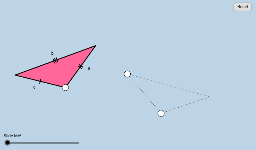
This example dynamically demonstrates the SSS Triangle Congruence Theorem by constructing triangles with given side lengths and verifying their congruence. It involves core mathematical concepts such as triangle congruence criteria, geometric construction, and dynamic geometry visualization. The construction utilizes GeoGebra commands and objects like Circle, Intersect, Segment, Polygon, Point, Line, Angle, Dilate, Vector, Translate, Rotate, Mirror, Ray, Min, and CircleSector. It is suitable for high school mathematics teaching and understanding the intuitive proof methods of geometric theorems.
GeoGebra Commands & Parameters
Circle(A, a) → d_1Intersect(d_1, e) → B, CCircle(C, b) → fSegment(A, C) → gCircle(A, c) → kIntersect(k, f) → F, G, ,Segment(C, F) → hSegment(F, A) → iPolygon(A, C, F) → poly1, f_1, a_1, c_1Circle(D, i) → pPoint(p) → ESegment(D, E) → nCircle(D, g) → qCircle(E, h) → rIntersect(q, r, 2) → HSegment(D, H) → sSegment(H, E) → tLine(A, n) → g_1Point(g_1) → IAngle(I, A, F) → αDilate(A, If[0 < o ≤ 1, 1 - o, 0], D) → A'Vector(A, A') → uTranslate(F, u) → F'Translate(A, u) → A'_1Segment(F', A'_1) → i'Rotate(F', If[1 < o ≤ 2, ((-(o - 1)) * α), (-α)], D) → F''Rotate(A'_1, If[1 < o ≤ 2, ((-(o - 1)) * α), (-α)], D) → JSegment(F'', J) → i''Dilate(A, If[2 < o ≤ 3, 3 - o, 0], D) → A'_2Vector(A, A'_2) → vTranslate(A, v) → A'_3Translate(C, v) → C'Segment(A'_3, C') → g'Line(D, g) → h_1Point(h_1) → KAngle(H, D, K) → βRotate(A'_3, If[3 < o ≤ 4, ((-(o - 3)) * β), (-β)], D) → LRotate(C', If[3 < o ≤ 4, ((-(o - 3)) * β), (-β)], D) → C''Segment(L, C'') → g''Line(C, t) → i_1Point(i_1) → MAngle(M, C, F) → γDilate(C, If[4 < o ≤ 5, 5 - o, 0], C'') → C'_1Vector(C, C'_1) → wTranslate(C, w) → C'_2Translate(F, w) → F'_1Segment(C'_2, F'_1) → h'Rotate(C'_2, If[5 < o ≤ 6, ((-(o - 5)) * γ), (-γ)], C'') → NRotate(F'_1, If[5 < o ≤ 6, ((-(o - 5)) * γ), (-γ)], C'') → OSegment(N, O) → h''Line(F, C) → j_1Mirror(A, j_1) → A'_6Mirror(C, j_1) → C'_4Mirror(F, j_1) → F'_3Polygon(A'_6, C'_4, F'_3) → poly1'_1, f'_3, a'_6, c'_4Point(j_1) → SPoint(j_1) → TRay(C'_4, T) → k_1Ray(F'_3, S) → l_1Segment(A'_6, F'_3) → m_1Segment(A'_6, C'_4) → n_1Dilate(F, If[0 < d ≤ 1, 1 - d, 0], E) → F'_2Vector(F, F'_2) → u_1Translate(A'_6, u_1) → PTranslate(C'_4, u_1) → QTranslate(F'_3, u_1) → RPolygon(P, Q, R) → poly2, r_1, p_1, q_1Translate(A'_6, u_1) → UTranslate(C'_4, u_1) → VSegment(U, V) → s_1Translate(A'_6, u_1) → WTranslate(F'_3, u_1) → ZSegment(W, Z) → t_1Translate(C, u_1) → C'_3Translate(F, u_1) → F'_4Segment(C'_3, F'_4) → h'_1Translate(A'_6, u_1) → A_1Translate(F'_3, u_1) → B_1Segment(A_1, B_1) → e_1Line(E, k_1) → f_2Point(f_2) → C_1Angle(C'', E, C_1) → δRotate(P, If[1 < d ≤ 2, ((-(d - 1)) * δ), (-δ)], E) → P'Rotate(Q, If[1 < d ≤ 2, ((-(d - 1)) * δ), (-δ)], E) → Q'Rotate(R, If[1 < d ≤ 2, ((-(d - 1)) * δ), (-δ)], E) → R'Polygon(P', Q', R') → poly2', r', p', q'Rotate(A_1, If[1 < d ≤ 2, ((-(d - 1)) * δ), (-δ)], E) → D_1Rotate(B_1, If[1 < d ≤ 2, ((-(d - 1)) * δ), (-δ)], E) → E_1Segment(D_1, E_1) → g_2Rotate(U, If[1 < d ≤ 2, ((-(d - 1)) * δ), (-δ)], E) → U'Rotate(V, If[1 < d ≤ 2, ((-(d - 1)) * δ), (-δ)], E) → V'Segment(U', V') → h_2Rotate(C'_3, If[1 < d ≤ 2, ((-(d - 1)) * δ), (-δ)], E) → F_1Rotate(F'_4, If[1 < d ≤ 2, ((-(d - 1)) * δ), (-δ)], E) → G_1Segment(F_1, G_1) → i_2Polygon(D, C'', E) → poly3, e_2, d_2, c''Dilate(D, If[2.5 < d ≤ 3.5, 3.5 - d, 0], D_1) → D'Segment(D, D') → j_2Segment(E, C'') → k_2Min(c, k_2 / 2) → o_1Circle(D, (0.3 * o_1)) → c_2Intersect(c_2, i'') → H_1,Intersect(c_2, j_2) → I_1,CircleSector(D, I_1, H_1) → p_2Intersect(j_2, k_2) → J_1Polygon(D, D_1, E) → poly4, e_3, d_3, d_4Dilate(D, If[3.5 < d ≤ 4.5, 4.5 - d, 0], D_1) → D'_1Vector(D, D'_1) → v_1Translate(p_2, v_1) → q_2Angle(E, D_1, D) → εRotate(q_2, If[4.5 < d ≤ 5.5, ((d - 4.5) * (π - ε)), π - ε], D_1) → r_2Intersect(c_2, g'') → K_1, L_1CircleSector(D, K_1, I_1) → s_2Polygon(D, C'', D_1) → poly5, d_5, d_6, c''_1Dilate(D, If[6 < d ≤ 7, 7 - d, 0], D_1) → D'_2Vector(D, D'_2) → w_1Translate(s_2, w_1) → t_2Angle(D, D_1, C'') → ζRotate(t_2, If[7 < d ≤ 8, ((-(d - 7)) * (π - ζ)), (-(π - ζ))], D_1) → c_3Dilate(E, If[8.5 < d ≤ 9.5, 9.5 - d, 0], C'') → E'Segment(E, E') → l_2Segment(E, C'') → m_2Polygon(A, C, F) → poly6, f_3, a_2, c_4Polygon(D, C'', E) → poly7, e_4, d_7, c''_2
AI Drawing Prompt Reference
Draw a triangle ABC with given side lengths a, b, and c. First, draw a circle centered at A with radius a, and let it intersect line e at points B and C. Then, draw a circle centered at C with radius b, and let it intersect the circle centered at A with radius c at points F and G, taking F. Next, construct triangle AFG, and then use D as the center to perform a series of transformations including translation, rotation, and reflection to obtain a congruent triangle A'B'C' to triangle ABC.
The prompt above was compiled from the original drawing commands and is for reference only.